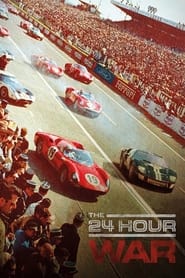
The 24 Hour War
Скачать English субтитры
Информация о релизе
Теги
Предпросмотр субтитров (English)
Первые 200 строк.
A.J. Baime : It all started with a business deal gone sour
and what came out of that
was the greatest rivalry in the history of racing.
Ford. Ferrari.
Two titans of the automobile industry
waged war, at what was at the time in the 1960s,
the biggest race in the world:
The 24 hours of Le Mans.
You have to imagine the scene:
250,000 people,
television cameras for the first time.
People all over the world were watching this one race.
It was like a Superbowl of Speed.
Definitely the most dangerous sporting event of any kind in the world.
Henry Ford III : To win Le Mans, it meant that you were the best.
David Hobbs : Everybody drove in it.
All the Formula 1 stars at the time
drove in Le Mans
alongside all the sports car heroes.
Mario Andretti : It's the ultimate venue.
You win Le Mans, the whole planet knows.
We're starting 55 cars.
I don't think more than 15 or 20 are going to finish.
Gordon Chance : For an automotive manufacturer,
it proves their endurance more than any other race
can possibly do.
Richard Altwood : Commercially, it is the most important race to win
in the world, for a car manufacturer.
From the moment the second automobile was built, racing was born
and the car that would win is the car that people wanted to buy.
It took a lot of cheek to think it could rival the horse
as a way of getting around.
The car lost the race...
but it won all the attention.
And none was any too modest in the things he had to say
about his own breed of horseless carriage.
The best way to settle these competing claims
was in a sport which W.K. Vanderbilt brought to America from Europe:
A race over public roads.
By the third year of the race, 1906,
2 million people turned out to witness this new sport
where men and machine were linked as teammates,
racing at 60 mph on the straights.
Only the fittest car survived.
And those which held up in racing competition,
redoubled their boasting in advertising.
A.J. Baime : From there on out, people who built cars,
knew that they had to win races to market their cars.
So, racing spread the gospel of automobile companies all over the world.
In Detroit, a man named Henry Ford
was making what he called a quadracycle.
It looked like a buggy, only it had no shafts or a horse to be harnessed to.
The horsepower was going to come from a gasoline engine he had made himself.
In 1901, Henry Ford was kind of struggling at that point.
He would end up starting and then failing twice
before he started the Ford Motor Company.
He was an engineer and a technical guy
and he was not one of the wealthy people at the time.
He had this very pivotal race against Alexander Winton.
Gordon Chance : He had the Crystal Bowl victory winner for this race.
He thought Alexander Winton was
the most important
race car driver of the day,
that maybe, if he got some of his engineers and
put together a car and raced Winton and beat Winton,
that would be the beginning of the new launch of the Ford motor company.
Henry Ford III : He raced a car that he called "Sweepstakes."
But it was lighter and it was more efficient than Alexander Winton's car.
And he was behind Alexander throughout most of the race.
And then Alexander's car began to slow,
so he eventually caught up and passed him and won the race.
Edsel Ford II : People came to him at the end of the race
and said, "Anything you want to do, Mr. Ford, we're happy to invest."
That's always been something in my mind that has
really kind of a key element of our company's DNA,
which is, that we were really born on the racetrack.
1923, I think, was the first year that Le Mans was run and there was a Model-T racer.
And various private companies had taken Model-Ts
and adjusted them and used them in racing.
Edsel Ford II : That started the modern day history of the Ford Motor Company.
Enzo Ferrari was born - Northern Italy,
1898, into a mixture of a rural and industrial area.
His father was called Alberto and he was a metal worker.
The family of Ferrari - they had a house in Modena.
They were producing parts for the Italian railway.
My father, as a kid, he was not
much interested in the family business.
He was a dreamer.
Brian Laban : In 1908, father took Enzo
to a big motor race called The Coppa Acerbo.
He was fascinated by these racing cars.
And so, he fall in love with moto racing.
And from that day onwards, he wanted to be a racing driver.
Piero Ferrari : The 1st world war happened.
It was a tragedy for everybody. It was a tragedy for him.
He lost a father.
He lost a brother.
Brian Laban : Enzo is called into the service.
He starts doing motor maintenance for the artillery regiment.
Still, in the back of his mind,
what he really wants to be is a race car driver.
Carlo Tazzioli : After the war, he did sell the house
for buying a racing car.
That is the reason for which, at the beginning,
the people from Modena thought he was crazy.
Brian Laban : For Alfa-Romeo, he did one race
called The Coppa Acerbo in 1924,
won that and said that that was the point
when his life changed completely.
That was when he said he became a real racing driver.
At the same time, Alfa-Romeo is going through all kinds of
financial problems with the parent company.
They can't be seen to be directly involved in motor racing,
in the way that they have been.
So, they hive off the motor sport side to Enzo.
He sets up a new organization called Scuderia Ferrari,
which is, in everything but name, is the Alfa-Romeo racing team.
For the first time, he had premises of his own.
He also had a badge of his own:
A black prancing horse on a yellow background.
Piero Ferrari : The prancing horse is a family story about my father -
That he was a young racing driver...
Carlo Tazzioli : And he won two years in a row,
a race called Circuito del Savio.
And in the crowd was a guy called Count Baracca.
His son, Francesco, had been a WWI fighter Ace
in the Italian airforce.
He had 34 kills before he was killed himself.
The mother of Francesco Baracca told Mr. Ferrari
to use the emblem of his son for his car because
he was the only man in Italy eligible to use the prancing horse.
Piero Ferrari : ..and to use the logo in 1929
when he established Scuderia Ferrari.
Brian Laban : While Ferrari is running Alfa-Scuderia Ferrari,
they win everything there is worth winning.
They win grand prix, they win the Targa Florio
and from 1931 to 1934, they win Le Mans 4 times -
All on his watch.
One thing that goes all the way through Ferrari's life:
He was an individual. He did things for him.
So, when Ferrari eventually negotiates his way out of Alfa Romeo,
around 1939, he gets quite a good financial payoff.
But, part of the settlement is that he will not be allowed to build cars
using his own name for 4 years.
As it turns out, those 4 years will be 4 years of wartime.
During WWII, we had basically converted all of our factories
for war production.
Tanks and airplanes and jeeps and everything.
It really was Henry and Edsel's idea to transform Willow run
and build bombers.
Henry and Edsel wanted to help the war effort.
They wanted to do whatever they could,
you know, to help win the war. Many of the history books would say,
"If the Ford Motor Company hadn't stepped-up
and built the bombers at Willow Run,
we might not have won the war".
The business during the war was
producing grinding machines for the army
and this was the means to survive,
to have his employees working, even during the war.
But at the same time, he was designing cars
and he had engineers who were working for him designing cars.
Modena is quite heavily bombed during the war.
A.J. Baime : It's possible that during World War II
Ford and Ferarri had their first run-in.
It's highly likely that the bombers that took out Ferrari's factory
had come from the factories of Ford motor company.
Brian Laban : Ferrari needs somewhere a bit quieter.
Carlo Tazzioli : With the money he got from Alfa-Romeo,
he bought a ground in Maranello, where he wanted to
build the factory with the purpose to produce cars.
I deem this reply a full acceptance of the Potsdam declaration,
which specifies the unconditional surrender of Japan.
Immediately after the war, in 1947, the design of the first Ferrari was ready,
two years after the war.
The 125 s It was a 12 cylinder.
You have to understand something. Italy was destroyed.
Everything was a ruin.
And to start producing racing cars
under these conditions was considered as to be crazy.
He was following his dreams,
his passion for engines and for racing.
The new Ferrari, it's very, very sophisticated.
He built very small engines, but very sophisticated engines.
And they were purely designed for racing.
So, it had overhead cam shafts, hairpin Springs,
lots of carburetors - Everything about it was a racing car.
The car, shortly after it's introduction,
won the grand prix of Rome: Circuito di Caracalla
He only built two 125s,
but those two cars did so much,
that Ferrari is now a name in his own right.
The cars are called Ferrari, and they start winning.
Edsel Ford II : Henry had gotten quite a bit older in the 40s.
He can't run Ford motor company. Edsel died.
So, they bring my father, Henry Ford II, out of the Navy.
My grandfather, for as strong of a personality as he had...
I think, really, still created that team atmosphere.
And he brought people in and delegated
and relied on other people to make important decisions.
The 24 Hour War subtitles in other languages
More English subtitles for The 24 Hour War
- The 24 Hour War 2016 1080p BluRay x264 AAC5 1-[YTS MX] · 32 downloads · 2025-10-31
- The 24 Hour War 2016 1080p BluRay x264 AAC5 1-[YTS MX] · 47 downloads · 2023-08-27
- The 24 Hour War 2016 1080p BRRip x264 AAC-ETRG · 51 downloads · 2023-03-25
- The 24 Hour War 2016 720p BRRip x264 AAC-ETRG · 44 downloads · 2019-04-07
- The 24 Hour War 2016 1080p BluRay H264 AAC-RARBG · 47 downloads · 2019-04-07
- The 24 Hour War 2016 720p BRRip x264 AAC-ETRG · 48 downloads · 2017-03-12
- The 24 Hour War 2016 1080p BRRip x264 AAC-ETRG · 32 downloads · 2017-03-05
- The 24 Hour War 2016 Bluray Releases · 58 downloads · 2017-03-01
Комментарии
No comments yet. Be the first to leave one.