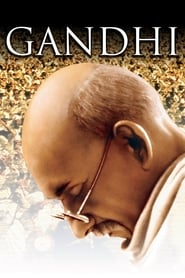
Gandhi
Download English Subtitle
Release info
Tags
English subtitle preview
The first 192 lines.
Stay a couple more days and then go. You've gotta see him.
There are more than yesterday. There must be...
He will be saying prayers in the garden. Just follow the others.
He will be saying prayers in the garden. Just follow the others.
Just follow the others. He will be saying prayers in the garden.
Brother, Bapu is already late for prayers.
Oh, God!
Oh, God.
[MAN PRAYING IN FOREIGN LANGUAGE]
The object of this massive tribute
died as he had always lived:
A private man without wealth,
without property,
without official title or office.
Mahatma Gandhi
was not the commander of armies,
nor a ruler of vast lands.
He could not boast any scientific achievement
or artistic gift.
Yet men,
governments, dignitaries from all over the world
have joined hands today to pay homage
to this little brown man in the loincloth
who led his country to freedom.
In the words of General George C. Marshall,
the American secretary of state:
"Mahatma Gandhi has become the spokesman
for the conscience of all mankind.
He was a man
who made humility
and simple truth
more powerful than empires."
And Albert Einstein added:
"Generations to come will scarce believe that such a one as this
ever in flesh and blood
walked upon this earth."
Tell me,
do you think about hell?
No, neither do I.
But this man here
is a Christian, and he's written that in order to believe--
Excuse me, sir.
How long have you been in South Africa?
- Uh... A week. - I don't know how you got a ticket.
Just what are you doing in this car, coolie?
Why, I have a ticket.
A first-class ticket.
- How did you get it? - I sent for it in the post.
I'm an attorney. I didn't--
There are no colored attorneys in South Africa.
Sit where you belong!
- I'll take your luggage back, sir. GANDHI: No.
Just a moment, please.
You see?
Mohandas K. Gandhi, attorney at law.
I'm on my way to Pretoria to conduct a case for an Indian trading firm.
Didn't you hear me? There are no colored attorneys in South Africa.
Sir, I was called to the bar in London
and enrolled at the High Court of Chancery.
I am, therefore, an attorney.
And since I am, in your eyes, colored,
I think we can deduce there is at least
one colored attorney in South Africa.
Smart bloody Kaffir.
Throw him out.
Just move your black ass back to third class,
or I'll have you thrown off at the next station.
I always go first class! I've traveled--
But you're a rich man. Why do you put up with it?
Yes, I am rich. But I am Indian.
I do not therefore expect to travel first class.
- In England, I was a poor student. - That was England.
This is part of England's Empire.
Mr. Gandhi, you look at Mr. Khan and you see a successful Muslim trader.
Most South Africans see him simply as an Indian.
And the vast majority of Indians, mostly Hindus like yourself,
were brought here to work mines and harvest crops.
Most Europeans don't want them doing anything else.
- But that is very unchristian-- Mr. Gandhi, in this country,
Indians are not allowed to walk along the pavement with a Christian.
You mean you employ Mr. Baker as your attorney,
but you can't walk down the street with him?
Well, I can.
But I risk being kicked into the gutter by someone
less holy than Mr. Baker.
Well, then it must be fought.
We are children of God like everyone else.
Allah be praised!
- And what battalions will you call upon? - I... Ahem.
I will write to the press,
here and in England.
And I will use the courts.
You'll cause a great deal of trouble. Our position is--
We are members of the Empire.
And we come from an ancient civilization.
Why should we not walk on the pavements like other men?
I rather like the idea of an Indian barrister in South Africa.
I'm sure our community could keep you in work for some time, Mr. Gandhi,
even if you caused a good deal of trouble.
Especially if you caused a good deal of trouble.
There's the English reporter. I told you he'd come.
You also said your article would draw a thousand people.
At least some of the Hindus brought their wives.
No, I asked my wife to organize that.
Some of them are leaving.
"Ladies and gentlemen,
we have asked you to gather here to help us proclaim our right
to be treated as equal citizens of the Empire.
We do not seek conflict.
We know the strength of the forces arrayed against us,
know that because of them, we can only use peaceful means.
But we are determined that justice will be done.
The symbol of our status is embodied in this pass
which we must carry at all times,
but which no European even has to have.
The first step towards changing our status
is to eliminate this difference between us."
Now?
You write brilliantly, but you have much to learn about handling men.
"We do not want to ignite
the fear or hatred of anyone.
But we ask you,
Hindu, Muslim and Sikh,
to help us light up the sky
and the minds of the British authorities
with our defiance of this injustice."
We will now burn the passes of our committee and its supporters.
We ask you to put your passes on the fire--
You bloody dog!
Those passes are government property!
And I will arrest the first man who tries to burn one!
Take him away.
You little Sammy...
bastard!
Now! Are there any more?
If you want this kind of trouble, you can have it.
Let me go!
Let me go!
Stop.
The London papers have arrived from the Cape, sire.
Yes?
The worst was the Daily Mail, sire. They said the burning of passes...
- Ask Mr. Herzog to see me. - ...was the most significant act
in colonial affairs since the Declaration of Independence.
They'll find we're a little better prepared this time.
Mr. Gandhi will find he's on a long hiding to nothing.
Hmm.
"A High Court judge has confirmed that Mr. Gandhi
would've been within his rights to prosecute for assault
since neither he nor Mr. Khan resisted arrest."
I told you about English law.
As I told you about English policemen.
Yes?
We're very pleased to have you back, Papa.
And I am glad to be back.
Come.
Mind your face.
Papa.
Tomorrow I'll tell you about my days in a police hospital.
Come, come.
Quickly.
Just like proper English gentlemen. I'm proud of them.
They're boys and they're Indian.
Will you take this off? It pinches every time I speak.
I've got it.
You'd be Gandhi.
I thought you'd be bigger.
- Oh, I'm sorry. - No, that's all right.
My name's Charlie Andrews, sir.
I've come from India.
I've read a great deal about you.
Some of it good, I hope.
Would you care to walk?
- You're a clergyman? - Yes. Uh...
I met some remarkable people in India.
And when I read what you were doing here, I wanted to help.
- Does that surprise you? - Not anymore.
At first, I was amazed,
but when you're fighting in a just cause,
people seem to pop up, like you, right out of the pavement.
Even when it's dangerous or...
Hey, look what's coming!
A white shepherd leading a brown Sammy!
- Perhaps we should, um...? - Doesn't the New Testament say:
"If your enemy strikes you on the right cheek, offer him the left"?
I think the phrase was used metaphorically. I don't think our Lord--
I'm not so sure. I have thought about it a great deal.
And I suspect he meant you must show courage,
be willing to take a blow, several blows, to show
you will not strike back, nor will you be turned aside.
And when you do that, it calls on something in human nature
that makes his hatred for you decrease and his respect increase.
Gandhi subtitles in other languages
More English subtitles for Gandhi
- Gandhi (1982) [edition-25th Anni Ver ] 2160p 4K BluRay x265 RARBG en · 77 downloads · 2025-10-21
- Gandhi 1982 NORDiC REMUX 2160p DV HDR HYBRiD UHD-BluRay HEVC TrueHD Atmos 7 1-RAPiDCOWS · 139 downloads · 2023-06-28
- Gandhi 1982 25th Anniv (1080p x265 10bit Tigole) · 130 downloads · 2021-08-16
- Gandhi 1982 720p BluRay x264 AAC-Mkvking com · 161 downloads · 2020-08-18
- Gandhi (1982) Ben Kigsley 2160P H 264 2CD (moviesbyrizzo) · 103 downloads · 2020-07-08
- Ghandi 1982 720p BluRay x264 YIFY · 363 downloads · 2020-06-27
- COMMENTARY - Gandhi 1982 UHD BluRay 2160p TrueHD Atmos 7 1 HEVC REMUX-FraMeSToR · 144 downloads · 2020-06-24
- Gandhi 1982 UHD BluRay 2160p TrueHD Atmos 7 1 HEVC REMUX-FraMeSToR · 278 downloads · 2020-06-24
Comments
No comments yet. Be the first to leave one.