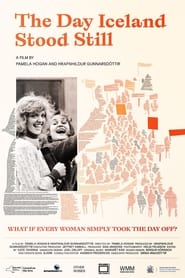
The Day Iceland Stood Still
Download English Subtitle
Release info
Tags
English subtitle preview
The first 200 lines.
In the snow the footprints are so quickly filled.
It’s very Icelandic.
And if you say that, it is a symbol for remembering.
Take care that the snow doesn’t fill the footsteps.
For some reason, this day I was alone.
And I remember -
I remember the clothes I was wearing.
And I don't have a clue
what is waiting for me there.
I have no idea how many women will show up
or what will happen.
I just knew I had to be there.
And this is one of those
frozen moments in your life.
Oh, I get the shivers when I think back about this.
It was probably the biggest event in my life
apart from having my babies.
That day I was just totally nervous
from here to the toes.
We are going to show them
that we can stop this society
by walking out.
THE DAY ICELAND STOOD STILL
Today my country, Iceland
is celebrated as one of the best places
in the world to be a woman.
But it wasn't always that way.
This is the story of one day
that changed everything.
I always knew that I would like to see the world.
I was asked, What are you going to do when you grow up?
And I said, I want to be a captain of a ship.
They said very sweetly to me
No, no dearest you cannot. Because you are a girl.
From the time I was 12
I said that I wanted to be a lawyer.
Everybody said
Oh no, you will be married before you're 18.
In the 1970s
we had this growing middle class
and the image of the housewife
happy about her new home.
Every woman wants to be in her own home, of course
with her own laundry and her own washing machine.
Taking pride in her beautiful children
and her successful husband.
You were told you have to wake up before him
and put on your makeup
because he is not supposed to see you
not at your best.
The man wasn't supposed to know how to make a coffee.
Those were the happy days for men!
I remember being small, hiding under a table
and listening to my mother and her friends smoking
and talking about what kind of world they would like to live in.
At this time, women didn't have education they didn't have their own money
their salaries were much lower than the salaries of men, if they had any work.
My mom raised six children.
She made all our clothes herself.
She didn't like it, but she did it.
I remember her once say that she would like to be locked up in jail
for about three months with a good book
just to be able to read.
I grew up on a farm. A very isolated one in the mountains.
To collect the sheep we had to go horse riding almost a whole day.
I learned to milk the cows and fetch them and ride horses and collect the hay.
The farm I was brought up on there was very much equality between the sexes.
But I discovered that the world wasn't like that everywhere.
On the farms around it wasn't the same.
Girls were not supposed to be as good as boys in many ways.
I remember one day, on another farm
all the men were building a stable...
I was helping, serving food.
They were talking about politics and everything and I started to participate.
Then I suddenly saw
nobody heard what I said.
It was like
I hadn't said anything.
It was strange.
I wanted to be more like a man working outdoors on the farm
using the machinery, and being with the sheeps and collecting them from the mountains.
But in 1970
a woman on the farm
she was a housewife!
My husband he was in the farmer’s society.
And I find out
that a woman can’t be there.
It was not a place for them.
Sometimes you had a woman among the farmers
but they had to be widows.
I got a point there to tell them
do I have to kill my husband
to be recognized as a farmer?
And I wanted not to be Mrs. Pálsson.
I wanted to be myself.
I was married to him
but I was not a part of him.
I was working in Landsbankinn.
It was a national bank.
So we were all working for the state, really.
Everything was done manually -
no computers.
So the bank was full with women
but the men were upstairs.
They were running the bank. We were not.
Young guys they come in very young like 10 or 15 years younger than you
and you show them the ropes
and before you know it, they are my boss
after I taught them everything I know.
It's always been like that.
People would say - You don't need more money.
Your husband is earning the money you need
and what you are earning is just for you
to spend on makeup and clothes.
So why should we make your wages higher?
It was like that.
I mean, we had lower pay than men
all over.
I was working at a very big newspaper in Iceland.
Morgunbladid. The conservative paper.
Of course they had to have a lot of girls that were very good in typing.
It was only women that did this.
The journalists were all mostly men.
One woman, she corrected everything.
We were very good friends and we wanted better pay.
But some of them were like -
No, I think it's okay.
It's just like that.
It was the favorite.
It is just like that.
But there were so many women in Iceland that wanted something.
They wanted to change the society!
We were not isolated here in Iceland.
We had sisters all over the place -
strong women wanting to change the world, just like us.
We knew about the Dutch women
influences from America,
Norway, Sweden and Red Stockings in Denmark.
We could feel it.
There were waves in the air.
The earth was all ready.
Everything was prepared
for doing something.
It only needed this to start.
INTERNATIONAL WORKER'S DAY, MAY 1, 1970
On the 1st of May, the radical people had a parade for worker's rights.
I went down to speak on the radio
and I just said
Women in red stockings
let's meet at the square in the morning.
They were all ready.
I just said, Yes!
We started making slogans straightaway,
Wake Up Woman!
Women want to have the same rights as men.
And we decided to wear red stockings.
The Red Stockings movement came in with a lot of noise.
It was a revolt.
You had to kick-start things.
I heard that women were gathering to change the world
and I jumped at it!
SOKKHOLT RED STOCKINGS HQ
There were not only we, the troublemakers -
there were fantastic young women
gathering together so we had a very broad scope.
We decided that we would not dress
like our mothers and grandmothers
and we would not use makeup
and we would not do anything about our looks.
That was not important.
We did not want to enter
the power structure that was we wanted to change it.
No leader.
We were all leaders.
You could be a Red Stocking
one time in your life
or just in the afternoon
or when your husband was not there.
There was no telling who was a Red Stocking or not
because there was no formal society.
We wanted equality, equality with men.
We thought that what we were doing was very positive for everyone.
For the society, for the individuals
for the world.
When I joined I was the sole man in the movement.
I was 18 and I was a revolutionary.
I found it very strange that women were not allowed
to do the same things as men.
So I chose to go over to the Red Stockings -
the movement with the greatest chance of changing the society radically.
The state radio opened up its door to us
which was very brave of them.
And we did a very popular program.
Popular?
I don't know if I should use that word.
We were saying things that had never been said.
RED STOCKINGS RADIO PROGRAM
I asked my 15-year-old students to write about their parents’ jobs.
"Why didn’t you write about what your mother does?" I asked them.
"What? My mother? She’s just at home.
The Day Iceland Stood Still subtitles in other languages
Comments
No comments yet. Be the first to leave one.