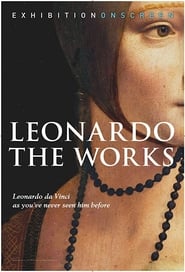
Leonardo: The Works
Download English Subtitle
Release info
Tags
English subtitle preview
The first 200 lines.
Leonardo grew up outside Florence, in the countryside,
in a little village, Vinci.
His mother was a peasant woman. He himself was illegitimate.
But his father was a very respectable notary
who married and had a legitimate family
into which Leonardo was, to some extent, absorbed.
So there was no question of him being disowned.
And his career was supported,
even if it wasn't necessarily going to be a reiteration of his father's career.
And what we've seen quite often in Italian Renaissance history
is that illegitimate sons
have a kind of ambition that takes them to the fore.
Renaissance Italy is very extraordinary.
There is this intellectual driving force because, more than any other country,
they felt the weight, or the tradition of classical antiquity.
Rome was around them and you combined that
with early capitalist economies, on a small scale, but very dynamic.
You had the city states, like Venice, and so on, which had major artists,
but Florence was extraordinary.
In the early 1500s, you had this astonishing flowering
of Brunelleschi, the architect,
Donatello, the sculptor,
Masaccio, the painter, and a host of others.
Art was becoming, in Florence, an intellectual pursuit.
Florence was an intensely mercantile city.
It was a city of transactions.
And even the great Medici had banking interests that spread across Europe.
But they also wanted to show that they were culturally sophisticated
and that they were using their wealth
for the benefit of the city,
for the benefit of their own souls,
when they were commissioning religious works of art.
So what you've got is this lovely melting pot
of factions and families in competition,
and painters who might serve one or other of them
and who were also themselves looking over their shoulder
all the time for what the latest innovation was.
"Leonardo's father one day took some of his son's drawings
to the artist Andrea del Verrocchio, who was a good friend of his,
and directly asked him what he thought.
Andrea was astonished by what he saw
and arranged that Leonardo should enter his workshop."
Giorgio Vasari, painter and historian.
This is the Tobias and the Angel from the studio of Andrea del Verrocchio,
a painting from the early to mid-1470s.
It's an apocryphal story in which the Archangel Raphael comes to young Tobias
and instructs him to take parts of the fish,
the gall, and the liver, and the heart, I believe,
as a remedy to cure the blindness of his father.
It raises some very interesting questions about how workshops work
and, indeed, how Leonardo functioned within the Verrocchio workshop.
Verrocchio was one of the pre-eminent workshops.
Many very important painters passed through the Verrocchio studio
in the 1460s and '70s.
I think one of the appeals of working with Andrea del Verrocchio
for someone like Leonardo
was the fact that this was, like many of these Florentine workshops,
a production centre for all manner of objects,
both two-dimensional, three-dimensional.
There was drawing, there was painting, there was casting, there was carving.
And, of course, the multiplicity of interests that Leonardo demonstrated
in his subsequent career
certainly had some resonance with what went on in the Verrocchio studio.
Where this painting in particular is involved, I think,
it's raised some very interesting ideas about collaboration and delegation,
suggesting that some of the details of this picture
might have been by the young Leonardo as an apprentice.
We know that he had some sort of formal training in the Verrocchio workshop
between 1469 and 1472.
It's been suggested that certain elements
that are more naturally observed,
more realistically observed,
have a higher degree of skill in execution,
like the movement of the dog and the fur,
or the fish and the way it hangs from the string so convincingly,
might be ascribed to the young Leonardo himself.
The traditional painting medium in the Renaissance,
certainly at the beginning of the 15th century,
was egg... egg used, mixed with water and pigments,
and applied in a fine, hatched way.
The introduction of oil painting is something that happened
during the latter part of the 15th century.
There were instances of pictures appearing from Northern Europe
and I think it had a tremendous impact on the way Italian artists worked,
both a need, or an interest rather, in learning how to paint this way,
but also it opened up different ideas about what you could depict
and what effects you could make.
We can point to certain moments.
For example, the arrival of the van der Goes Portinari altarpiece
in Florence from Bruges
was a revelation, I think, to Florentine artists working in that time.
With Leonardo, it's certainly true that oil painting
was a relatively new technique that was available.
It certainly allowed him to explore and to depict things
that were interesting to him anyway:
the optics of vision and the way that things go in and out of focus,
or the way that shadows lose their colour in lower light.
All these things you can achieve much more convincingly with the oil medium.
That certainly was his interest,
and it lies deep at the heart of many of the things
he tried to do and paint later in his career.
Leonardo thought that paintings should be able
to show everything that was visible
and everything that was invisible in our universe.
He started that way of thinking
by looking very, very closely at the world around him.
For example, one of his very earliest drawings shows, apparently,
a view of the Arno Valley.
It's dated, it feels like an observation and yet there are aspects to it
which I think most of us would now agree are almost impossible.
So the point of his landscapes,
the point of his observation of the human figure,
is that he's always wanting to move from the specific to the ideal
and from the observed to the imagined.
Probably his earliest independent painting was The Annunciation,
which is a long, rectangular panel,
with the standard subject of the angel and the Virgin Mary,
but with enormous amount of effort going into it.
Leonardo spends a lot of time on the perspective of the Virgin's house,
and we know from scientific examination,
the walls, initially, are rather different
with the window in a different place.
So, he's saying, "Look, I can do perspective."
The draperies are done taking a lay figure with linen,
which is then soaked in clay and draped over the figures,
giving a very sculptural impression.
And, above all, he is saying, "Look what I can do with nature."
The carpets of flowers in the enclosed garden, which is symbolic of the Virgin,
are absolutely wriggling with life and vitality.
And then the angel's wing is based on a bird.
You've got this observation of the feathers.
The primaries at the end of the wing have deteriorated a lot.
So, there's a rather offsetting brown smudge,
but you look at the rest of the wing,
the secondaries, all the other feathers,
are painted with this enormous sense of observation.
So, this young man is saying,
"Look what I can do. I can master all the key things in art."
The Annunciation that Leonardo made very early in his career
can be seen as the culmination of his apprenticeship
in Verrocchio's workshop.
We have continued to study and make new investigations.
Not only looking at the finished painting
but also understanding all the stages
Leonardo went through to arrive at the final composition.
Looking at the changes he made
he clearly did not arrive immediately
at a complete and definitive conclusion.
There is undoubtedly on Leonardo's part
a kind of internal challenge.
So this is not so much a problem of wanting
immediately to prove himself as an innovative artist
but really the need to challenge himself
and therefore to progress.
One has the sense he's never satisfied by whatever he's doing.
Therefore it's more a dialogue of Leonardo with himself
than with the rest of artistic society.
"Verrocchio was making a picture
in which St. John was baptising Christ,
and Leonardo worked on an angel who was holding some garments.
Even though he was so young he accomplished it in such a manner
that it was much better than Verrocchio's own figures
that were located beside the angel of Leonardo.
This was the reason why Andrea never again wanted to touch colours,
dismayed that a young man understood painting better than he."
Giorgio Vasari.
"He's a poor pupil who does not surpass his master."
Leonardo.
I think that we see Leonardo in contrast to Verrocchio most clearly
in the Baptism of Christ in the Uffizi,
where a fairly orthodox landscape
is changed to a remarkable degree
as Leonardo's imagination literally floods the plain
to bring water and movement and light into a picture
that otherwise might have been somewhat static.
What Leonardo does is provide a unity,
a unifying factor that turns a good picture into a remarkable one.
Generally speaking, and we certainly see this with Raphael later,
the young artists tend to get commissioned
to do smaller scale paintings.
The less expensive ones, as it were.
Which is Madonnas and portraits,
and in Leonardo's case, portraits of women in particular.
He's already getting the narrative Madonna,
which was one of his great contributions
to reforming "Madonna and Child" painting.
So he's already, in these little pictures
which are, on the whole, conventional subjects,
he's already stretching his wings, as it were.
"Leonardo then made a picture of Our Lady
which was in the possession of Pope Clement VII,
and which is very excellent.
Amongst other things that were in it,
he reproduced a carafe full of water containing some flowers.
In addition to the marvellous lifelikeness of the flowers,
he had imitated the dewdrops of the water on them,
so that they seemed more alive than life itself."
Giorgio Vasari.
"Little babies are thin at all their joints,
and the intervals located between the joints are fat,
More English subtitles for Leonardo: The Works
- English Forced Foreign language only Leonardo The Works 2019 1080p WEBRip x265 · 55 downloads · 2022-02-27
- Leonardo The Works 2019 WEBRip [YTS Corrected] · 30 downloads · 2022-02-06
Comments
No comments yet. Be the first to leave one.