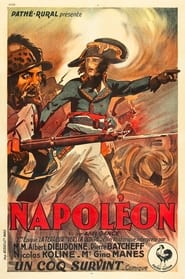
Napoleon (Napoléon)
Download English Subtitle
Release info
Tags
English subtitle preview
The first 183 lines.
CANNES FESTIVAL OFFICIAL SELECTION 2024 CANNES CLASSICS
La Cinémathèque française presents Napoléon as Seen by Abel Gance (1927)
Reconstructed and restored under the guidance of Georges Mourier, assisted by Laure Marchaut,
with the help of the Eclair Classics/L'Image Retrouvée laboratories, set to music by Simon Cloquet-Lafollye.
The restoration work was carried out by La Cinémathèque française with the aid of the Centre national du cinéma et de l'image animée
and the Centre national de la musique in partnership with Radio France.
To film his Napoléon, Abel Gance shot with several cameras, generating two different negatives and hence two original versions:
one called "Opéra" (Premiered at the Opéra de Paris, 4 April 1927, 4 hours long)
the second called "Apollo" (presented to the press and the operators of the Apollo theater in May 1927, 9 hours and 30 minutes long).
Gance then established a final version from the Apollo negative alone, of a length of around 7 hours.
It is on this definitive version called the "Grande Version" that the restoration carried out by La Cinémathèque française between 2015 and 2022 is based.
The splitting of the film into two parts was carried out from the Abel Gance archives preserved at La Cinémathèque française and la Bibliothèque nationale de France.
It includes the final triptych called "Departure of the Army from Italy" according to the three-screen projection process conceived by Gance that he would later name "Polyvision".
The reconstruction and restoration of images were carried out from elements preserved in the following archives:
La Cinémathèque française, Centre national du cinéma et de l'image animée, la Cinémathèque de Toulouse, la Cinémathèque royale de Belgique (Bruxelles),
la Cinémathèque de Corse-Casa di Lume, la Cinémathèque du Luxembourg, The Danish Film Institute (Copenhagen), Filmoteca de Catalunya (Barcelona),
Fondazione Centro Sperimentale di Cinematografia-Cineteca Nazionale (Roma), Jugoslovenska Kinoteka (Beograd), MoMA (New York), and several private collections.
The elements were digitized in total immersion in 5K at the Eclair Classics/L'Image Retrouvée laboratories with the help of Nitroscan.
The digital elements were conformed, restored, tinted, and calibrated.
Abel Gance did not give instructions for the musical accompaniment of the definitive version called the "Grande Version", la Cinémathèque francaise entrusted
composer Simon Cloquet-Lafollye with the order of an original score constituted by arrangements of pieces drawing from a symphonic repertoire going from Mozart to Penderecki.
This score was executed and recorded by Radio France's musical formations (Orchestre National de France,
Orchestre Philharmonique et Choeur de Radio France) under the guidance of Fabien Gabel with the participation of the tenor Benjamin Bernheim.
LA SOCIÉTÉ GÉNÉRALE DE FILMS and The FRENCH COMPANY GAUMONT-METRO-GOLDWYN present:
NAPOLÉON
NAPOLÉON as Seen by Abel Gance
as Seen by Abel Gance
A cinegraphic epic in two parts
The triple-screen process at the end of the second part is one of Abel Gance's inventions.
Its use for shooting was patented by André Debrie, and for projection by the House of Gaumont.
Director of Photography: J. Kruger
Operators: Mr Mundviller and
Messrs L. Lucas, R. Hubert, E. Pierre, P. Briquet.
FIRST ERA BONAPARTE
with Albert Dieudonné in the role of Napoléon Bonaparte
I would like to be my posterity and witness what a poet would make me think, feel, and say. (Napoleon)
All texts, speeches, and narratives taken literally from History are followed by the mention: 'Hist.'
Prologue: Brienne
Then came the memorable winter of 1781, when the snow piled up in the courtyard of the École de Brienne. (Hist.)
Napoléon Bonaparte at the age of 11… Mr. Vladimir ROUDENKO
... had sworn to resist with ten comrades in a small fort built by his own hands...
... against the assaults of forty artillerymen. (Hist.)
The Minimes Fathers, who encouraged these battles and applauded the students who distinguished themselves by
their skill or the invention of some stratagem, emboldened that day by an overly keen curiosity... (Hist.)
The two leaders of the opposing camp, Phélipeaux and Peccaduc, personal enemies of Napoléon at Brienne, and who, by
a troubling coincidence, we will find opposing him for 15 years on most of the battlefields of the Empire. (Hist.)
Thinking to surprise Napoleon
Tristan Fleuri, dining hall boy. Mr. KOLINE
Beware Napoleon!
Phélipeaux puts stones in his balls!
Thank you!
Already possessing incredible mastery, he dictated the movements, motionless at the center of the melees. (Historical)
Let the winner of the fight come here.
Your name? (Hist.)
"Napoleon." (with a Corsican accent, he pronounced it Nabulioné) (Hist.)
What did you say? Straw in the nose?....
"My little one, you will go far, remember it is Pichegru who tells you this." (Hist.)
The geography lesson: study on the climate of islands.
As for Corsica, this almost wild island...
As for Corsica, the most beautiful island in the world, the climate there is...
Ah... I almost forgot!
A small islet lost in the Ocean...
Saint Helene, a small isle...
I am very unhappy here, and my heart is not made for these people around me.
I wait patiently because I want to one day restore freedom to my country. Who knows? The fate of an Empire often depends on one man. Napoleon
Sir, Napoleon is hiding letters in his bed!
The only comforter of Bonaparte in the attic of Tristan Fleuri.
Proud companion in misfortune, a gift from Uncle Paraviccini, a great eagle hunter in Ajaccio.
Who is the one who made my eagle flee?
So, you are all guilty!
Who do you think you are, little rascal?
A man!
I maintain that he will go far. He is granite heated by a volcano.
End of Prologue
First Part Napoleon and the French Revolution
June 1792 At the Club of the Cordeliers.
Death to Tyrants
The secretary of Danton, Camille Desmoulins... (Mr. VIDALIN)
and his wife Lucile.
The three gods...
Chatterboxes!
Your friend Diétrich sends you an officer from the Army of the Rhine carrying a song that he believes will be useful to the people.
Can we have the copies distributed while waiting for the session?
Listen!
The tense crowd vaguely sensed that a great flame was about to rise in the history of the world.
Your name?
Rouget de Lisle
People, sit down!
Let us learn, my children.
They all bray like donkeys!
Thank you for France, Sir, your hymn will replace thousands of cannons.
Thank you, Lieutenant, tell me your name so that I may remember your prediction.
Napoleon lived in Paris in misery.
The wanderers, including Joséphine de Beauharnais, were looking
that morning for the famous fortune-teller, Mademoiselle Lenormand.
An incredible fortune... you will be QUEEN, madam!
Bonaparte's misery was nothing compared to that of the suburbs...
Hearts sing, but stomachs scream with hunger, and the night of August
10 erupts suddenly, bringing Bonaparte echoes of a throne collapsing...
What remains of a great event seen from a small room.
Everything related to carnage is worthless; if we are not
careful, the best fruits of the Revolution will be lost. (Hist.)
At the National Assembly, the agony of the MONARCHY. (King Louis XVI: Mr. Louis SANCE)
(Queen Marie-Antoinette: Miss Suzanne BIANCHETTI)
If the Revolution is a furnace, it is also a forge! Let us build the REPUBLIC now!
"What is needed to defeat the enemies of the Fatherland?" (Hist.)
"Audacity, more audacity."
How cowardly and vile men are. Peoples are hardly worth the trouble of so much concern.
Everyone seeks their own interest and wants to succeed through the force of honor.
Declaration of the Rights of Man and of the Citizen
"This is what you have done today with the MONARCHY." (Hist.)
And from second to second, while the Monarchy was collapsing,
Napoleon vaguely felt a source of light growing within him.
IN CORSICA
"Bonaparte, who has not returned to Corsica for 12 years, arrives in Ajaccio with his sister Elisa to try to awaken national sentiment there." (Hist.)
"Mother Letizia."
The best friend of the Bonaparte family, the shepherd Santo Ricci
Hello, 'Cousing'.
This is not the time to laugh, Napoleon!....
You must learn the dreadful truth immediately.
"Paoli, our old and great Paoli, our revered father to
all, is in the process of selling us to the English." (Hist.)
"As long as I live, Corsica will never become English." (Hist.)
"All the scenes in Corsica, in particular, were filmed in the houses and
at the exact locations where the rigorously verified events took place." (Author's Note)
HIS COUNTRY
At the Casone grotto, which had witnessed his adolescent dreams,
Napoleon would come to meditate on the fate of his small homeland.
His house.
NAPOLEON WAS BORN IN THIS HOUSE ON AUGUST 15, 1769
His family.
"His dear mother Letizia, his brothers Joseph, Lucien, Louis, Jérôme,
his sisters Elisa, Pauline, Caroline, in the adorable garden of Milelli."
"...the Bonaparte family finds itself facing the jealous ferocity of Pozzo di
Borgo, who became Attorney General Syndic in Corsica and secretary to Paoli."
Would he choose, away from all political turmoil, a peaceful and family life...
...or rather, sacrificing his personal happiness, would he try
to become one of the important actors on the world stage?...
Napoleon, the official representative of France, soon saw all the inhabitants distance themselves from him,
as they, along with Paoli, desired English rule, and Pozzo’s hatred found fertile ground there.
"Death to Napoleon Buonaparte!"
It was at this time that, neglecting the wise advice of his family, who urged him to flee the hatred of an entire people,
Napoleon came each day to the deserted point of the Sanguinaires to speak of the future with his friend, the Ocean.
"The whole question was whether Corsica would become English, according to
Paoli's desire, or if it would remain French, according to Bonaparte’s."
Napoléon Buonaparte, through his secret correspondence with the Convention, is currently the most
serious obstacle to our alliance with England. In the name of the Corsican Fatherland, give me his life.
"Order to the civil and military authorities to pursue Napoleon Buonaparte, traitor
to his homeland. A reward of 500 livres to whoever brings him back, dead or alive."
Signed: For the Corsican Consulta, Paoli
At the inn of Moulin il Re (Moulin du Roy), where politics holds its meetings.
ORDER To the civil and military authorities To pursue Napoleon
Buonaparte, traitor to the fatherland. A reward of five hundred livres
for whoever brings him back dead or alive. In the
name of the Consulta Corse, The Supreme Leader, Paoli
Napoleon’s brothers, Lucien and Joseph, leave disguised
for Calvi, to seek help from the French authorities.
What are you going to do, my dear son?
To act, Mother!
From this moment on and until his return to France, the life of the young
artillery lieutenant will become the most incredible of adventure novels.
"Our homeland is Spain with Buttafuoco! Death to Napoleon Bonaparte!"
"No, our homeland is Italy with the Duke of Savoy! Death to Napoleon Bonaparte!"
"No, our homeland is England with Paoli! Death to Napoleon Bonaparte!"
"No... our homeland is France!"
"With me!"
"If you could understand what dream enflames my
soul with enthusiasm, you would all follow me."
"France, you see, she is our mother to all of us!...
"Believe me...
A man will come who will know how to gather upon his
head all the hopes of the nation, and then......"
"The war with France is declared."
I take it. It is too big for you!...
In just a few moments, the announcement of the declaration of war, linked
to Bonaparte’s escape, brought the excitement of minds to its peak.
Surrounded at the Capitello Tower.
The sea… supreme refuge of the exiles.
"No sails, no oars!"
"I will bring it back to you!"
Thus, on May 26, 1793, at the Tower of Capitello, after an epic pursuit,
Napoleon set sail for the open sea in the gondola of Captain Ucciani.
The Exiles.
Napoleon subtitles in other languages
Comments
No comments yet. Be the first to leave one.