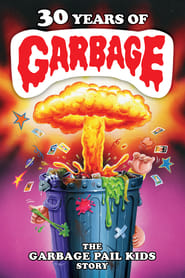
30 Years of Garbage: The Garbage Pail Kids Story
Download English Subtitle
Release info
Tags
English subtitle preview
The first 200 lines.
What are Garbage Pail Kids?
Garbage Pail Kids are pictures of
people who are a little bit worse off
than you are... but only slightly.
Garbage Pail Kids were part of the kids counterculture
of the 1980s in a fine tradition
of anti-authoritarian stickers and jokes would be sold
with bubble gum for, I think it was a quarter.
They're a take-off on Cabbage Patch Kids dolls
as gross little characters on
bubble gum stickers
Remember, in 1985 we're still in the Cold War
and here was a card of a Cabbage Patch Kid
going nuclear. And I was like wow
you know this, this means something.
I knew that even then.
There's always a smile they have on their face
like something terrible is happening but I'm still good.
They're just jokes...
Never has there been a more exciting time to be alive,
a time of rousing wonder and heroic
achievement, as they said in the film Back to the Future,
Where we're going, we don't need roads.
If you don't like the subject of this next piece,
just think this too shall pass. Here's Jeff Greenfield.
Just come to any neighborhood school
and watch as the latest fad instantly sweeps
across a classroom and then across a continent.
Watch that is if you dare because
the odds are that what appeals to the
young is going to appall the old.
Latest case in point.
Are you ready for Garbage Pail Kids?
Here we go...
You got it? Your sure?
I gotta get these out of my hands.
We just made it to Art's house, Art's studio.
Do you wanna hear that?
Yeah, I don't know, would it be funny to talk about it?
Hi, I'm Art Spiegelman.
I'm a comics artist.
Um, and for many decades I worked for Topps Bubblegum
Company making novelty items to be sold with bubblegum
and one of the more renowned of the projects
I worked on with Topps was Garbage Pail Kids.
And they were parodies of Cabbage Patch Kids
although attorneys would not like to hear
me say that. But they were parodies of a then popular doll
uh, that uh, allowed kids to destroy parents' refrigerators
and taunt each other and excoriate themselves for
whatever they'd been named, by having their little first names
underneath grotesque images of these cute,
little uh, doll kids.
And they became a fad
and Topps was essentially something that was
in the fad business.
At the top of the heap were the comic strip artists below those
were the comic book artist and somewhere way down right before
you hit tattoo artist
was the people who worked at Topps Bubblegum.
Topps was like, to me the end of the road in Brooklyn,
like the real southern end. And that was
probably about a 45-50 minute bus ride from where I lived.
Topps was in Brooklyn then, in a very, kind of,
romantic area - kind of - good background for a
Mafia movie, where they put people in cement and stuff
and throw them into the river. It was a warehouse street and it
was really cool. And when you would go
into inside the buildings it was like a bunker.
There were like no windows and I
don't know. It was just really strange.
These interminable, Xeroxed buildings that looked one like
the other going forever and every direction near
the waterfront. Inside one of
which on a kind of, cobblestone street there's
one building looking like all the others,
except it had, uh, detached doll heads in the street
that you had to step
on while walking and because a place called
Uneeda Doll was right on top of the bubble gum company.
The Uneeda Doll Company. And yeah, I mean you know on our way
to work with our coffee in our hand, we'd be walking down
the street and there'd be doll heads
like littering the sidewalk.
I'm sure worked it's way into our - into -
into our work the following afternoon.
When I first went out to Topps Bubblegum to meet Len Brown,
I didn't know what to expect. And
so I took the dingy subway, out to the dingy part of Brooklyn,
walked the dingy street to this weird factory building. I knew
it was Topps because when I came out
of the subway stop I smelled bubblegum.
It was unique in that the gum was made two flights above
our editorial business offices.
When you be approaching our building just like walking down
the street. You could be talking,
and the sugar dust would actually land on your tongue.
And you could actually taste the sweetness in
the air and smell it, you know from the manufacturing. You knew
you were approaching Topps. It was totally unique.
I'm Len Brown. I'm living in Bee Cave, Texas and I
worked at Topps for 40 years and the last 25, I was the creative
director in the New Product Development Department.
We started to come into the candy business
in a much bigger way. Bazooka uhh, was our big
bubblegum, I don't think I mentioned the name of it.
But Bazooka was probably the number one
bubblegum in the country
back then. It was such an icon up America
in the '50s and '60s.
They made as a staple bubblegum, not even the best
bubblegum eventually but they
made bubblegum and that allowed them a franchise
to move into these baseball cards.
And it was this man who would become incredibly important to
the history of popular culture
and certainly to me, named Woody Gelman.
Woody's job was to come up with trading card ideas.
Woody Gelman was of course the creative nucleus of Topps.
He had been a cartoonist.
He was a story and idea man first
for Disney and then for the Fleischer Brothers.
Going back to the earliest days, he helped create baseball
cards and hired all these
amazing artists to work on the Topps product that people from
EC, Norm Saunders later Robert Crumb, Len Brown. The list goes
on and on.
But then we started talking about different products that we
could be putting out.
And more and more, there was a need for what they called
non-sports cards. They felt that was a market that we weren't
really tapping into as best we could.
One of the first things that we worked on
collectively was a civil war series back I guess around '61.
We were instructed by the president that a company with a
civil war Centennial coming up let's put out civil war cards
and Woody and I both at first thought it was a terrible idea.
That it's educational. Kids get that in school.
Why would they want civil war cards for?
And Woody had the notion well, we'll make them want it.
We'll make them violent
and bloody battles of the civil war.
We'll show blood and guts.
And 'lo and behold it became a big hit.
And that was a forerunner of Mars Attacks.
And that was a forerunner of Mars Attacks.
Wacky Packs which was one of the very important
pop culture moments that Topps engaged in,
grew out of hanging out with Woody.
Oh, Woody was the world's greatest collector, I mean,
going to his house was a real treat.
It was like going to a great museum of pop culture.
Stuff that nobody could ever get to see like
all the Little Nemo Sunday pages. A lot of the originals.
Multiple runs of
Life Magazine when it was a humor magazine.
All the old Argosy, the old Amazing Stories pulps,
old runs of Saturday Evening Post from the '20s and '30s.
And what Woody did was
collected one run that just stayed as bound volumes.
Two runs that he could cut apart.
And then say OK- here's the Art Young file.
Here's the Harrison Cady file.
Here's the John Held file.
He'd like be organizing the stuff in a time
when nobody had any interest in this stuff,
I can't tell you how far outside the radar this was.
It wasn't a world of e-bay.
It was a world where finding it involved
meeting like-somebody just
happened to have a pile in their basement you know.
And one day he brings in a bunch of these things
to Topps on a day that I'm there
and shows me and he says
I love these things.
These are advertising cards
from like the 1890's and early 1900's.
They'd be things that would look like a tin can
or an ear of corn was one I remember...
an airplane... whatever.
And there'd be an advertisement
for something printed on the back,
on the front was this really beautiful rotary
printing on light cardboard.
He said you know we should be doing these,
says Woody. I think what he envisioned was
a pouch that a pre die cut ears of
corn and apples with a bite taken out and whatever
and something on the back.
They're beautiful. But you're saying
what? Like we would do a box of cornflakes?
Or a pea pod with some peas in it?
Well, yeah that would be good.
Well, wouldn't it be better to do it like the way Mad does it
and do parodies of these things,
rather than the actual thing?
I remember the back cover of one issue of Mad had a spoof,
a spoof of the cigarette Salem.
But I cut out the size of that package and showed it to Woody
and he liked it right away.
30 Years of Garbage: The Garbage Pail Kids Story subtitles in other languages
More English subtitles for 30 Years of Garbage: The Garbage Pail Kids Story
- 30 Years Of Garbage: The Garbage Pail Kids Story (2017) · 52 downloads · 2020-08-19
- 30 Years of Garbage The Garbage Pail Kids Story 2017 720p AMZN WEB-DL DDP2 0 H 264-NTb · 42 downloads · 2019-03-14
Comments
No comments yet. Be the first to leave one.