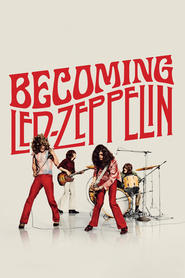
Becoming Led Zeppelin
Shkarko Titrat English
Informacioni i lëshimit
Etiketat
Pamje paraprake e titrave në English
200 rreshtat e parë.
As a kid in England,
we were living in the shadows of the Second World War.
Your parents and your grandparents
had been through two world wars.
And at the end of the Second World War,
there was this great feeling of hope towards the future.
In London,
there was lots of damaged buildings
and craters and...
I mean, it was an apres war zone.
There was rationing still. I remember
uh, getting eggs and milk and butter and stuff
with a little book with coupons.
People were recovering.
Outside of London, in the West Midlands,
it was a post-war, sort of semi-suburban
quiet life.
So America was my dream
because it was a totally different world
to the one that we were in.
I was listening to this marvelous rock and roll
coming in from America.
And you're hearing all this electric guitar playing.
I mean, it was almost like it was coming from Mars,
even though it was coming from Memphis.
But here in Britain, we were stuck with these musicians
who were really safe,
until this force of nature called Lonnie Donegan arrived.
I was so mesmerized
by having seen Lonnie Donegan play.
It was like a portal.
It gave some access
to the sort of freedom that you hadn't witnessed in England.
Give it up, Jimmy!
So, one day I come to school and I see...
this fellow standing up in the field
with lots of people around him.
His name was Rod Wyatt,
and he's playing the Lonnie Donegan songs
on an acoustic guitar.
So I went up to him and said,
"I've got one of those at home."
And he said, "Bring it along
"and I'll show you how to tune it up."
And then he showed me some chords as well.
I was absolutely inseparable from the guitar.
You know, I'd play it before breakfast
and then play it on the way to school.
I'd go there and want to practice,
but it would be confiscated
and given back at the end of the day.
My father was like,
"Well, I don't really understand
all this guitar business, but...
"I'm with you on it,
"providing you keep all your schoolwork up."
But my mum was really supportive to the idea
of me carrying on and starting in a group,
and she really believed in me.
I mean, it was really a big deal.
My parents were in vaudeville.
My mum was the straight singer in the evening gown
and my father was a comedian.
He would play the piano.
And so I used to travel around with them
to all the bases,
where they'd entertain the troops.
And there would be just one international act after another.
Accordion players and banjo players.
I took all this in.
So I was from that musical tradition.
And it was all the basis
for everything I ever did afterwards.
I grew up in the West Midlands.
My father's bloodline is from there,
and my mother's side of the family are Romani Gypsy.
My childhood was very sheltered,
until my parents sent me to a big school in a big town.
Studied to be a chartered accountant.
I mean, I'd really dug a lot of what was going on at school,
but when Little Richard appeared,
it was so provocative and all-consuming
and hypnotic
that it kinda knocked everything else out of the water.
I knew then that all I wanted to do was sing.
I mean, that was it.
The syringe was in the arm. Forever.
Oh, well, I'm John Bonham.
I always liked making drum sounds when I was a kid.
I got my first drum kit when I was ten.
And we went to see a film with Gene Krupa,
and it was just amazing.
Up here in the Midlands,
I used to buy completely different records, you know.
Johnny Kidd & the Pirates were a strong influence then.
You heard it on all the jukeboxes.
Of course, they've got those huge 15-inch speakers.
That's about all you could hear, was the bass.
I heard that and thought,
"That's a sound I would really like to make."
When I told my father, he said,
"Bass guitar is a novelty instrument.
"And in two years' time it will never be heard of again.
"Get yourself a saxophone, you'll always work."
So I said, "No. I want a bass guitar, Dad."
He heard me practicing and went,
"Hmm, you're coming with me.
"All you've got to do is watch my left hand."
On the piano. So...
I learned all the standards from that.
I had a little band.
We were playing at the youth club.
And I got talking to their very go-ahead young priest.
He went, "We'd really like an organist."
I said, "Well, I could be an organist for you, if you like."
Not thinking anything of it. He went, "Yeah. Okay."
In church music you have to improvise.
But as I wasn't very good at playing from music anyway,
I just improvised everything.
I learned the hymns.
I could figure out what the hymns were.
I'm not particularly religious, but it was a good gig.
All right? And he was a really cool priest.
And so I became organist and choirmaster at 14.
Which paid me the princely sum of £25 a year,
which bought me a Fender bass.
I used to go and jam on Thursday night
at the Marquee Club.
And after a period of doing this,
this band called Carter-Lewis and the Southerners
came up to me and asked me
if I'd like to play on their record.
I said, "Yeah, sure. That sounds really good."
So I went along with my kit.
The DeArmond foot pedal and the amplifier
and my brand-new Gibson Les Paul.
And the band would say,
"Well, just make something up for the solo."
By the second run-through, I've already got a part for it.
And the buzz must have gone around
about this young guitarist,
because I started to get calls for more studio dates.
When I got into this session world,
I was, like, seven years younger than anybody else.
And they didn't have somebody in the old guard,
or the current guard,
who really knew all the influences
and the points of reference that the young bands had.
So, of course, I knew all of it,
whether it was, like, R&B or whether it was blues
or rock, whatever it was.
Everybody was getting these records
that originally came over
maybe with the American merchant vessels.
The R&B boom had kicked in.
I went to see Sonny Boy Williamson
at the American Folk Blues Festival.
It was around the time I was learning to play harmonica too.
So it was just this amazing onslaught
of music from whence we had no idea.
Sonny Boy was almost everything
that's become my whole entire musical bloodstream really.
But in my own hometown, I had my own hero,
and it was Perry Foster.
And he had this kind of setup called the Delta Blues Band.
And, um, somehow or another, I managed to blag my way
into this band.
I was prepared to be a mod or a rocker
or a beatnik or anything so long as I could sing
and gather these looks around me,
just trying to make it stick on the wall.
I used to play and I used to have a job as well.
I used to be working with my father in the building trade.
Used to be good builders then.
But, you know, the job gradually gets less
and the music more, you know. That's what seems to happen.
You know, we left school and we formed small groups,
and things like that,
and played locally and everything.
You know, for me, soul music was a strong influence then.
James Brown was a big favorite
because, you know, the drum sound was just amazing.
I thought, "I'm gonna get that sound."
When I was 16,
I went to see a group with Robert singing.
The gig went incredibly well because he was bloody great.
In the crowd watching this
was some larger-than-life guy with his beautiful girlfriend.
He got a hold of me afterwards and he said,
"Well, you're okay,
"but you'd be a lot better with a proper drummer behind you."
And I thought, "Jesus Christ. Here we go."
The first time we played together
we were about 16.
And it was really good.
John was amazing.
He was a really powerful drummer.
I watched him with absolute amazement.
He was just fantastic.
But it's so competitive playing locally anyway.
Becoming Led Zeppelin subtitles in other languages
More English subtitles for Becoming Led Zeppelin
- Becoming Led Zeppelin 2025 1080p AMZN WEB-DL DDP5 1 H 264 (SDH) · 2 downloads · 2026-07-31
- Becoming Led Zeppelin 2025 WEBRip x264 AAC5 1-[YTS MX] / BluRay · 117 downloads · 2025-07-24
Komentet
No comments yet. Be the first to leave one.