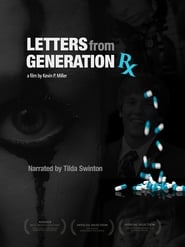
Letters from Generation Rx
Pakua Manukuu ya English
Maelezo ya toleo
Lebo
Hakikisho la manukuu ya English
Mistari 200 ya kwanza.
I've had to renegotiate that memory
over and over and over again.
Gravel spitting and water flying and kids screaming.
It was the summer after I turned eight.
We never really knew what to expect from mum.
During a particularly bad swing,
she went through some really desperate days there and
she put us all in the Bronco
and took us for a drive down to the river.
Before we got to the river, she was just purely robotic.
She decided it was time for all of us...
to die.
It's time to die; we re all gonna feel better soon;
"we'll all feel better soon,
"we re all gonna feel better soon"
My memories of that moment are really in black and white.
I'm not sure I ever really met my mum again after that point.
- A strange story out of Florida this morning,
where the mother of three children drove
into the ocean off of Daytona Beach.
The pregnant mum spoke of demons
before driving into the Atlantic...
Police say they've never seen anything like this...
The tiny city of Newburgh New York is trying to come to grips
with the deaths of 3 young children
who died when their mother drove them into the Hudson River.
We are talking about a tragedy in this city
that I would say is probably second-to-none.
- It all unfolded at this boat ramp Tuesday evening.
- Any effort to locate the vehicle,
difficult at best, it was not floating, it was underwater.
- Among the victims are 2-year old Lance Pierre
and his 11-month old sister.
- Perhaps we should take nothing for granted:
not our loves, nor our lives,
our families or friends,
even our sanity.
One minute, all is well,
the next, we re plunged into darkness,
unable to process what is real,
and what is madness.
Autumn Stringham realized this all-too-young.
- It was the summer after I turned eight.
- She should not be alive, and she knows it.
That was the moment
that shattered trust.
How do you...
You know, how do you trust anybody after that?
- Forced to confront a mystery beyond her comprehension,
she spent decades haunted,
in search of answers,
in pursuit of peace.
When something like killing all six of her children
made sense enough to put the kids in the Bronco
and drive into the river...
I see it.
Gravel spitting and water flying and kids screaming.
Somehow she managed to dig it up to back out of that.
And that's an incredible victory
for somebody in that state of mind.
You know, there are other mothers
who don't win that battle.
- In exchange for this redemption,
there was a price, however.
And it's taken me thirty years
to, um...
to be able to find the...
the beautiful side of that memory.
- Autumn's mum did eventually die by suicide,
alone on a country road.
Tony Stephan was now widowed
with eight children at home.
- I'm laying in bed at night in my room
listening to a house full of mourning;
and it just shattered the whole family.
It just shattered the children, it shattered me.
It has become so commonplace,
these irrational acts and horrific deeds,
that we've almost become numb to it.
We've seen them in schools and public spaces,
in homes and churches.
They're all over the news.
Try as we might to understand them, we can't.
Try as we might to ignore them, they call to us still.
We called the paramedics,
they tried feverishly to revive her.
And I was trying to give her mouth-to-mouth resuscitation
but I knew something was wrong because her body was cold.
- It's 2004. Andy Downing's world has just been shattered;
his daughter, a victim of an unimaginable act of violence.
But it was how this 11-year old girl
died that truly horrified the world:
Hello, I'm Candace Downing.
Candace... hanged herself.
When Candace first died, we asked ourselves,
how could we not know that she was unhappy?
- The Downings didn't realize it at the time, of course,
but her case was not a rare event.
No. Candace was far from alone.
- She started on this drug somewhere around January.
And these things make you unafraid.
They make you do things you wouldn't do normally.
They make you...
able to put a rope around your neck and hang yourself.
Caitlin died at home and we found her,
and she'd probably had been dead
for maybe at the most five minutes
when we found her.
She'd hanged herself in the guest bedroom upstairs.
It really is like a perfect mystery murder novel.
I mean, it's almost like killing somebody
with an icicle and it melts and the weapon is gone.
- They were still dizzy from death,
traumatized and broken,
when they solved the mystery.
The drugs responsible, they say, are called SSRIs
and they're among the best-selling drugs in the world.
It was a sample pack of Paxil.
Cipralex.
Sertraline, which is Zoloft.
And the maximum dose of Zoloft legally allowed.
There was one thing in her system in the coroner's report:
a therapeutic dose of Fluoxetine hydrochloride.
SSRIs are better known as antidepressants.
These are some symptoms of depression.
Psychiatric drugs like SSRIs have been defended
with religious zeal by their believers
and damned by others
as some of the most dangerous drugs on the planet.
Distinguishing truth from fiction has been a challenge,
and this has placed the public in the unenviable position
of de-constructing the scientific
and medical dogma on their own,
in the midst of a 30-year social experiment.
As Director of the National Institutes of Mental Health,
Thomas Insel has been at the centre of a storm
of contradictions about the use of these drugs.
I think that we have to be very humble about this right now,
because we've often been so self-congratulatory,
because we have, after all,
many people feel, made great strides.
The numbers don't really support that.
- Dr. Insel's candour is sure to shock and upset many,
on all sides of the debate.
The word failure is one few have dared to utter.
Fundamentally, why have we failed here?
Why has the suicide rate not come down?
Why have the measures, disability,
whatever those might be,
why have those continued to go up instead of down?
All of the numbers are going in the wrong direction,
so where, where have we failed? What's gone wrong here?
- The answers, according to Insel,
run contrary to the standard arguments put forth
by mental health professionals.
- A lot of people say it's because of stigma and access.
The fact is that actually more people are
getting more treatment than ever before,
so it's hard for me to quite believe that.
I would just submit that from the NIMH perspective,
the answer about why we've failed
is a little more disruptive.
And that answer is that we don't know enough.
- To hear the Director of the NIMH say now that
all of the exultations about psychotropics
from the media, from academia,
from the profession, from governments,
were not merited is unsettling.
After billions of prescriptions
and hundreds of billions of dollars in drug company profits,
how did this occur?
I think that our field has gone off track here
by devoting so much of its resources
over the last 20 to 30 years,
both publicly and privately,
just trying to understand how the drugs work.
If the drugs were truly curative,
if it was like trying to understand how
insulin helps somebody with diabetes,
that might be defensible.
But you've got medications here that, at most
reduce some of the symptoms of mood disorders,
of psychotic disorders.
They don't, in any sense, provide a cure.
This change of heart contradicts what we've been told
about psychiatric drugs for a generation now
and raises serious questions about how and why these drugs
have been dispensed so indiscriminately to millions.
I was massively drugged.
I tried drug after drug.
I did what they told me to do.
I used to take tranquillizers,
bezodiazepines,
that's all I did was pop pills all day.
They just kept handing me pills, you know,
here, let's try this, let's try this, let's try this.
And I felt like a walking pharmaceutical company, really.
And nothing was working.
I was drugged out.
I was a non-existent person.
More English subtitles for Letters from Generation Rx
- Letters From Generation Rx 2017 720p WEBRip x264 AAC-[YTS MX] · 6 downloads · 2022-01-23
- Letters From Generation Rx 2017 1080p WEBRip x264 AAC-[YTS MX] · 6 downloads · 2022-01-23
Maoni
No comments yet. Be the first to leave one.