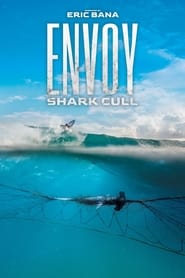
Envoy: Shark Cull
Pakua Manukuu ya English
Maelezo ya toleo
Lebo
Hakikisho la manukuu ya English
Mistari 200 ya kwanza.
Good evening, a great white shark has been hunted, caught
and killed after a horrifying attack near Mandurah.
The shark was hooked on drumlines off Falcon
and towed out to sea,
but there's no confirmation
it was the shark that attacked the surfer.
Our whole lives, we've been taught to fear them.
Good evening, two surfers have been injured.
-A shark attack. -Multiple attacks.
-Bitten by a shark. -Mauled by a shark.
Monsters, murderers, man-eaters.
-Shark attack. -Shark attacks.
-A shark attack. -Two shark attacks.
Terror in the shallows.
But what if we've been taught wrong?
What if the very thing you were taught to fear
had more to fear from us?
-Great white... - Shark attack...
-A great white... -Shark attack.
- Two shark attacks. -Bitten by a shark.
What if we knew we had a greater chance of being killed
by almost any other animal on Earth
than by one of nature's oldest and most evolved species?
-Bitten by . -Shark attack.
What if our ignorance is about to wipe them out?
Not in 100 years, not in 50 years.
This generation. Right now.
They can't speak for themselves.
So we must be their envoy.
I feel that one of the greatest ways
that we can overcome our fear of the unknown is get to know it.
One of the greatest ways
I've been able to reduce my fear of sharks,
is swimming with them.
Getting to understand their gentle, curious nature,
it was one of the most beautiful things
I ever had to do
was just actually sit underneath a bull shark
and watch it gracefully glide around over the top of me,
it was just so beautiful.
I never ever have experienced a fear of a shark since then.
So pretty much, you know, raised in Hawaii
since I was two.
You know, I had seen them as a lot as a kid, you know, spearfishing,
and I still was really, really kind of a afraid of them.
But it wasn't until I had a really bad accident where I broke my back.
And it left me paralyzed for almost a good portion
of three or four months and the remedy that really,
that made the healing process get better was the diving.
And so now I was getting engaged in diving,
like almost every day trying to get my back to normal.
And the interactions with sharks were a little bit more consistent,
and they were far, far, far
from what I was told what I saw on TV, you know,
and they were more scared of me than I was of it
and that kind of like, created this passion
and desire to want to learn more.
It's that fear of the unknown, you know, for most people,
and then you have other people trying to fill in the gaps
with that lack of information.
So I think a lot of the public fear all has to do with fear of the unknown.
It's that dark basement, or what you can't see in the water,
and the more we understand about sharks
and their motivations and the behaviors,
the more that fear just dissolves away.
I've been with HSI for almost two years now,
I'm a marine biologist and ocean campaigner.
There's been this massive divide lately between science
and between what's been accepted or what's taken as fact.
And I think just as important as pushing forward
our knowledge and continuing to do science and research,
it's important to bridge that gap.
There's something about, you know, when you're 20 meters underwater,
and you're sitting there with the sharks, they come past you
and their eye swivels around and definitely looks at you.
There's that awareness there.
And it's so calming and quite lovely.
Part of my mission and a lot of scientists out there
and conservationists, and even people who just love sharks
and just love talking about the them,
is to really sell the truth of it.
We've got over 320 odd species of sharks
and Rays in Australia.
You know, half of them aren't found anywhere else in the world.
And the go to species that everyone thinks of
are your tiger sharks, great whites,
are your whale sharks, which are amazing,
and incredibly beautiful in their own right.
But there's also these other species that were just...
the majority people I don't think are aware of.
I grew up in the ocean, and I got to see sharks
for what they naturally were,
which is absolutely beautiful and fascinating.
And as I grew up, I realized how important they were.
I went to school for marine biology.
And as I traveled around the world
and worked around the world, I realized that people
had a very heavy damaging misconception of them,
and that they're actually the real victims
and the ones that have something to fear.
I think for a very long time,
people didn't know very much about sharks.
So it's very easy to be afraid of them,
you're afraid naturally of something that you don't know.
When you see sharks under the water,
they're just so majestic
and actually a lot more scared of us
than what you know what we typically are of them as well.
So getting to know sharks under the water
is probably the best way to meet sharks
and understand them.
There was this moment when I was about 15 years old,
and I was diving with two really big tiger sharks.
And it was just amazing, it was late in the afternoon, the light was beautiful,
and then suddenly they disappeared.
So there's this is anticipation,
and all of a sudden out of the corner of this
great hammerhead swims through,
the middle of the water column,
and its head was as wide as I was tall.
And at first I thought it was a whale, it was that big.
And this creature, this massive creature
that I had been kind of taught by society my entire life to be scared of,
just passed through and didn't even pay attention to me
and it was one of the greatest things
I had ever seen in my entire life.
I grew up on the Gold Coast I've been here my entire life.
It's been home.
And I feel like when I was a kid,
I was the only person looking out to sea,
seeing the shark nets and drum lines
and thinking what on earth is going on here?
When I got involved in the chapter in Brisbane,
I didn't have a lot of knowledge about nets and drum lines.
I was probably typical of a lot of the population.
I learned to surf on this beach, in that water
starting around seven years of age.
To be honest I've never even thought about the shark nets.
I used to use the buoys to paddle around
when we were doing a lot of open ocean paddling.
I've been assisting Humpback Whale Research
for the past four years, and particularly on the east coast of Australia,
humpback whales are becoming entangled in shark nets.
And that sparked my interest with shark nets
and exactly what are they and what are the aims
and the methods of this program?
So I basically took the initiative to go out there
and get a view for myself of exactly
what's happening beneath the surface.
The biggest misconception that people have
towards the Shark Control Program
is that a lot of people think
that it's a physical barrier between them
and the open ocean.
People aren't aware that this device is a fishing device,
it's there to capture and to kill passing sharks
and I think a lot of people are surprised
when they realize that it's not a physical barrier
that is completely enclosed
or it doesn't touch the bottom of the ocean.
Bright buoys visible from the shore in the air,
draw a line through the ocean,
between the comfort of the shallows and the mystery of the deep.
Not many people know exactly what they are,
or how they work, just told that it keeps them safe.
Even fewer people know the truth.
Australian beaches renowned for their long unbroken
surf line and clean white gold sand
are among the most beautiful in the world.
This lovely beach is a typical example.
Shark nets were first introduced off the east coast
of Australia in 1937,
with drumlines following soon after.
It's the very same decade Qantas first started flying
between Australia and London.
Flights could fit just ten passengers,
had 21 stopovers, and took a total of 12 days.
Our world has evolved beyond recognition since then,
but shark nets and drumlines have stayed fundamentally the same.
Shark nets in Queensland are 186 meters wide by six meters,
hang from the surface, and sit in water 12 meters deep.
Shark nets in New South Wales are 150 meters by six meters
are anchored to the sea floor, also in water 12 meters deep.
Both programs cover only a tiny portion
of any given beach,
allowing sharks ample opportunity to swim over,
under, around, and towards beaches.
In fact, a high percentage of sharks
are caught inside the nets.
They've already been to the beach,
and are peacefully making their way back out to sea.
Drumlines use a large buoy on the surface
to suspend a baited industrial fishing hook
dangling below on heavy duty chains.
They chum the waters, attracting sharks,
in the hopes of hooking them.
If anyone in a snorkel and fins can navigate
around this technology,
why would we think that sharks can't?
People think that shark incidents are happening
Envoy: Shark Cull subtitles in other languages
Maoni
No comments yet. Be the first to leave one.