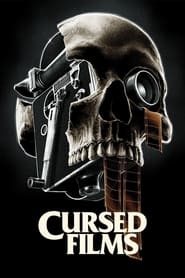
Cursed Films
English வசனம் பதிவிறக்கம்
வெளியீட்டு விவரம்
குறிச்சொற்கள்
English வசனங்களின் மாதிரிக்காட்சி
முதல் 200 வரிகள்.
What have you heard about the legends
surrounding the making of "The Wizard of Oz"?
Um...
- I mean, there's just so many rumors in general
about "The Wizard of Oz".
- Oh, we could talk about that all day.
I mean, I've researched this stuff
since the time I was a little kid,
I'll get you, my pretty.
- Definitely heard about the burning of Margaret Hamilton.
Yeah. Oof.
- You know, she caught fire once unintentionally.
- I definitely know of the makeup situation
that happened with the Tin Man.
- Heard about the Munchkin hanging.
- I've heard that a small person hung themselves on set.
- The list goes on and on and on and on and on.
I think it's a part of the legacy...
I think that when some people look at films
that are super beloved
and they hear stories about the difficulties
or the tragedies that happen on set,
they then go on to ascribe that production as "cursed",
because it's hard to hear these stories of tragedy.
And you want to believe that at least someone
or something is in charge
because the reality is no one's in charge
and the universe doesn't care about you,
but that is too crushing
to encompass with our minds.
So, we come up with ideas like that production is cursed,
'cause it makes us feel a little bit better
about the terrible things that might have happened on the set.
When I was five,
I sat down and watched "Wizard of Oz".
Everybody had a great night,
but I had the life changing experience.
The characters and the fantasy and the songs,
but I just kind of bought into all of it.
You don't choose these things, they choose you.
And that's a statement that I think anybody watching this
who has any kind of passion for anything can...
can comprehend.
What "The Wizard of Oz" is about
is not a question I have actually considered.
And that's amazing to me.
There are lots of theories.
People thought that the Yellow Brick Road
was something to do with the gold standard.
Society had been through some really difficult times
with the depression
and then the war.
People were forced to move all over the place.
And then we still had lots of first-generation immigrants
who'd come in in the 1910s and 20s.
They had to leave their homes
and knew they would never be able to go back.
Here was Judy.
She was disrupted.
She was off in a whole 'nother world,
just like the population of the country.
And the whole tension was "she couldn't go home".
Close your eyes
and tap your heels together, three times.
But suddenly through magic,
she is able to go home
and she is sort of like a surrogate
for the American population.
There's no place like home.
They went out of the movie
with some sense of redemption.
At least Judy got home.
I think it's about the way
in which human beings trust each other
to lead each other through the world.
Yeah.
'Cause the Wizard's not inherently a bad guy,
but he has a lot of power.
And power corrupts.
That's absolutely true.
It was made in 1938
and it opened in August 17th, 1939,
and America was at the cusp of a World War.
Go, fly! Fly!
Fly! Fly! Fly!
And that dark energy,
it was part of the air they were breathing at that time.
That beat of war was going on in the background.
I mean, and they so much made it real
with the Winkies marching like Nazis.
"The Wizard of Oz"
was a hopeful outcome of that dark energy
because the witch is dead.
Dorothy gets back to Kansas.
The objects themselves associated with the production
still have that power over people
and an object like the Ruby slippers
is a perfect example of that.
I've seen people just break down in tears,
coming into this room
and seeing the ruby slippers in real life.
You know, Dorothy Gale is a stand-in for anybody
who's ever thought about wanting more out of their life
or being unhappy with their circumstances,
seeking something over the rainbow.
Having an object in front of you
that represents that,
it's actually very powerful.
"Wizard of Oz" was a very difficult shoot.
There were conflicts and re-castings
and accidents and script problems.
- They wanted to make a realistic film
that was a fantasy.
All of the characters suffered through the costumes.
Dad had to eat every meal through a straw.
The lighting was so intense.
They were dying under those costumes.
There was a fire marshal on the set at all times
with a light meter going around to make sure
the set wasn't going to catch on fire
from the heat of the lights.
There were 14 writers and five directors
and three choreographers
and a potentially fatal accident,
a potentially fatal reaction to makeup.
I would imagine you'd have to ask
any number of the cast members
who worked on "The Wizard of Oz"
if "The Wizard of Oz" was cursed or not.
And if you asked Buddy Ebsen,
he might tell you, yes.
His participation was cursed.
Originally Buddy Ebsen was cast to play the Tin Man.
And he was a very popular film actor of the time
known as the song and dance man.
And he would've been a perfect fit for the film.
The makeup was pretty basic.
They used clown white
and then they dusted it with ground up aluminum.
He found that he was starting to have cramps
in his fingers, or in his feet.
And then one night it spread to his arms
and his legs and he could not breathe.
- They were putting silver paint on him
and they didn't realize it, you know,
he was being poisoned.
He had been inhaling the aluminum particles,
you know, that floated around.
They had coated his lungs.
- He went home one night. Couldn't breathe.
Ended up in the hospital
with pneumonia in an oxygen tent.
Unfortunately, his participation in the film
was cut short.
And it ended up being a film
that kind of scarred him in a way too.
Um, literally scarred his lungs
uh, because he had a tendency toward bronchitis
for the rest of his life.
In the early 2000's
I had a show called "MythBusters"
and we were doing a story we called "The Goldfinger Myth".
And it's about the actress, Shirley Eaton,
who got painted gold in the James Bond film,
supposedly got suffocated by the paint.
Which she didn't.
But as part of the research for that myth,
we came across the famous story from "The Wizard of Oz"
that Buddy Ebsen was originally slated to play the Tin Man.
And couldn't because he was poisoned
by the silver paint that they put on him
to play the Tin Man.
When we first started to look at doing a story
about "The Wizard of Oz",
there are a few avenues to that negative affect
and one is poison.
So, if Buddy Ebsen was poisoned by lead in the paint,
we-we can't test that on ourselves.
But the other main reason given
for the difficulty with the paint
was that it cut off the oxygen
that you breathe through your skin.
And if you paint your whole body
um, you will somehow suffocate.
That is testable by us.
The suffocation is something that we can creep up on.
We have an EMT on set.
We can make sure our pulse oxygen levels are up to snuff.
And that is the aspect of the story that we tested.
- This is the exact stuff that they were using on the Tin Man.
Which was just pure aluminum powder.
Now, why are you guys feeding her oxygen?
Her heart rate's gone up.
When most humans think about being Buddy Ebsen
in that moment, oh, you get to play a Tin Man.
So, they're gonna build this elaborate costume around you.
And then they're gonna paint you silver.
These are all the activities of like,
the best day ever for a 10-year-old.
And I think every one of us intersects with that of like,
Cursed Films subtitles in other languages
More English subtitles for Cursed Films
- Cursed Films S01 BDRip x265-ION265 · 16 downloads · 2023-03-17
- Cursed Films S02E05 1080p SHDR WEB-DL AAC2 0 H 264-PMP · 43 downloads · 2022-05-30
- Cursed Films S02E04 Cursed Films The Serpent And The Rainbow 1080p AMZN WEBRip · 40 downloads · 2022-05-30
- Cursed Films S02E03 Cursed Films Stalker 1080p AMZN WEBRip DDP2 0 X264-NTb · 40 downloads · 2022-05-30
- Cursed Films S02E02 Rosemarys Baby 720p AMZN WEB-DL DDP2 0 H 264-NTb · 42 downloads · 2022-05-30
- Cursed Films Season01 WEBRip x264-ION10 · 25 downloads · 2020-05-01
- Cursed Films S01E05 WEBRip x264-ION10 · 16 downloads · 2020-04-16
- Cursed Films S01E05 WEBRip x264-ION10 · 13 downloads · 2020-04-16
கருத்துகள்
No comments yet. Be the first to leave one.