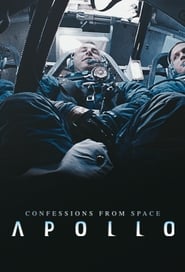
Confessions from Space: Apollo
English வசனம் பதிவிறக்கம்
வெளியீட்டு விவரம்
குறிச்சொற்கள்
English வசனங்களின் மாதிரிக்காட்சி
முதல் 198 வரிகள்.
Duke: If you're gonna accomplish something,
You gonna have to take risks.
To land a man on the moon and return him safely to earth
By the end of the decade.
Duke: It was really a fighter pilot's ride.
We were close to not being able to come home.
Collins: And then bingo, the moon was in your window,
Filled your window.
I just looked in awe at this incredibly beautiful planet.
Armstrong: It's one small step for man,
One giant leap for mankind.
Captions paid for by discovery communications
Hello. I'm richard garriott.
I'm the first second-generation american astronaut,
Son of apollo-era astronaut owen garriott,
Who flew on skylab and the space shuttle.
And here on the 50th anniversary of the apollo moon landings,
We are going to bring together these apollo astronauts
Who almost never get the chance to get together,
And we will sit down with each of them...
Well, again, thank you so much.
...And talk about their amazing experiences
On their journeys to the moon.
-Yeah. -Okay.
-Alright, let's roll it. -Copy mark.
Let me welcome you all today
To what is clearly a historic gathering
Of six of the apollo astronauts who are at the tip
Of our national effort to take humanity from its cradle here
On earth and for the first time,
Extend our reach 240,000 miles through space
To the surface of the moon.
These six astronauts flew aboard apollo missions
Which took us incrementally further
And further until we had not only landed on the moon,
But we had done it six times.
12 of our astronauts walked on the moon.
They brought back 842 pounds of moon rocks.
The first three crews walked 4.4 miles across the surface,
And the last three used rovers to cover about 56 miles.
From apollo 7, the first apollo
To carry people into space, lasting 11 days in space.
For the first time, we also had live tv.
Man: We have liftoff.
Garriott: Please welcome apollo 7 lunar pilot walt cunningham.
From apollo 9, the first crewed saturn v full stack.
Also performed crewed dockings and a space walk.
Please welcome apollo 9 lunar module pilot
Rusty schweickart.
From apollo 11, the command pilot
Who was left alone in orbit around the moon
When his crewmates descended to the surface,
Becoming likely the loneliest man
In the universe, michael collins.
Also welcome from apollo 11, the lunar module pilot,
Who along with neil armstrong, became the first humans
To walk on the moon.
I give you buzz aldrin.
From apollo 15, the fourth successful landing on the moon
And had a strong focus on science
For their entire mission,
Please welcome the apollo 15 command module pilot,
Al worden.
And finally please welcome the apollo 16 lunar module pilot
Who drove a long stint of very rough terrain.
Charlie duke.
First to you, walt --
You think of the early projects,
Mercury and gemini and apollos 7, 8, 9, 10 --
These were all stepping stones to reaching the moon.
Can you tell us a little bit about this drive to get there
And how quickly we tested these things one after the next?
I think the public today doesn't realize
The steps it took to get there.
I think the number was something like 240,000 people
Who worked on apollo or something like that,
And we worked 10, 12 hours a day,
Sometimes 24 hours a day if it took it,
Six days, seven days a week,
Whatever was required because of that incredible,
Imaginative goal that kennedy set.
We choose to go to the moon in this decade
And do the other things, not because they are easy
But because they are hard.
Aldrin: When kennedy gave his talk,
Obviously we had an objective -- the moon.
We had a time -- before the end of the decade.
We did not have a plan.
That was a wonderful, wonderful mandate for us.
It was a masterpiece of simplicity.
We knew exactly what we had to do
And exactly when we had to do it.
Now, the how of it, that was left to us.
Duke: But it was a bold program
And we had eight years and six months
From kennedy's announcement to get it done.
So the focus was let's do it.
You were learning all about the spacecraft.
We were learning geology.
We were learning the science that we were going
To be doing on the moon.
You wanted to know it,
At least the spacecraft systems, absolutely perfectly
Because you could kill yourself if you do something wrong.
Worden: Over the three-year period,
I got 1,500 hours of simulator time.
And if you calculate that out, that's 500 hours a year
So it's like 25% of my time was in the simulator.
The gemini program was a lot of fun and it was good
And it was exciting
And maybe a tiny bit like a sporting event.
The apollo program wasn't no sporting event, baby.
The eyes of the world were on you,
And you better have everything in perfect alignment.
Time's running out and we're being watched by friends
And by foes as well.
Worden: The whole thing was a competition between us
And the russians.
We all wanted to win on our side.
Cunningham: I think the most significant difference then
And now was the attitude that we had,
All fighter pilots, mostly test pilots,
We had confidence in ourselves.
We also had that feeling, I'm sure,
That you're not gonna get any place unless you are willing
To stick your neck out.
And that was risky, because it was the first one,
But that's just the way we did.
Wallace: This is a cbs news special report.
This is mike wallace at the cbs news room in new york.
America's first three apollo astronauts were trapped
And killed by a flash fire that swept their moon ship
Early tonight during a launchpad test
At cape kennedy in florida.
I remember that was on a Friday, and it was late afternoon.
We had performed that same test on Thursday.
But we had not closed the hatch.
And when you don't close the hatch,
You don't have to secure and operate at 100% oxygen.
Man:
Fire in the cockpit!
Man #2: Get in there and help them.
Cunningham: Operating at 100% oxygen and then you have
To over-pressurize that to keep the hatch closed.
Nobody had really been as terribly concerned
As we should have.
But what that did, that initiated changes
In the apollo program and subsequent other programs too.
On the operations with 100% oxygen.
Everybody started operating differently.
And a lot of that came about because our friends,
Grissom, white, and chaffee, sacrificed their lives,
Triggered some of that.
It was interesting to me that at edwards,
They lost several pilots in experimental aircraft.
They crashed.
Now, the fire showed up on page one,
And the experimental aircraft crashes showed up on page 20.
So that's the difference in how we perceive these things.
But I got to tell you, the feeling is the same.
I don't care whether you're sitting at edwards as a pilot
Or you're sitting at the cape as an astronaut
Getting ready to launch,
When you lose the crew, it's bad.
And I absolutely believe that because we had that fire,
We were able to make changes in the spacecraft
That allowed every flight after that to be successful.
I think it was because of that. I really do believe that.
Space flight is not risk-free,
And even after apollo 1 caught fire and the crew was killed,
We were dead in the water, but we weren't giving up.
Apollo 7 was the first manned apollo launch.
The longest, most ambitious, most successful
First test flight of any new flying machine ever.
Then you've got apollo 8.
And apollo 8, we broke the barrier
To get away from the earth's gravitational field.
Apollo 9, we finally got
To where we could test a lunar module.
Finally, apollo 10, we got to the point
Where they went through everything
On that apollo 11 landing, except the last 50,000 feet.
Then, we get apollo 11 and they did one hell of a fine job.
People waving, like goodbye.
Everything was going
Duke: It was eerie at first.
Cunningham: We launched on the 11th of October in 1968.
There was no frightened morning or anything like that
In getting ready for that flight.
Schweickart: It was a morning like any other morning.
Not quite, but we had our breakfast,
We went down to the medical office.
The difference, of course, was as we went out
To the transfer van, which took us
From the crew quarters out to the pad,
There were more people and news cameras and things
And people waving, like goodbye, and things like that.
Duke: We took a van out to the launchpad.
கருத்துகள்
No comments yet. Be the first to leave one.