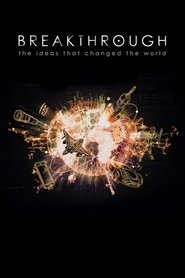
Breakthrough: The Ideas That Changed the World
English வசனம் பதிவிறக்கம்
வெளியீட்டு விவரம்
குறிச்சொற்கள்
English வசனங்களின் மாதிரிக்காட்சி
முதல் 200 வரிகள்.
Since the dawn of humankind,
we have looked to the stars and wondered,
what's up there?
What lies beyond this small, blue planet we call home?
"If only," our ancestors thought,
"there was a way to bring the sky closer
to really see the stars."
Just how humanity managed to do this is quite a tale.
It would take crystals forged inside the earth...
Just the right amount of salt,
a chance alignment of two small pieces of glass,
a property boom in New York,
and an accident of chemistry and light
to create the device that would open our eyes
to the universe itself...
The telescope.
These are the inventions that define our age
and changed our world forever.
They have allowed us to move on the ground
and in the air,
to connect with each other,
and make machines in our own image...
Each a story of ingenuity, of wonder, of breakthrough.
Today, we are on the brink of a new revolution.
Giant new telescopes are being built all over the world,
which scientists hope will answer some of the oldest
and most profound questions humans have ever asked...
How big is the universe?
Are we alone?
Do the stars go on forever?
This is a really fantastic time to be an astronomer,
helping us build the picture of understanding
about the universe that was completely unimaginable even 100 years ago.
Around the world, a new generation of telescopes
is pushing the limits of our vision ever deeper into the cosmos,
and the Hubble space telescope is still at the forefront of this effort.
Astronomers here at the space telescope science institute
are combining images from Hubble with other telescopes
to stretch our vision as far as possible.
We're looking for the most distant galaxies
that we can find in the universe.
There's entire systems and worlds out there
that, you know, I'm seeing for the first time.
The story of the telescope
is inseparable from who we are.
It took over 13 billion years to get to this point
where we could build telescopes in space
and witness our origins.
These gleaming technological miracles
of glass and steel define our age.
But the telescope's origin is stranger than you would imagine.
It would all begin with a pile of rocks in Southern Europe.
6,000 years ago, the stone age people
living in this part of Portugal
built these stone structures.
For the last 10 years,
I've been studying these ancient sites
around the countryside where I grew up.
And I believe these megaliths were one of
our earliest attempts to study the stars.
But why were the stars so important to these ancient people?
Because the stone age communities living here
were hunter gatherers and Shepherds.
They were living off the land, which isn't always easy.
That's why in the summer
they would go into the mountain ranges that were green
and provided enough pasture for their animals and for themselves.
And the best way to know when it was time
to move to the mountains was to look to the stars.
So how did these megaliths help them in this quest?
In a perfectly dark night sky,
the human eye can see around 5,000 stars.
To look beyond and see things that we wouldn't normally see,
we need the telescope.
And I think that such technology was already present 6,000 years ago,
1,000 years before Stonehenge
and about 1,500 years before the pyramids in Egypt.
And we also find the remains of it here in Portugal
in the shape of these stone monuments or dolmens.
They only had stone tools, wooden tools,
and possibly bone tools.
And yet, somehow they managed
to carve these rocks out of the landscape,
drag them a few miles, and put them in place.
This was clearly a project
of huge significance for these communities,
and they didn't just do it once.
There are between 15 and 20 monuments
in this river valley alone
with the same orientation, towards the east.
I think these rock chambers were used
to accustom their eyes to the dark,
allowing them to see fainter stars.
Using computer software, we can reconstruct the skies 6,000 years ago,
as it would have been seen from inside these stone monuments.
In the course of a year, as we orbit the sun,
as seen from the earth,
the sun appears to pass through
different parts of the sky.
In the spring, a star called Aldebaran begins
to appear close to the sun as it rises in the east,
marking the perfect time of the year
to move to higher pasture.
The problem is that Aldebaran is all but obscured
by the glare of the rising sun,
which makes it hard to see.
But I think these dolmen,
with their large chambers and long, stone tunnel,
would have allowed them to focus their eyes on a smaller patch of sky
to see the star at sunrise
sooner than they would by standing outside,
signaling to move to the mountains for the summer.
These structures Mark the moment in human history
when we realized that the skies ran predictably like clockwork,
and if you could see the stars better
and, therefore, decipher the patterns in the night sky,
it could help you to survive.
Across the world there are many other
stone structures from this time
which also appear to be aligned with the heavens.
It seems that as soon as we could deploy technology,
even stone technology, we applied it to the stars.
To me, this potentially represents humanity's first steps
into this journey of discovering their place in the cosmos.
Across the world, our ancestors were exploring the heavens.
From Egypt to Australia, early human civilizations
were driving a revolution in human vision,
stretching our sight further out into the cosmos
than the naked eye alone could achieve.
But the telescope requires one material above all others...
Glass.
And the first glass would come from the earth itself.
Over 5,000 years ago,
the people of Rifeh and El Badari in central Egypt
started to pick up small pieces of glassy quartz crystal
that caught their eye, and this is one of them.
Around the world, people were finding
naturally-occurring crystal fragments like this
that appeared to distort the light.
No one knows for sure what they might have been used for,
perhaps as a tool of some kind or simply as jewelry
or some kind of decoration.
But they all have one thing in common...
They could control light.
How they were doing this remained a mystery,
one that would only be solved by someone living
in an extraordinary place at an extraordinary time.
Baghdad in the 9th century really was one of the greatest
and most amazing cities in history...
Perfectly round, 4 miles in circumference with 4 gates,
each at right angles to the other.
Clearly the people who live here just loved math and loved using math.
Baghdad in this period was like Florence during the renaissance
or silicon valley in the age of the Internet.
We often talk about this mythical place, the house of wisdom.
Some would say it was a library
or it was a translation house
that brought together the knowledge of the Greeks,
the knowledge of the Persians,
the knowledge of the Indians,
all converging on this one spot in Baghdad
in the house of wisdom,
a cross fertilization of ideas
that hadn't really happened anytime before that in history.
One of the greatest of scholars of the medieval time
was Ibn Al-Haytham, who was curious about the world.
Ancient Greeks couldn't agree on the nature of light,
on how we see.
Some thought it was light entering our eyes,
some thought it was light beamed out from our eyes.
In a ground-breaking experiment
that would prove which it is, Ibn Al-Haytham blocked a window,
leaving a tiny hole
to create what's known today
as a pinhole camera or camera obscura.
A faint view of the street outside
materialized on the wall opposite,
proving that the light was entering the room from the street,
rather than being projected from his eyes.
But there was a second revelation...
The image was upside down.
Ibn Al-Haytham realized this must be
because the light from outside was traveling
in straight lines as it entered the room.
In fact, all light bounces off objects
in all directions in straight lines.
And once you know that,
you can start to manipulate light
and use it to reveal things that were previously hidden.
Light travels in straight lines.
A phrase that would be translated into
other languages all around the world.
Ibn Al-Haytham's theories are documented
in his celebrated "book of optics,"
written almost exactly 1,000 years ago in the early 11th century.
Its pages contain profound ideas about the nature of light,
and they explain why those crystal lenses
distort the light as they do.
For me, Ibn Al-Haytham is the most significant physicist of his age.
His accurate modeling of the nature of light
More English subtitles for Breakthrough: The Ideas That Changed the World
- Breakthrough The Ideas That Changed the World S01E06 The Smartphone · 17 downloads · 2019-05-30
- Breakthrough The Ideas That Changed the World S01E05 The Rocket 1080p HDTV x264 AAC MVGroup org eng · 22 downloads · 2019-05-30
- Breakthrough The Ideas That Changed the World S01E04 The Car 1080p HDTV x264 AAC MVGroup org eng · 22 downloads · 2019-05-30
- Breakthrough The Ideas That Changed the World S01E03 The Robot 1080p HDTV x264 AAC MVGroup org eng · 24 downloads · 2019-05-30
- Breakthrough The Ideas That Changed the World S01E02 The Airplane 1080p HDTV x264 AAC MVGroup org eng · 28 downloads · 2019-05-30
கருத்துகள்
No comments yet. Be the first to leave one.