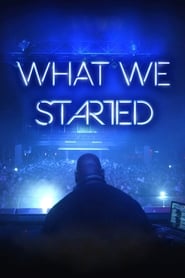
What We Started
English வசனம் பதிவிறக்கம்
வெளியீட்டு விவரம்
குறிச்சொற்கள்
English வசனங்களின் மாதிரிக்காட்சி
முதல் 156 வரிகள்.
The biggest misconception is
that dance music is a new thing.
That it just kind of burst from the ether.
People don't see it as part of a long history.
My drive has always been about
sharing the love of music.
Finding it, and then sharing it.
Some tracks make me really happy,
some tracks makes me think,
some tracks make you forget everything.
Such an experience of freedom.
And experiencing this freedom with other people,
all through the sound of music.
Dance music has always been about
an escape and letting go.
Just get lost in this aural sound state.
I close my eyes, stick my head in the speaker,
and just be...
Absorbed.
Sweet!
I'm very nervous.
What if something goes wrong?
I've always done everything
for the love of music.
Always.
I was always building tree houses
with my dad.
And we'd put a radio in it,
bought, like, cheap car speakers,
kept expanding it.
Before we knew it, we had, like, uh...
Kind of "tree... Tree house club."
My friends were there, we started playing music.
Then, we made it like, mobile,
so we could, like, travel with it.
It wasn't a tree house anymore.
It was just like a kind of dj booth.
We made a very big sign
saying, "dj Marty" on it.
And it all fitted in the car,
so I could drive him to, uh,
the places where he wanted to perform.
So, eight years old,
my father was bringing the music home,
I got inspired by the music he was playing.
Carl played music nonstop.
We constantly told him,
"turn it down!"
I used to take my sound system to school,
and an hour-break that we had,
I would play music to them to the canteen.
I kind of grew up all the way through the '70s, '80s,
playing hip-hop, R&B, funk, and soul music.
Most of the parties that I did, we never got paid for.
My dad thought I would amount to nothing.
Dj'ing was not something that my dad thought was a job.
He didn't encourage Carl.
He was always just looking at me, going,
"just get a proper job,"
because whatever you're doing now
"is never gonna amount to anything."
I discovered electronic music
due to tiësto's performing at the Olympics.
I heard, like, the sound on television,
and I never, never kind of listened to it before,
I never really got connected to it.
I, I loved it.
I, I played at, like, the local house parties,
for like, ten people.
I had my first real dj gig
on 16th of January, 2010.
There were, like, 250 people,
and there was, for me, already like,
there was, like, a goal for me to, like, make it bigger.
I started to understand music
at a very early age.
I'd just study there as much as I possibly could.
Where does it all stem from?
How did we get here?
When I first started working in nightclubs,
there were really one kind of music that would fill a room.
Live music.
The people I worked for had a concept,
where they would have a dj play records.
Everybody said, "it will never work.
People want to see a live band."
That was sort of the beginning of disco.
Uh, everyone comes here to do whatever they want.
Disco is the phenomenon of our time.
The paradise garage.
Where so many artists,
so many people met and congregated,
and created the downtown New York scene.
There's a way for people who would disenfranchise
to connect with other like-minded individuals,
express themselves, and dance.
I went to the paradise garage when I was about 14,
and my sister snuck me in.
That's when I went to my first club
and never turned back.
That was kind of, the, the theater for the dj.
The way Larry levan was playing,
he had two copies of the same record,
going between the two turntables.
Remixing the record on the fly,
and extending bits of work with the crowd.
He knew about sound.
How to pick the right music at the right time,
and it just opened up a whole new thing for everybody.
This is dj heaven, when you walked in that club.
There's a space for an idea
for freedom and expression,
that was outside of popular culture.
And then, the next thing I knew,
that every single holiday inn in America
converted their lounge into a discotheque,
and it started becoming a caricature of itself.
It became almost too comical.
Disco died an ugly death.
Disco sucks!
Disco sucks! Disco sucks!
And the white sox went along.
In Chicago, a shock jock on the radio
challenged everyone to burn their disco records.
And everyone did it.
I've ever seen in a ballpark in my life.
It's getting out of hand.
America just gave up on disco and kind of,
came out of its stupor and said,
"this is gay black music.
We can't listen to this. We like rock and roll."
So then it went back underground.
Those primal beats returned in different forms.
Really like a rebirth of disco.
Although it... It wasn't called disco.
["In the beginning" by Chuck Roberts playing]
When house music first kind of started,
it was like the map was completely redrawn.
The inner city of Chicago
really celebrating disco from ten years before.
Experimental sessions of, of setting
drum machines and synthesizers.
And no one have ever actually heard
what a drum pattern played over six, seven minutes
coming out of a machine sounded like.
["Time to Jack" by chip e. Playing]
The beginning, for me, for this movement,
was, basically, chip e., "time to Jack," 1986.
This track, for me, changed everything.
It would literally stop the dance floor.
People didn't understand where this was coming from,
why am I playing it.
It has no elements or soul to it because they can't see a band.
Well, to me, that was exciting,
because all we've done is see bands.
Now, what we're seeing is what could be created and electronic.
What We Started subtitles in other languages
More English subtitles for What We Started
- What We Started 2017 AMZN WEB-DL AAC2 0 H 264-NTG · 42 downloads · 2019-06-25
கருத்துகள்
No comments yet. Be the first to leave one.