English வசனங்களின் மாதிரிக்காட்சி
முதல் 200 வரிகள்.
Hero-Film Oslo Presents In Cooperation With Le Trident Paris
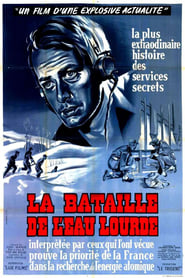
Operation Swallow: The Battle for Heavy Water
An account of real events which took place during the last world war.
The men who appear in the film are, with a few exceptions,
the same who participated in the battle:
In the past twelve months we have reported how the Allied air forces
have given the war a new face. Day and night, the German war machine is
attacked at its weakest points.
Yesterday, a squadron of 80 American Flying Fortresses made another sortie.
It dropped a bomb load of hundreds of tons on a factory in Norway,
where they work around the clock to produce a substance
the Germans believe may play a crucial role in the outcome of the war.
This is what we told you on 17 November 1943.
What we could not reveal at the time,
is that the bombardment was only a single episode
of a drama that would last for five long years.
For the Allies, the most exciting part of this battle
was fought in Norway, by 11 saboteurs from the famous Linge Company.
They parachuted onto the Hardangervidda plain,
where they struggled through snow and ice for months,
keeping England informed about the German dispositions.
This modern saga, the battle For heavy water, started in 1939,
behind the venerable facade of the Collège de France.
Here, an intense scientific undertaking took place,
led by the nuclear scientist prof. Joliot-Curie.
Science, industry and civilization will take a giant leap forward
once we are able to control uranium fission.
We still need to do a lot of research, but one day,
we will be the masters of this immense energy reserve.
A new era will begin.
It will benefit the whole world.
In the laboratory in Paris, the nuclear research runs its course.
Curie and his closest associates, prof. Halban and laboratory chief Kowarski,
are facing an important decision.
Like a fortress in steel and concrete,
the factory rises out from the middle of the mountainside.
But its production is for peaceful purposes:
Nitrogen fertilizer for agriculture.
The water is led down through the steep penstock
to one of the largest power stations in the world.
Deep down in the factory basement, another kind of production takes place.
Slowly, drop by drop, a precious liquid is made:
Heavy water.
The process is so slow that production is limited to
a few grams a day.
In Paris, Joliot-Curie reveals his plans to the Armaments Minister, Raoul Dautry.
His fear is not without reason.
In Oslo, director Aubert of Norsk Hydro
is visited by an emissary from the German government.
The Reich's government would like this business
to be completed as soon as possible.
Once again, I must regretfully decline.
We cannot meet your demands.
Like I said, we accept your terms.
It is not a question of money.
This substance is produced in such small quantities
that we simply cannot make a business transaction.
Business transaction? According to our scientists,
the heavy water can benefit all of humanity.
I do not doubt it.
And do you accept our sincere regrets?
I must say goodbye.
In Paris, Minister Dautry meets with a certain "Monsieur A".
And shortly thereafter, the secret envoy is on his way to Norway.
But German spies follow Monsieur A on his journey, and attempt to spoil the plan.
But Monsieur A arrives safely in Oslo,
and director Aubert gets a second visit in his office.
[Speaks French with a terrible Norwegian accent]
Thank you.
[Speaks French with a terrible Norwegian accent]
From the factory at Vemork, the heavy water is shipped to Oslo.
The French secret agent goes to Fornebu airport,
where his baggage is loaded into the airliner.
This is observed with great interest by two German spies,
who are watching the departure.
When this car slips into the dark, they have no idea that it is carrying
the heavy water container.
They see the Frenchman getting onto the plane.
What they do not see, is that he immediately jumps out on the other side
and sneaks over to another plane.
The airliner is starting, but the French secret agent
is now getting onto the other plane, which is carrying the precious cargo
and leaves Fornebu quite unheeded.
The old trick has succeeded once more.
Over the North Sea, the decoy plane is attacked by the Germans
and is forced to land at an airport near Hamburg.
Open it, open it!
Simply ordinary granite.
After a journey from Oslo to Edinburgh and from there to Paris,
the heavy water now rests in the basement of the Collège de France.
9 April. The German military invades Norway.
The sea appears to be burning under the blows
from the most fearsome war machine the world has ever known.
At this point there is no force that can stop it.
Black wings cover the sky.
Huge tanks roll along the narrow Norwegian roads.
Soon, the Germans march into Rjukan and occupy the factory at Vemork.
Then comes the invasion of France.
The irresistible storm surge pours into a country
where anything that grows is trampled down.
Civilians flee in endless rows.
Paris is threatened.
The heavy water containers are taken from the Collège de France...
...And are temporarily sheltered in the old prison in the town of Riom.
Meanwhile, the Germans have reached Paris,
and armored vehicles rumble along the Champs-Elysees.
Then the motorized Army continues its onslaught
through a France completely paralyzed by misfortune.
In a villa in Clermont-Ferrand, Joliot-Curie and his associates
have quickly set up a makeshift laboratory.
Once more, the heavy water is moved.
The ship manages to escape Bordeaux just before the Germans get there.
It transports the heavy water to the laboratories in England.
That is how the small original supply of the precious substance was saved.
Even though the Germans did not get a hold of the heavy water,
they now control the factory.
But their growing demands are met with tenacious resistance from within.
Five thousand kilos, sir.
Five thousand.
This year.
Impossible. For that I would need... - You will get what you need.
I need five thousand kilos.
Goodbye.
Have you got a minute?
It's about these new blueprints.
What did that guy want?
They want us to increase the heavy water production.
Do you know why?
If that's what I think, we have to inform the Allies immediately.
Well, what can they do about it?
I think Professor Tronstad should be informed.
Do you know he just arrived in London?
London. Devastated and mutilated by bombing,
the relentless and indomitable London
has become the center for all resistance in Europe.
Here, people from all occupied countries have found refuge.
One of these is the Norwegian scientist Professor Leif Tronstad.
Personally, I think sabotage is always more effective
against industrial targets than bombing.
I agree with you, Major Tronstad. If it's a small target.
Yes. In this case, the target is particularly difficult.
Look.
And here. A seven-story steel and concrete building.
And the heavy water room right at the bottom, there.
It's a bad target for bombing.
Certainly looks like a job for our new airborne troops.
Noise damned if we can't ship our gliders in there.
Yes. We've got to get at that heavy water somehow.
It'll be hard to land them close.
I'm wondering whether British troops will ever get through those mountains.
We'll send a small advance party of Norwegians.
They can prepare the landing. They can guide them right in.
Right you are, then. We'll get some airborne troops under special training.
You pick your Norwegians.
How about sending Norwegian contact men over straight away,
to keep us up to date on German movements?
Good idea. And I know just the right man.
He is a native of Rjukan who escaped to England a week ago.
At home they think I'm on a a mountain trip.
The only one who knows anything is my brother, Torstein.
No, thanks.
But it's important to be back as soon as possible.
We can drop you in tonight if the weather holds.
The difficulty is dropping you in the right place.
Oh no, it will be fine.
As long as I have a good pair of skis, I'll be home by dinner time tomorrow.
Good. So: contact Vemork, contact us.
Good luck. - Thank you.
Thus the first man, Einar Skinnarland, is dropped over Norway.
The weather is good, everything goes as scheduled, and before dark,
Einar reaches Møsvatn where his brother, Torstein, is a dam keeper at Hydro.
Magnanimity.
Generosity.
Endurance.
And Germans. Indeed!
That Hitler guy needs a good thrashing.
You'd like that, wouldn't you?
They're scared of him, you see. That's a mistake.
But if I'd been a few years younger, I would give him a piece of my mind.
Good morning, Torstein. - Good morning.
Good morning, Halvor. - Good morning.
You're here, then? - Where have you been?
Me? I've been hunting in the mountains.
Young people! Instead of doing something useful,
they lark about on skis.
You didn't get across?
Torstein? - Yes?
Do you think you can get me a job at Hydro?
I think I can get you a job at the dam.
Nice. - A job, you say?
I think my hearing's getting bad.
I thought I'd do some work for the Germans, you see.
You scoundrel. - Oh, it might not be such a bad idea.
Here you go. - Thank you.
Will you take this with you? - Yes.
At professor Tronstad's office in London,
new information on the activity at Vemork arrives every day.
Reports, micro photographs and detailed sketches
made by the factory manager, Engineer Brun,
and other members of the home front,
கருத்துகள்
No comments yet. Be the first to leave one.