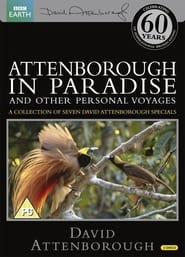
Attenborough in Paradise
ดาวน์โหลดคำบรรยายEnglish
ข้อมูลรุ่น
แท็ก
ตัวอย่างคำบรรยาย English
200 บรรทัดแรก
Australia.
This is the home of what is, for me
one of the most extraordinary of all families of birds.
They're extraordinary because they're artists -
sculptors and painters.
And the males use their creations and the treasures that they collect,
in order to impress females
in a way that is parallelled by no other kind of animal on earth.
Except for, of course, us.
These are the treasures.
Each one specially selected and all arranged with meticulous care.
And behind them, an extraordinary two-walled construction.
This is not a nest
it's an art gallery or, perhaps, a treasury.
And these are the jewels that it's been built to show off.
Bones.
Snail shells.
Pebbles.
They have one thing in common. They're all white.
Because the artist that built this has a passion for the white.
And if I retreat and have a little patience, he may well appear.
This is him - the western bowerbird.
And this is his bower. It dominates his life.
If it's sufficiently impressive, then female after female
after inspecting it, will mate with him.
Each will then go away and rear her family entirely by herself,
while he stays here, doing what he can to improve his bower's appearance,
rearranging and adding to the treasures it contains
and hoping for yet another mating.
This is a female, who's touring in the neighbourhood, seeing what's around.
How does this bower compare with others that she's seen?
He watches her closely to see what her reactions are.
Maybe he can add a little spice with a dance.
All other male birds, when displaying,
have only their bodies to show off to females.
A lyrebird uses his tail feathers.
A bird of paradise flaunts special plumes.
Coloured bald patches are effective, and inflating a throat pouch works well.
So can wattles, particularly if they are as splendid as a tragopan's.
The male cock-of-the-rock wears a cocked hat.
The King of Saxony bird of paradise bounces up and down
to show off his amazing head plumes.
Some male pheasants sprout iridescent feathers of breathtaking beauty.
All these are bodily decorations with which to impress females.
We ourselves find some of these plumes so beautiful
that we hunt the birds which grow them and use their feathers ourselves
for exactly the same purpose.
Men in New Guinea who live alongside birds of paradise,
not only use their plumes to impress women,
but bounce up and down, similarly, to display them.
Indeed, all kinds of males in all parts of the world,
have always tried to rival the peacock.
In 16th century England, few were finer, or vainer, than Henry VIII.
Prisoner's first name Thomas Cromwell...
Do you think I look like a bridegroom? Hm? Eh?
Magnificent,
I want that girl more than anything in my whole life,
And needless to say, he got her, again and again.
But most birds, unlike kings, have to grow their decorations.
Supposing, instead of showing off your body and the feathers you've grown,
you were able to impress females with the beauty of inanimate objects
that you collect, and the way you display them,
you wouldn't be encumbered with all those feather decorations
you have to carry around all the time.
And what is more, the female, when she comes to inspect your treasury,
would be impressed whether you were there or not.
And that's just what this bird does.
The tooth-billed bowerbird.
The objects he uses for display, leaves, could hardly be more unremarkable,
and his way of displaying them,
in what was perhaps the first kind of bower developed by the family,
is simple in the extreme.
It's no accident that all these leaves are pale side uppermost.
The bird clearly prefers them that way,
and I can easily prove that by turning one of them the other way up.
That's better!
And, while he's at it, there are also some bits of twigs and leaves
that some litter lout has left around the place.
That must be put right too.
But no matter how attentive and conscientious he is
he has to go off to feed sometime,
and that means leaving his treasures unattended.
And no sooner has he left than another male appears.
But this one is behaving rather differently.
He seems nervous and apprehensive.
He's a neighbour.
These leaves have come from a tree nearly a mile away.
Why fly all that distance to get more, when these are nearby?
To prevent that kind of thievery,
each male spends as much time as possible beside his court,
and when he's not working on it,
he tries to attract the attention of females by singing.
He listens to his neighbours and tries to outdo them
by mimicking the songs of other species in the neighbourhood.
A female has arrived.
Immediately, the male comes down to his display ground...
and hides.
He's only allowing her little glimpses,
as if trying to make her curious
as to where this strange clicking song of his is coming from.
She seems interested.
Now's the time to increase her curiosity, to go up a gear,
with a little fancy footwork and a gargle.
It's a somewhat alarming way of demonstrating his charms,
but it must, presumably, be the sort of thing that turns on a female.
No, not good enough! Or at any rate, not yet.
North of Australia, across a narrow arm of sea, and almost on the equator,
lies the huge, thousand-mile-long island of New Guinea.
Its thick, rain-drenched forests
were once continuous with those in tropical Australia.
So it's hardly surprising that the bowerbird family
has representatives up here too.
It's not easy country to travel in.
It rains almost every day, so everything in the forest is permanently wet.
And over great areas there are no roads, only thin tracks,
so the only way to get around is on your own two feet.
But it's a journey worth making,
for here there are species that build some of the most extraordinary bowers,
one that not only uses a toothbill's technique of decorating the ground,
but drapes the branches above as well.
In this forest where every tree is hung with moss,
you might walk straight past this bower,
unless, that is, you noticed
that there were blue berries balanced on this branch.
And then, behind you,
dried orchid stems hung round this sapling
like tinsel on a Christmas tree.
And they go ten, twelve feet up, and extend twenty feet beyond me.
And then, as you walk into the heart of this bower
really conclusive evidence of what it is.
Here, lots and lots of wing cases of beetles
and most extraordinary and conclusive of all
three of the amazing head plumes of the King of Saxony bird of paradise.
They could never have fallen like this naturally.
They must have been deliberately placed there
by the owner of this gigantic, somewhat untidy bower.
And this is the proprietor, Archbold's bowerbird
until recently, the least-known member of the whole family.
That yellow, curly crest shows that this is a male.
A beetle's wing cover is clearly out of position.
This is the female. She doesn't have that yellow crest.
Her arrival is the cue for him to display.
He seems to be playing hide and seek, like the male toothbill.
It's a way of drawing her attention to the wonders he's laid out on the ground.
When the female comes down to inspect them,
he chases her, in a ritualised way,
back and forth across the floor of the bower.
But whether he's successful or not who knows?
No ornithologist has ever seen the mating of Archbold's bowerbird.
It takes a practised eye to immediately recognise that bower,
but there's another kind in these forests that you can't possibly miss.
It's easy to imagine
how baffled early European travellers must have been
when they found something like this in the depths of the forest.
It's based around the stem of a tree fern.
These aren't tree fern roots. They're separate twigs, each individually placed.
On the end of many of them, there are pendants made of caterpillar droppings.
This is a rim round the corridor
made of impacted moss.
And on the top of it, little black objects.
They're actually fungus, but rare fungus.
It's very hard to find these if you look in the forest here.
Here's the owner MacGregor's bowerbird.
Fungus, clearly, in any well-appointed, properly tended bower,
should never be found in the runway round the base of the maypole.
Keeping the bower smart requires such continuous attention
that the male has little time for other things.
So when he goes to forage, he brings back as much food as he can carry
and stores it nearby.
That way, he doesn't have to leave the bower when he wants a snack.
His reproductive success will depend on his having, in the eyes of the females,
the most impressively ornamented bower around.
One can never have too many caterpillar droppings hanging on one's maypole.
But suspending them is not easy.
What next?
Another twig. That could go on the very top of the maypole.
We know that the females tour all the bowers in the neighbourhood,
assessing them and presumably making a choice between them.
And there must be 15 or 20 within a mile of where I'm sitting now.
So on what basis do they choose?
Well, they aren't judging as to whether the bird is going to be a good father
in the sense of helping at the nest
because these male bowerbirds have no part
in either building the nest or feeding the young.
So the females, presumably, are judging on the way that the bower has been built,
how it's been decorated
and how he dances within it.
And that means that the females mus, t have some kind of aesthetic sense
artistic sense.
The interesting thing is, in recent years,
European sculptors have also thought that there is great aesthetic power
in constructions like this.
Andy Goldsworthy is one of the most highly-regarded artists
who create what has become known as land or environmental art.
My art is unmistakably recognisable as the touch of a person,
I am not a bird, and I do not mimic the things that I see birds and animals make,
However, there are parallels to be made,
It seems undeniable that both bowerbirds and artist
find something attractive, rewarding, satisfying,
in constructions made of natural materials
Attenborough in Paradise subtitles in other languages
More English subtitles for Attenborough in Paradise
- 7of7 Amber Time Machine xvid ac3 www mvgroup org ENG · 16 downloads · 2007-10-04
- 6of7 Life On Air xvid ac3 www mvgroup org ENG · 18 downloads · 2007-10-04
- 5of7 The Song Of The Earth xvid ac3 www mvgroup org ENG · 12 downloads · 2007-10-04
- 3of7 Lost Gods Of Easter Island xvid ac3 www mvgroup org ENG · 16 downloads · 2007-10-04
- 2of7 A Blank On The Map xvid ac3 www mvgroup org ENG · 16 downloads · 2007-10-04
- 1of7 In Paradise xvid ac3 www mvgroup org ENG · 13 downloads · 2007-10-04
- -=COMPLETE=- xvid ac3 www mvgroup org ENG · 35 downloads · 2007-10-04
ความคิดเห็น
No comments yet. Be the first to leave one.