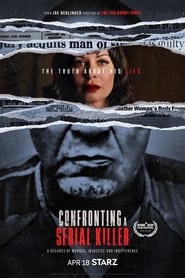
Confronting a Serial Killer
ดาวน์โหลดคำบรรยายEnglish
ข้อมูลรุ่น
แท็ก
ตัวอย่างคำบรรยาย English
200 บรรทัดแรก
His hands are around my neck.
It should've been a slam dunk.
You caught the man in the act.
This was the worst outcome
of my career.
Samuel Little never thought
that he would be convicted.
There was such a miscarriage of justice.
They failed me.
They failed every woman after me.
Because we're prostitutes, we're women,
it doesn't really matter.
So guess what.
All the deaths after me are on them.
It sickens me now
that so many women are dead:
Melinda LaPree, Patricia Mount,
Carol Alford, Audrey Nelson,
Guadalupe Apodaca, and more.
But there's two more prostitutes
that have survived Sam's attack:
Hilda Nelson and Leila McClain.
Leila McClain summed it up to a T
when she said, "Ain't nobody gonna believe
"a Black prostitute
in Pascagoula, Mississippi, in 1982."
In August of 2018,
when I interviewed Sam the first time,
he had maintained his innocence,
but by the end of our second interview,
he started confessing to me,
and he told me about 13 murders that day.
It left me, like, frozen.
I sort of
said, "Okay, call law enforcement immediately."
And so I called Mitzi Roberts, and I said,
"He's talking.
What do I do?"
And she said, "There is a lead investigator
on this now, and he is a Texas Ranger."
Ranger James Holland
was organizing a national effort
to solve these cold cases
related to Samuel Little.
So I got a call from Ranger Holland, saying:
"Hello, this is Texas Ranger James Holland,
and I hear that you have some information for me."
And I said, "Well, you know",
"can I just organize my notes? Can I"...
He's like, "No. Just read them to me.
Just give-just give it to me. What do you got?"
And as I went through them, he was like,
"Got it, go.
Next one, next one, next one, next one."
And I was just like, "Okay, I guess he knows
about these murders already."
And then I told him
about the victim in Omaha that was left in a barrel,
and then he said,
"Stop.
Say that again?"
Right.
Right.
The victim was a Native American woman.
She was in a bar,
and Sam walked in, and he said,
"Is that an Indian?
Never met a real Indian."
Her friend said, "Don't get in the car,"
but she got in the car.
Hmm.
And he strangled her there in the car
and left her naked body in this barrel.
So two days later,
Ranger James Holland calls back,
and he's like, "We got her.
We got the victim in Omaha,"
the one from my confession.
That was the information that identified her,
and it was Agatha White Buffalo.
In 1973,
the body of the 34-year-old was found
stuffed in one of these barrels
at 27th and N.
She had been strangled to death.
Her murder is no longer a cold case.
Omaha police tell me it's officially classified now
as exceptionally clear.
Initially, I wasn't trying
to solve a murder.
I just remember walking outside and saying,
you know, like, "I think maybe I just did the best thing
I've ever done in my life."
And I haven't been able to stop since.
The FBI calls Samuel Little.
America's most prolific serial killer.
If you want me to tell my secrets to you,
come down here and look me in my eye
while I do.
My deal with the devil is,
"You will not die alone if you tell me the truth."
I'm not gonna admit to those girls.
I don't believe you.
So you tell me the truth right now.
Little strangled 93 victims
between 1970 and 2005.
He was tried and got off
again and again and again.
Investigators believe
that Samuel Little killed more people
than serial killers Ted Bundy,
John Wayne Gacy, and Jeffrey Dahmer combined.
If you weren't locked up,
I'd probably be dead by now.
You're right.
These are all drawings
that Sam has sent me.
These are his murder victims.
Sam learned to draw in the Ohio State Reformatory,
where he was incarcerated
when he was 17 years old.
It's interesting to think about how you can have
the kind of close observation that art requires
and then also... the complete disregard
for human life that murder requires.
You can definitely see his art changing over time.
I guess my hope is that they're getting more
true to life,
because then they might be matched
to an unidentified victim.
You know, these are the ones I keep in my office...
As sort of references and, um, inspiration
to keep going
investigating these murders.
These are not curiosities to me.
These are lives
that were lost.
This is Audrey,
one of Sam's victims from Los Angeles.
I have a relationship with a lot of the victims,
but I most relate to Audrey
and think that that could've been me.
Audrey was really artistic.
She was, like, a very loud, bright personality,
and so when I want
kind of creative motivation or inspiration,
I'll talk to Audrey.
This is a victim of Sam's
that is still unidentified.
He often draws petechial hemorrhaging
in their eyes,
which is
what happens when you're strangled,
broken blood vessels in your eyes.
I write a lot from the victims' perspectives,
which I feel is taking a lot of license,
and I wanna be very mindful of that.
I really try to
ask their permission.
And I ask,
"Can I tell your story,
and will you help me?"
What I like to imagine
is that Sam is no longer
the only person
who witnessed those moments.
I don't want them to...
Just have been alone with a monster, you know?
This is one of his favorite victims.
I don't think he even knows
why certain victims stay with him more than others,
or he-he goes over and over and over them
again in his mind
while he's lying there in his cell.
This reads, "Sam kill me but he knows I love him.
Ms. Sam."
And then this reads,
"Your sister Jillian.
My dream. Mr. Sam."
There's very little that does not creep me out
about any of this.
Yeah, he believes
that I'm
basically one of his victims,
like I'm a living, breathing victim,
but essentially, I belong to him.
He possesses me
the same way that he feels,
uh, about his victims,
and, um, that we're all gonna be together again
in heaven.
You feel that God has forgiven you?
Right.
Jesus.
How did I get the ear of a serial killer?
I listened to him.
I told him I cared.
I told him I wouldn't judge him.
I told him I wouldn't leave him.
I said, "Give it to me straight",
Confronting a Serial Killer subtitles in other languages
More English subtitles for Confronting a Serial Killer
- Confronting A Serial Killer S01 NORDiC 1080p WEB H264-EGEN · 12 downloads · 2023-04-25
- Confronting A Serial Killer S01 NORDiC 1080p WEB H264-EGEN · 17 downloads · 2023-04-25
- Confronting A Serial Killer S01E05 720p WEB H264-WHOSNEXT · 17 downloads · 2021-05-17
- confronting a serial killer s01e05 1080p web h264-whosnext · 15 downloads · 2021-05-17
- confronting a serial killer s01e04 1080p web h264-whosnext · 14 downloads · 2021-05-10
- Confronting A Serial Killer S01E04 720p WEB H264-WHOSNEXT · 20 downloads · 2021-05-09
- Confronting a Serial Killer S01E03 Behold The Monster 1080p AMZN WEB-DL DDP 5 1 H 264-FLUX · 14 downloads · 2021-05-03
- Confronting a Serial Killer S01E02 WEBRip x264-ION10 · 12 downloads · 2021-04-30
ความคิดเห็น
No comments yet. Be the first to leave one.