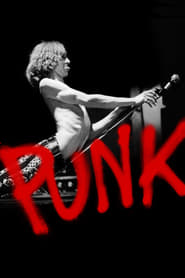
Punk
ดาวน์โหลดคำบรรยายEnglish
ข้อมูลรุ่น
แท็ก
ตัวอย่างคำบรรยาย English
200 บรรทัดแรก
Previously on Punk...
"Hey, man!" Pow!
They just started calling it hardcore.
"Who could name a band such a thing?"
"Bang-atta-bang-atta- bang-atta!
Ba-bah! Blap-bang!"
Boom! Boom! Boom! Boom! Boom!
What the fuck?
"Man, I think I love punk rock."
Pow! Pow!
We were like, "Taxi!"
Punk rock was never a career choice.
It just wasn't.
You were in it for the music,
and drinking beer with your friends,
and talking conspiracy theories, or whatever.
It was never something
where, like, "Oh, if we do this and this,
then we're going to get signed,
and then we're going to get the big house, and the cars,
and the chicks."
But we very much wanted to be in the mainstream.
We wanted to infiltrate the masses,
we wanted to be on MTV,
we wanted to be on the radio.
Well, there's more people to hear what you have to say,
provided you have anything to say.
But being a rock star was like a four-letter word, you know?
It was, like, you got called a rock star,
it could've been, like,
the biggest insult of your entire life.
But, you know, sometimes
things that are actually really good go mainstream.
: My feeling is that punk was a gift,
and that if you receive the gift,
and you take care of the gift,
and you give it to somebody,
it replicates, and you have another one,
then you can give it to somebody else, right?
At some point, some people receive that gift,
and when they polish it, they think, "Oh, I can sell it,"
but when you sell it, it's fuckin' gone.
The thing about being in a band in the early '80s
and the mid-'80s is there wasn't...
there was no hope of ever being successful,
because all that was on MTV was hair metal,
which is so terrible,
and then these '80s bands
singing stupid songs about dinosaurs,
and dragons, and...
and, uh, how many ways there are to rock,
and who can you salute for rocking.
So there's no way we're going to make a living,
which is why so many bands broke up in the '80s,
and NOFX, luckily, uh...
we're alcoholics, and we like touring,
so we just stayed together, 'cause touring is fun.
What else are you going to do?
I was working a 9-to-5 job at a media company,
wearing a suit and tie,
and then at night I would go play these shows,
and, like, hardcore punk shows,
and one time I came in with a broken nose,
and everyone at the place thought that I got a nose job.
: I was a janitor
at the high school that we all went to,
and I realized that was a dead-end job,
so I got a job as a...
as a head custodian at an elementary school,
you know, where I got to wear a bigger badge,
and make more important decisions.
I was still a janitor
when we did our first two cross-country tours,
and our first tour of Europe, really, in support of...
supporting NOFX over there.
I was about to quit NOFX.
We did our first European tour in 1988.
That's before we got good,
because we were really, really terrible,
so bad that halfway through our European tour,
we switched slots with the opening band,
and they started headlining.
This is true.
But the last night of our tour,
we played with Fugazi in Amsterdam,
and this girl from the Yeastie Girls
played me Bad Religion "Suffer."
"Suffer" changed NOFX.
That's when I remembered,
"Wow, punk rock is so good.
Why are we playing hardcore?
Why are we yelling,
when we could write good songs, and sing,
and use words that are big?"
And so you have melodic harmonies,
five-dollar words
you end up looking in the dictionary,
saying, you know, "What the hell did I just hear?"
I mean, I think to this day,
that record stands up
as some of the best lyrics out there,
and it just inspired us,
and all of us got together and said, you know,
"Let's start a band.
We want to do the same thing as Bad Religion."
Thank you. Thank you very much.
: I think the unique thing about "Suffer"
is how melodic it was, and...
"Suffer" sounded really good,
because I had been a full-time recording engineer.
I had run an indie label.
It's almost like I went to, you know, music boot camp
and learned every possible aspect.
I must have done 10,000 hours of recording.
I mean, I was eating, drinking, breathing recording.
If you had a band in L.A., I would record you.
For 200 bucks, I'd make you a record,
and I'd make it in 48 hours and not sleep.
That was my life,
and I always thought that our first records
sounded crap.
So I thought,
"Well, it'll be fun to write a new record,
but it would be really fun to record a new record,
because I can make us sound good," you know?
I always thought that those major-label punk bands
always sounded so great,
and the L.A. hardcore bands
always sounded so shite, you know,
because nobody could afford to record anything, you know,
but "Suffer" was like a calling card,
and many of the punk bands that were happening at the time
came to me
because they wanted that Westbeach sound,
and if they were good,
I would say, "Hey, can I put out your record on Epitaph?"
And so I signed NOFX,
I signed the Offspring,
I signed Pennywise, I signed Rancid,
and I literally didn't sign anybody in between.
Those were all the bands I signed,
but at the time,
and a lot of people watching this show
might not realize it,
it was hard to find punk rock...
...but, you know, one time
I was sitting in my little office at Epitaph
on Santa Monica Boulevard,
and I get a phone call,
and the guy on the other end says, "Hey, is this Epitaph?
This is Kelly Slater.
I'm a surfer, and I make videos."
: I think the whole skate/surf scene
was something that
a certain brand of individual got interested in,
and that being,
I guess, a delinquent.
The straight kids played baseball,
and basketball, and football.
The guy who wanted to jump on his skateboard
and fly down the hill at death-defying speeds,
or paddle out when the waves were huge,
that's a different brand of individual.
So you're not going to listen to classical music
or Fleetwood Mac.
You're going to listen to Bad Brains
and some music that's going to get your blood pumping.
: So I started providing music for free
to the producers of skate and surf videos.
"All I want you to do
is put on the screen the name of the song
and the name of the group,"
and, you know, they'd be skating to NOFX,
or they'd be skating to Rancid, right,
or surfing to Bad Religion,
and suddenly, you know,
it became the thing to listen to if you were a skate kid.
So punk was really starting to grow,
yet it was still invisible.
On the other hand,
grunge was on everybody's radar.
: Before everything became so interconnected,
there was such a thing as regional sound.
There was a D.C. sound,
there was a Boston thing,
there was a New York thing,
and I think
that had to do with some kind of isolation,
you know, which...
I don't think anything's isolated anymore,
but, of all places, Seattle was very isolated.
It was just so fucking far away.
Say you're in a punk rock band, and you're on tour,
and you've got to get from Minneapolis
to San Francisco,
you're not going to fuckin' go around the horn
up the Pacific Northwest.
You don't have the money, you don't have the time,
you know, so you skip it,
and in that, I think that Seattle wound up
More English subtitles for Punk
- Punk S01E04 WEBRip x264-ION10 · 45 downloads · 2022-07-13
- Punk S01E03 WEBRip x264-ION10 · 45 downloads · 2022-07-13
- Punk S01E03 WEBRip x264-ION10 · 45 downloads · 2022-07-13
- Punk S01E02 WEBRip x264-ION10 · 43 downloads · 2022-07-13
- Punk S01E02 WEBRip x264-ION10 · 51 downloads · 2022-07-13
- Punk S01E01 WEBRip x264-ION10 · 51 downloads · 2022-07-13
- Punk S01E01 WEBRip x264-ION10 · 61 downloads · 2022-07-13
ความคิดเห็น
No comments yet. Be the first to leave one.