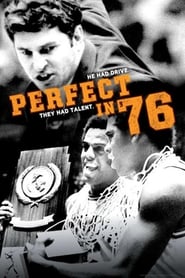
Perfect in '76
ดาวน์โหลดคำบรรยายEnglish
ข้อมูลรุ่น
แท็ก
ตัวอย่างคำบรรยาย English
200 บรรทัดแรก
*
>> (Narrator) For most people, most of the time,
even the very thought of perfection can be a trap.
Despite plans, preparation and practice,
it's simply an unrealistic goal.
But the Indiana coach was not like most people,
and the 1976 Hoosiers were not an ordinary team.
They demanded the most of each other,
and they had the capacity to fulfill the highest
of expectations.
His.
Something their coach made perfectly clear on the
first day of the 1976 season:
>> Your goal is not winning the Big Ten Championship,
not winning the National Championship,
but going through the entire season,
from first game
to NCAA Championship game undefeated.
*
>> Bob Knight once said that basketball might have been
invented in Massachusetts, but it was made for Indiana.
So much so that it would be hard for any place and any sport
anywhere in the United States to be more connected
than Indiana and College Basketball.
The undeniable truth is that basketball simply
means more in Indiana.
>> In the small towns and the farms that dot the state,
folks are born into the game,
and are weaned on the Hoosiers.
It's a personal and imminent love affair that goes back to
the days of IU's first two national championships,
1940 and 1953.
>> But it would take another 23 years,
and one magical team for Indiana to again be
crowned champions,
a summit they were nowhere near in the mid-60s.
>> Indiana wasn't winning, the bottom kind of dropped out,
there was a 5 year period when Indiana was last in
The Big Ten 4 years.
>> The talent wasn't there, the coaching,
quite frankly, wasn't there.
They had one year where they won the Big Ten championship,
but I was here from 1966 to 1970
and the cultural change was such that
competitive sports were not at the forefront of
the new generation.
>> When I entered the university in 1969 as a freshman,
a time of turmoil, a time of controversy.
Spring of 1970 was the Cambodian Incursion,
and bombing that led to protest on campus.
Somewhere around 10,000 to 12,000 people in Dunn Meadow.
We were averaging about 2,000 to 3,000 spectators
in the old field house.
That was not a good way to pay bills.
>> Tired of mediocrity, in the spring of 1971
Indiana handed the ball to Bob Knight,
an impressive but demanding 30 year old
coach from Army who immediately showed
why he was called "The General".
>> When I went to Indiana, the first day I was there
I wanted each player in my office that day,
and so I just wanted them to know what they could
expect and what I expected.
>> I walked in to shake his hand,
welcome him here, and he said
"Steve, I want you to figure out where you want
to transfer to when you leave Indiana."
I said "What do you mean, Coach?
I'm not - I'm your center!
I'm the best player you got here",
I'm thinking this, you know.
He said "No, I've looked at your grades and you're just
doing C work, you're doing just enough to get by,
and if you're that way in the classroom,
you'll be that way as a basketball player
and I can't use anybody like that."
I ended up with a 3.0 point average
because I really thought that he would make me
leave if in fact my grades didn't improve.
We were a loose bunch, I mean, nobody was used to
running 4 miles a day, doing all these things
that he asked us to do in practice, I mean,
two and a half hour workouts and,
I mean, he punished us.
All he did was holler at us the whole time.
I did not really like Coach Knight
to be honest with you (laughs)
I've never seen him smile.
>> The practice was open for anybody who
wanted to come and watch you practice,
and when Coach Knight came that was all over.
>> A lot of people were upset about that 'cause they
had cages, a wire cage is what it was,
I mean, that separated the floor from the tunnel,
and he had a sign "Closed Practice",
and they'd stand there, "What is this?"
you know, and if that didn't leave,
they sent a manager over there to make them get out.
>> "There ain't gonna be any open practices",
I said, "we're gonna practice, and we're gonna practice,
and we're gonna work at getting better.
They can come watch us play on Saturday."
I didn't particularly like the way they played,
they were used to running and shooting a lot and I've
always felt that you have a lot better
chance with good defense and Indiana didn't have that.
I learned an awful lot about the returns
for good defensive play when I was at West Point.
*
>> I'll treasure that my entire life.
>> It was a perfect place for a history major to go,
and he was quite absorbent of that atmosphere.
Traditions, all the things that West Point stood for.
You look at Bob's 6 years there, and they
stand out by themselves in Army history.
He was 102-50 there, nobody has done that,
nobody has had a sustained period like that,
and always the leaders are the team defense.
>> Here comes this guy from Army,
I was his first recruit back in '71,
and one of the first books I got after signing was
a Devil on the cover, "How To Play defense",
another one was a guy on a ladder putting a ball through
a hoop and saying "we gotta get a good shot",
and I go "Oh my gosh, what did I get into?",
'cause I was a run and gun kind of kid.
>> That's the way you were gonna play,
and if you don't want to play that way,
then you're gonna have your ass on the bench,
or you may transfer.
>> He's someone who forged his own path
and did things his own way,
and if people liked it and got onboard,
that's fine, if they didn't, he could care less,
but one thing trumps everything else,
and that's winning, and people got behind him
when he started to win, and win impressively.
>> In December of 1971, Digger Phelps was a
first year coach at Notre Dame,
Bob Knight's a first year coach at Indiana,
and Indiana won the game, believe it or not, 94-29.
They just crushed Notre Dame.
>> Knight's disciplined defense first approach might have
seemed foreign to Hoosiers fans, but it clearly worked.
In just his second season, Indiana marched all the way to
the 1973 Final Four.
>> This is the worst defense we've played all year,
you're letting them do anything they wanna do.
Let's play some basketball.
>> But in the National Semi-Finals,
the Hoosiers were beaten by Bill Walton's UCLA,
the eventual National Champions.
Almost overnight, the culture had changed in Bloomington,
thanks to players like Quinn Buckner,
who was the starting point-guard as a freshman
on the 1973 Final Four team.
Just a year after he chose Indiana over several other
high-profile schools.
>> He had a recruiting trip here,
and I was in the car with him, we were driving around,
I said "Well Quinn, where else are you thinking of going?"
he said "I'm thinking of going to UCLA and Michigan",
and he's riffing off all these schools like
"Wow, this guy's really, really up there",
I mean, I just barely got into Indiana and this guy is,
you know, he can go anywhere he wants.
>> He came to Indiana largely because
his father had played football here.
>> My dad was 5'10 and 280 lbs.
He said "Sign this, boy, you're going to Indiana".
He said, "You can go to UCLA and win a championship
and be one of many", he said, "you can go to Indiana
and win a championship and you'd be one of very few".
>> In addition to basketball, Buckner also played football,
starting all 10 games as a freshman.
But midway through his sophomore season,
he began to rethink his decision to try both sports.
>> My sophomore year I got hit so hard
I could feel it today,
and I'm pretty sure it was Ohio state.
>> Scott May used to come to games and watch me play,
and said "Quinn, you need to get off the football field".
>> They used to get killed at football.
I don't know if the two years that he played that they
won half their games, it was that bad.
>> We used to talk about it quite a bit,
back in the dorm or at dinner, whatever,
and I was like "Man, maybe you oughta quit,
maybe you oughta concentrate on basketball,
we need you, we're trying to win
the National Championship."
>> I just told him one day, I said
"Here's what we're gonna do:
I'm going to release a statement.
You're going to have to give up football to play basketball,
that we need you as a full-time basketball player,
then that way if anybody's irritated
they can be irritated with me,
and so that worked out very well.
>> Knight was not one for fooling around.
ความคิดเห็น
No comments yet. Be the first to leave one.