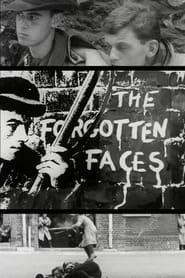
The Forgotten Faces
ดาวน์โหลดคำบรรยายEnglish
ตัวอย่างคำบรรยาย English
102 บรรทัดแรก
Michael Daniel Kale, aged 17.
Dead in the gutter of Kálmán József street,
Budapest, Hungary.
The date is Monday, October 29th, 1956.
It is morning, a harsh morning.
Everywhere can be seen the scars of revolution.
Because for six days,
Budapest has been agonized by an armed revolt against its communist government.
It was begun, as so many revolutions are begun, by students.
These are their faces.
It was their ultimatum to the government on October 23rd,
which set in motion the gear wheels of revolution.
They are the faces of embryo technicians,
lawyers, artists and teachers,
all fevered with the social discontent of their time.
A discontent which has spread itself from the most advanced of students,
to the most junior of school boys.
From their secret and forbidden meeting places,
the revolution has brought the students and the workers,
out onto the open of the streets of Budapest.
Joined by soldiers and other civilians,
and armed with a few sub-machine guns, grenades and ancient rifles,
and bearing their national flags and emblems,
they march in procession to defy the Hungarian government,
and the Russian tanks it has called in to suppress them.
On this morning, October 29th,
such a procession passes up our Kálmán József street.
Their purpose, demonstration.
The objective, Parliament square in the centre of the city.
But they are never to get there.
For suddenly the crowd is fired upon
by police snipers and machine gunners on the roof of a nearby barracks.
In a few moments, many of the marchers are lying dead on the ground below.
But the crowd finally manage to fight their way into the building.
Then for a brief moment, the oppressed become the oppressors
as the crowd take their revenge on the uniformed men inside.
The dividing line between murder
and justifiable execution is difficult to find.
And in the fury of the moment, no one looks for it.
Those freedom fighters who died have been moved further down the street
and lie flag-covered in the dust.
Around them, the everyday life of Budapest starts again.
The grocery rounds-man, whose van has been smashed by a Russian tank,
plods his way from house to house with his bicycle,
his tyres slashed to ribbons by the broken glass in the road.
Here is one of the dead, a schoolboy.
He will be buried in an improvised plot in the nearby park.
One of the men goes off to find the boy's family to tell them of his death.
They must come and identify the body.
The boy's name was Michael Vela Imredi aged 18 years and three months.
Eight minutes ago, he had tried to throw a grenade
through one of the police barrack windows.
He had missed. Some of his friends had laughed at him.
Then a bullet from a police sniper had hit him in the back and killed him.
The man on the left is Tamás Varasi, a primary school teacher, aged 37.
A reserved and quiet man.
He only openly joined in the revolution the day before this.
Because, as he said,
"loan no longer sit still and do nothing,"
"when my friends are being killed in the streets outside my home."
Now he is actively organizing a local first-aid post.
Kálmán József street lies in an industrial suburb called Ujpest,
which like the entire capital has taken on the appearance of a wartime Hungary.
The one small thing that Tamás can find time to do for the Imredi family
is to send one of the young boys who knew him at school to take them home.
The first-aid post is in the cellar at the rear of this ruined house.
It is packed with the wounded from many neighbouring streets.
The conditions down there are not good.
The walls are running with water from the nearby river
and there is an acute shortage of dressings.
Only the very seriously wounded can be moved across to the hospital,
which is two blocks away across a road junction
still under heavy shellfire.
The name of this girl is Margit Zeke.
Aged 33, she is the fiancée of Tamás.
A journalist, she tries to find time between helping him with the post,
to finish a series of articles she is writing
for one of the revolutionary newspapers.
These two have both been on their feet all through the night,
working in the cramped confines of the cellar dressing the wounded.
This little boy seated in the rubble is called Robert Fodor.
His nickname is Roby and he's aged 12.
This is his sister, Zsuzsa, who is 17.
Their father was killed the day before yesterday in the street fighting.
They both saw it happen.
Zsuzsa has tried to be practical and put the tragedy out of her mind.
But young Roby can't and won't let anyone do anything for him.
Not even his sister. And that doesn't help her very much.
This very noisy young man's name is Ernó Szigeti,
a garage hand from Kobanya.
He's trying to get everyone to listen as he tries to persuade Margit Zeke
to read the latest article of hers recently published
in the revolutionary literary gazette.
At first she doesn't want to, but soon she realizes that she has no choice.
Everyone wants to hear the words of freedom she's written.
And for the moment all else is forgotten as they listen to them.
On these faces, as each tragedy is relived and talked about,
can be seen a vivid cross section of the shifting moods of a revolution.
Gentleness and hatred, fervour and grief.
And in these varying expressions and on the faces that reflect them,
can thus be seen the whole enigma of the Hungarian people.
A highly strung and volatile nation,
ความคิดเห็น
No comments yet. Be the first to leave one.