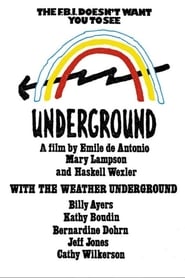
Underground
ดาวน์โหลดคำบรรยายEnglish
ข้อมูลรุ่น
แท็ก
ตัวอย่างคำบรรยาย English
200 บรรทัดแรก
We're five people
from the Weather Underground Organization
We're in a house...
it... you could call it a safe house.
We're here with a group of filmmakers
and together, we're gonna make a film.
We're underground in this country.
We've been underground for five years.
Those of us here today are fugitives.
We've been asked to come here by our organization
to speak for the organization.
My name is Jeff Jones.
And around the table is Kathy Boudin,
Cathy Wilkerson,
Bernardine Dohrn,
and Billy Ayers.
You could say that this screen, that's between us,
is a result of the war in Vietnam,
or is a result of racism in this society.
It's, it's, it's an act, it's an important act,
to overcome this, this barrier.
And we're gonna try to...
reach through it, talk through it.
* There's a new world comin'
* And it's just around The bend *
* There's a new world comin'
* This one's comin' to an end
* There's a new voice callin'
* And you can hear it If you try *
* And its growin' stronger
* With every day That passes by *
You know, the reason why we're underground
is that...
we believe that we have to overthrow...
US imperialism.
And replace it with a different society.
And that's why we're underground,
because it's gonna take a long fight.
And the reason it's gonna take a fight
is 'cause they're gonna make it be a fight
We, we want to make a revolution.
We think there has to be a revolution.
Many people think that we went underground
because we had to go underground,
because we were fugitives and there's some truth in that.
But we also went underground because we believe in the,
in the necessity for building it underground.
This was a move that was offensive,
that wasn't simply a defensive move.
And we feel like this is a very important thing to say,
because...
Because most people think of underground as being...
Like being forced to hide.
We're forced underground, hiding and we're...
-And constantly on the run. - Exactly.
You know, they're after you, so that's why you went under...
You know, we think of building
an underground organization,
building an underground movement,
in that way,
we don't think of it as a particularly defensive action.
We think of it as a base to study,
a base to think, a base to survive,
a base from which to fight.
Not just in the early stages
where the fighting is small and selective,
but along the way as it develops and grows,
and as the fight becomes...
a really massive...
social upheaval.
We're a group of people
who are committed to each other on a certain level.
We're committed to study, studying with each other,
to arguing about what's right and what's wrong,
about deciding as a whole what to do,
and then going forward, and carrying it out.
That's the only way we can find out whether or not we've...
what we've decided is right or wrong.
And in that... that's, that's the contribution
that we have to make and that the, uh...
that the revolutionary movement as a whole has to make
to the people in this country.
We all were produced by massive social situations
Um, our revolutionary consciousness was a result of
growing up in the age of the atomic bomb,
by growing up in the '60s.
We are who we are because Malcolm X...
was around teaching, or Rap Brown.
Um, we're trying to draw out our own particularity
and yet we feel completely tied into the particularity
of all these other struggles.
That's the kind of web we're trying to spin.
My name is Cathy Wilkerson.
My political history began in 1962.
I went to a, a dem... a picket line outside
Woolworth's in Cambridge, Maryland,
and heard Gloria Richardson speak.
And for me, that was the beginning
of realizing there was a struggle going on that had...
um, deep importance for everybody's life.
Um, and including mine.
Uh, but I was still somewhat of a spectator until '64
when I went on a picket line against segregated schools
in Chester, Pennsylvania.
And was arrested for the first time
and found out that even the jails were segregated.
I say violence is necessary.
Violence is a part of America's culture.
It is as American as cherry pie.
Americans taught the black people to be violent.
We will use that violence
to rid ourselves of oppression if necessary.
We will be free by any means necessary.
I remember, really distinctly,
the day that I walked down a hall at school
and there was a, a poster on the bulletin board
and it was a leaflet that had been put out
by a, a black community group in Chester, Pennsylvania,
that was fighting for integrating the schools.
The word around was that people were gonna be arrested.
And I remember standing and staring at that leaflet,
and knowing, absolutely, that this was the time
when I had to make a decision in my life.
If I got arrested, I knew what the consequences were.
I knew in terms of everything I had been programmed to do
for the rest of my life.
I hope I haven't put anybody on the spot.
I'm not intending to try and stir you up
and make you do something
that you wouldn't have done anyway.
I pray that God will bless you in everything that you do.
I pray that you will grow intellectually,
so that you can understand the problems of the world
and where you fit into, in that world picture.
And I pray that all the fear that has ever been in your heart
will be taken out.
And when you look, when you look at that man,
if you know he's nothing but a coward,
you won't fear him.
If he wasn't a coward, he wouldn't gang up on us.
He wouldn't need to sneak around here.
This is how they function.
They function in mobs, that's a coward.
They put on a sheet, so you won't know who they are,
that's a coward.
The time will come when that sheet will be ripped off.
If the federal government doesn't take it off,
we'll take it off.
Thank you.
My name is Bernardine Dohrn.
One of the first, um, political things
I remember growing up,
is watching the Army-McCarthy hearings
on television.
Watching my mother ironing day after day
and watching these hearings.
My parents were Midwest Republicans.
They voted for Joe McCarthy
and it wasn't until eight years later
um, that these ideas began to be really challenged for me.
But I knew that taking the first step
would change my life.
And I hesitated for a long time.
The first demonstration I took part in
was an anti-US demonstration.
And then increasingly,
I became involved in organizing work in Chicago
and joined the open housing drives
for equal housing rights
that took place on the west side of Chicago in 1966.
- -
We're gonna march with the force of our souls.
Mobilize bodies in concern for justice.
And somehow, we're gonna step out here tomorrow,
and we're gonna take the ammunition of determination.
We're gonna move out with the weapons of courage.
We're gonna put on the breastplate of righteousness
and the whole armor of God,
and we're gonna march over this city!
-And this is it. -
Black people of Chicago demonstrated
day after day and weekend after weekend...
Go home, you niggers!
...by marching into neighborhoods
that they were not allowed to live in all over Chicago.
And what they elicited from these marches
was the kind of blatant, open, violent racism
that you see today in Boston
and any city in the United States.
And, uh, by this time, I was a law student
and I joined the National Lawyers Guild.
At the height of the student movement,
I joined SDS.
This was long after I was a student myself.
I was elected national officer of SDS
and had the opportunity of meeting
with the Vietnamese and the Cubans.
This experience in particular...
made me a full-time revolutionary
and really changed my own idea of myself
ความคิดเห็น
No comments yet. Be the first to leave one.