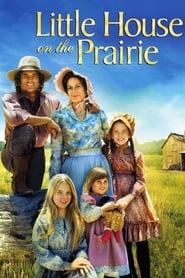
Little House on the Prairie
ดาวน์โหลดคำบรรยายEnglish
ข้อมูลรุ่น
แท็ก
ตัวอย่างคำบรรยาย English
200 บรรทัดแรก
Laura Ingalls Wilder: Prairie to Page
has been made possible in part by a major grant
from the National Endowment for the Humanities,
Bringing you the stories that define us.
Support also provided by the following.
Young woman:"Once upon a time, 60 years ago,
a little girl lived in the big woods of Wisconsin
in a little gray house made of logs.
The great dark trees of the big woods stood all around the house
and beyond them were other trees and beyond them more trees.
"There were no people."
Narrator: When Laura Ingalls Wilder
told the stories of her childhood,
millions of young readers were spellbound.
For teachers, the "Little House" books were a perfect primer
on the settling of America,
written by someone who was there.
Harper: "I realized that I had seen and lived it all..."
All the successive phases of the frontier...
first the frontiersman,
then the pioneer, then the farmers, and the towns.
And then I understood that in my own life
"I represented a whole period of American history."
Anderson: Laura Ingalls Wilder
is the quintessential American pioneer.
Thousands of people had very similar experiences
as Wilder and her family.
But her storytelling made that an adventure story.
Young woman: "Pa and Ma were still and silent on the wagon seat",
and Mary and Laura were quiet, too.
But Laura felt all excited inside.
You never know what will happen next,
nor where you'll be tomorrow,
"when you are traveling in a covered wagon."
Fraser: She's almost like a folk artist.
The novels as she left them are almost works of folk art
that capture the attitudes of the time.
Narrator: After more than 30 million copies sold,
and a long-running TV show...
Laura: Home is the nicest word there is.
Pa: One of the nicest, that's for sure.
Narrator: The "Little House" books
are a part of the American fabric, and so is the woman
who based them on her extraordinary childhood.
Anderson: We have the image
of this wonderful, white-haired, pretty lady
telling America's kids all these great stories.
That became an urban legend.
Narrator: To her readers, Wilder's novels
were a wondrous achievement from a humble farm woman
who seemed to have perfected her craft all on her own.
They had no idea the books emerged
from a hidden collaboration with her daughter, Rose.
Fraser: Rose's role in this is not to be dismissed.
Anderson: Friends of hers ask her,
"What did you have to do with your mother's books?"
And she cut them off very sharply.
It was a deep, dark secret.
Hill: I think all good writers are mysterious in some way.
What was real and what was not real in their lives?
Fraser: They're wonderful family stories.
They show us who we want to think we are.
We want to think that we're self-reliant pioneers.
We want to think that that's the truth about ourselves.
But when you examine that fantasy, you realize
that the reality was much, much, much more complicated.
Sarah: There are two Lauras.
There's Laura of the book,
and there's Mrs. Wilder,
who used to be Laura.
Harper: "All I have told is the truth
but not the whole truth."
Fiery: "Mrs. Laura I. Wilder",
Rocky Ridge, Mansfield, Missouri.
Dear Mrs. Wilder,
I like the material you have used.
It covers a period in American history
about which very little has been written,
"and almost nothing for boys and girls."
Narrator: The news from a New York editor was unexpected.
And at 64, Laura Ingalls Wilder
was on her way to becoming a children's author.
The manuscript, "When Grandma Was a Little Girl,"
was spun out of a memoir Wilder had written
called "Pioneer Girl."
It showed promise, but it needed more work.
Fiery: "Would you be willing to make some editorial changes"
on your manuscript?
The more details you can include
about the everyday life of the pioneers,
such as the making of the bullets,
what they eat and wear, et cetera,
the more vivid an appeal
"it will make to children's imaginations."
Narrator: "When Grandma Was a Little Girl"
turned into "Little House in the Big Woods,"
and that turned into something else entirely.
Harper: "When to my surprise the book made such a success
and children all over the U.S.
wrote to me begging for more stories,
I began to think what a wonderful childhood I had had."
Narrator: So began the "Little House" series...
Wilder's eight books about growing up and moving West.
Running through them all, she later said,
were her parents' values.
"When possible, they turned the bad into good.
When not possible, they endured."
Harper: "Sister Mary and I loved Pa's stories best.
We never forgot them, and I have always thought
that they were just too good to be altogether lost."
Narrator: And when Wilder preserved her father's stories,
she made him a mythic figure... Always looking West.
Her readers would come to know Charles Ingalls as Pa,
just as she did.
Charles Ingalls was born in Western New York in 1836,
one of nine children.
Fraser: Charles Ingalls came from a family
of not great means and some insecurity himself.
He was born in Cuba, New York.
His father didn't have his own land,
is working as some kind of laborer.
Narrator: Mottos and slogans of the day
said, "Go West, young man, and grow up with the country,"
and the Ingalls family did just that, heading out to Illinois.
Fraser: This is for sure Charles Ingalls' first exposure
to the prairies.
This may be the time in his life
when he is exposed to music.
Maybe gets his fiddle in this town or crossroads in Illinois.
Narrator: But for all the opportunity advertised,
the family never found it.
They eventually moved on to Wisconsin.
Fraser: There's not a lot of stability in... in this family.
They're working. They're trying to make a living.
They're not really succeeding for any length of time.
They can't really put together enough of a stake to last,
and so that's Charles' youth.
And he will basically hew to that pattern
for most of the rest of his life.
Narrator: In Wisconsin, Charles Ingalls' family
befriends the Quiners who live across the Oconomowoc River.
Charles courts Caroline Quiner, and they marry in 1860.
Harper: "Mother was descended from an old Scotch family"
and inherited the Scotch thriftiness
which helped with the livelihood.
Although born and raised on the frontier,
she was an educated and cultured woman.
She was very quiet and gentle, but proud and particular
"in all manners of good breeding."
Hill: Their personalities were very, very different.
Caroline was more quiet and reserved.
Charles Ingalls was more outgoing,
a poet, a hunter, a musician.
That's how Laura Ingalls Wilder came to think of her father.
Wilder: Pa holds his fiddle,
and he nearly always sat in his chair when he played
and kept time to the music by patting his foot on the floor.
Hill: He was the more romantic of the two, I think.
But they had a very solid, very happy marriage.
Harper: "The spirit of the frontier"
was one of humor and cheerfulness
no matter what happened,
whether the joke was on oneself or on the other fellow.
Strangers coming West possessed or acquired that spirit
if they survived as Westerners.
My parents possessed this frontier spirit
"to a marked degree."
Narrator: Charles and Caroline's early years together
were marked by the Civil War.
But another war hit closer to their Wisconsin home.
Fraser: The incident that is mentioned
in "Little House on the Prairie,"
the U.S. Dakota war of 1862,
happened five years before Laura was born.
Beane: The Dakota War took place
because of a number of broken treaties,
broken promises between this government and Dakota people.
The people who did fight in the war
were fighting to protect the rights of our families
to remain in our homeland and to remain Dakota.
And they were very, very violent battles that took place.
And the media coverage that happened during that era
was media coverage that was trying to incite fear in people.
Fraser: The Ingalls would've known all about that because
they were living just across the Mississippi in Wisconsin.
Wisconsin as a state was...
was scared spit less,
because the refugees came flooding back
across the river into Wisconsin.
So all the Wisconsinites thought that they were next,
you know, that they were going to be attacked.
White women at that time did feel great fear
of Indians.
And, you know, Wilder, years later,
I think she was rem... Remembering the fear
that her mother must have expressed
and the racism that her mother clearly felt.
Narrator: 1862 also brought the Homestead Act.
In exchange for a small filing fee, men and women,
freed slaves and immigrants,
Little House on the Prairie subtitles in other languages
More English subtitles for Little House on the Prairie
- Little House on the Prairie, SEASON 9, 1080p [23 976 FPS] · 179 downloads · 2026-06-25
- Little House on the Prairie, SEASON 8, 1080p [23 976 FPS] · 185 downloads · 2026-06-25
- Little House on the Prairie, SEASON 7, 1080p [23 976 FPS] · 167 downloads · 2026-06-25
- Little House on the Prairie, SEASON 6, 1080p [23 976 FPS] · 86 downloads · 2026-06-25
- Little House on the Prairie, SEASON 5, 1080p [23 976 FPS] · 141 downloads · 2026-06-25
- Little House on the Prairie, SEASON 4, 1080p [23 976 FPS] · 121 downloads · 2026-06-25
- Little House on the Prairie, SEASON 3, 1080p [23 976 FPS] · 123 downloads · 2026-06-25
- 01 Pilot en [23 976 FPS] · 29 downloads · 2026-06-25
ความคิดเห็น
No comments yet. Be the first to leave one.