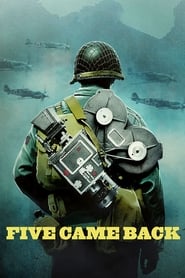
Five Came Back
ดาวน์โหลดคำบรรยายEnglish
ตัวอย่างคำบรรยาย English
200 บรรทัดแรก
When the five filmmakers got to Washington D.C.,
they were thought of as mythmakers.
They were making Hollywood movies. They were making stuff up.
This was the real world, folks. This was the real war.
And now we've got these Hollywood guys coming to tell us how to acquit the war,
or suggesting how they can make a contribution to the war effort?
Well, how dare they?
The relationship between the US government and Hollywood
was entirely unclear.
No one had done this before.
There had never been a situation
where you could take Hollywood professionals
and use them to help sell the war to the American people,
and to help win the war by building morale.
And so, they were really trying to figure out:
"What should those movies be?"
The idea of propaganda filmmaking
is to propagate, to disseminate ideas.
Each of the five men that we're talking about goes at it differently.
You have John Ford, who approaches it on a mythical, epic scale.
You have John Huston going at it almost like an adventure.
Wyler and Stevens approach it from an incredibly human point of view.
And their experiences are different from Capra,
who approaches it very much as a concept problem-solving point of view.
When the immensity of World War II comes in,
he is given to a single sentiment: Why we fight.
From millions of feet of film
confiscated from the enemy or donated by American film companies,
these men are preparing pictures to set the war record straight
and to counteract enemy propaganda.
Scream you're abused,
shout you're oppressed.
The world's wrong, you're right.
If you speak it loud enough and often enough, they believe you.
One of the most brilliant ideas
is for him to use iconic, simple, super clear animation,
created by Disney, for everyone to read and see and understand.
In the summer of 1942, the British Army was fighting
to maintain its position against the Nazis in North Africa.
The British Army of the Nile
digs in after its withdrawal from Libya.
And the US launched its first military offensive
against the Japanese
with a surprise invasion of Guadalcanal.
Off the hostile shore,
American warships bombard the Japanese position.
The attack takes the Japs by surprise,
and this wave of leathernecks encounters little resistance,
swarming ashore.
Official pictures made by the United States Marine Corps.
In September,
John Huston's last film before reporting for duty was released.
You probably don't share my enthusiasm for the Japanese.
I don't know. I never thought much about them.
Across the Pacific
is a kind of early propaganda Hollywood film
against the new enemies we were going to be facing.
You guys have been looking for a war, haven't you?
That's right, Rick. That's why we're starting it.
You might start it, Joe, but we'll finish it.
While shooting Across the Pacific,
Huston lost track of his enlistment papers
and suddenly realized he was due to report immediately to Washington.
He was forced to let another director finish the film.
He was married and having a bunch of affairs,
and that whole mess in his mind is partly what made him escape to the Army
and join the Army.
The Army didn't trust Huston.
A report called him "Capable and intelligent,
but also self-centered, with an odd personality."
They put me behind a desk, and it was ghastly, it was terrible.
What I wanted, you know, I wanted to be out with a camera in the field.
Finally, he received his first assignment,
on a battlefront as out of the way as could be imagined.
Eventually, he was sent to this Aleutian outpost
near the Bering Strait,
which was the Japanese's closest point to us.
But it was a place where absolutely nothing was happening at all,
and he was just there with these men,
day after day after day,
just living to get a letter from home or, you know, playing cards,
and occasionally, some bombers would come over,
and they would refuel them, and they would go off.
Well, I wasn't at all self-conscious about it.
It seemed to me that making a documentary was...
It wouldn't be any different than making any other film.
I suppose it was a somewhat different approach,
in that in the documentary, I allowed material to reveal itself.
And slowly, the shape of the thing appeared.
He had that great asset as a filmmaker,
as he could always write a fantastic narration,
and he could record it, too.
Bookkeepers, grocery clerks,
college men and dirt farmers.
That is, of course, ex-dirt farmers, ex-bookkeepers, ex-college men.
Soldiers now, as though all their lives they'd been nothing but.
Despite the monotony at the base,
Huston came face to face with the terror of war.
On an aerial bombing run, he saw a gunner shot dead in front of him.
By the way, it was to be a propaganda film.
And I'm afraid there are elements of that that show in Report from the Aleutians.
There was a little bit of the hurrah in it,
where we were cheering our own boys on, as it were.
Our bombs found the target.
There were planes lost on that mission,
but the War Department wanted it to be a completely successful mission.
Nine bombers came out,
and nine are going home.
Audiences were very used to a sterilized Hollywood war.
Listen, Dale, this is your first time up. Don't try to win this war all by yourself.
You know, with John Wayne,
and where the war is secondary to the heroes who were fighting it.
And so, we see bloodless combat,
and it's exciting,
but it is nothing like the real thing.
Look, Captain Jim! Lookie! Wham, wham!
Termites.
Hollywood made a lot of movies about the war.
Air Force, The Fighting Seabees. They were basically made
to get people to get out of their seats and write a check.
Calling all Americans.
Calling all Americans to buy war bonds and stamps.
The motion picture industry mobilizing America's 100 million moviegoers
into a regular bond- and stamp-buying army.
The esprit de corps, after Pearl Harbor,
of wanting to be part of this
and wanting to be an American, not a movie star...
James Stewart, winner of top film honors for 1940,
volunteers for his greatest role:
buck private in Uncle Sam's Army.
...is something that we forget.
We forget the fact that Clark Gable and Jimmy Stewart and many actors,
they flew missions.
In the heart of Hollywood Bette Davis spearheaded
the opening of a popular nightclub for enlisted men.
John Ford's wife, Mary, often helped out at the Canteen
while her husband was away.
Although the Armed Forces were still segregated,
the Hollywood Canteen welcomed servicemen of all races,
a rarity at the time.
Shortly after Pearl Harbor,
a poll revealed that half the residents of Harlem
believed they would be no worse off if Japan won the war.
Their morale became a subject of great concern for the War Department.
Capra wanted to prove that this was not just a white man's war,
that all Americans needed to be involved.
Capra proposed what he called a "Negro War Effort" film.
William Wyler, eager for his first assignment,
signed on enthusiastically.
And they knew very early on that, used in the right way,
a film could influence just scores of Americans.
Wyler recruited an African-American playwright named Carlton Moss
to write the film,
and the two men embarked on a research tour
of Southern military bases.
Wyler was appalled, both by the way Moss was treated
and by the racism that the black servicemen he met routinely faced.
In Georgia, a group of black soldiers
told him of living in fear of attacks from nearby townspeople
and the Ku Klux Klan.
Wyler received guidelines, not from Capra,
but from the War Department directly,
about how to depict African-American soldiers,
including: "Play down officers most Negroid in appearance.
Omit all references to Lincoln, race leaders or friends of the Negro."
Wyler wanted no part in making a film
that would perpetuate this kind of racism.
When he got to Washington, he told Capra he was out.
At a party in the capital
Wyler met the Commander of the Army Air Forces
and asked for a filmmaking assignment.
He was made a major the next day and sent to England.
In London, tensions between the two Allies were running high.
The British were frustrated that the American effort
had been focused on the Pacific front,
and not on helping them in Europe and Africa.
When Wyler arrived in London
he ended up in the same hotel as John Ford.
Wyler was struggling to navigate Army bureaucracy
to get equipment and crew, and was being ignored.
He saw the ease with which Ford was able to get what he wanted
and approached him for help.
Ford didn't help Wyler in London
when they were in London during the war.
Really, he should have done.
That was the petty side of Ford.
For a great man, he did have his petty side.
Ford had been sent to England on his first assignment after Midway
to prepare to film the Allied invasion of North Africa.
It would be the first cross-Atlantic military operation
of American troops in the war.
Bear in mind, that was very important for Britain.
Here we were, you know, a small island, we'd been pinned back.
We'd fought on our own for a long time.
The Americans and the British each had filmmaking units
working independently.
Ford arrived in Algiers with a crew of Navy filmmakers.
But once on the ground, he learned he was no longer in charge.
Darryl Zanuck, his old boss at Fox,
was now Colonel Darryl Zanuck, his commanding officer,
Five Came Back subtitles in other languages
More English subtitles for Five Came Back
- five came back s01e03 720p x264-eng · 54 downloads · 2021-03-04
- five came back s01e01 720p x264-eng · 34 downloads · 2021-03-04
- Five Came Back S01E03 The Price of Victory 1080p NF WEBRip · 21 downloads · 2017-07-25
- Five Came Back S01E02 Combat Zones 1080p NF WEBRip · 22 downloads · 2017-07-25
- Five Came Back S01E01 The Mission Begins 1080p NF WEBRip · 22 downloads · 2017-07-25
ความคิดเห็น
No comments yet. Be the first to leave one.