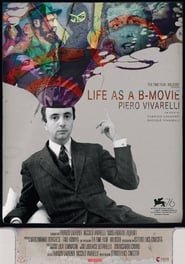
Life as a B-Movie: Piero Vivarelli
English Altyazısını İndir
Sürüm bilgisi
Etiketler
English altyazı önizlemesi
İlk 200 satır.
I'll be right there.
Piero was a real rocker.
Vivarelli who?
The one who wrote "24,000 Kisses"?
Piero was a lot of fun
handsome
simpatico, funny
erudite, a gentleman.
He wanted a taste of everything.
It was impossible to know what he did.
Once I asked him:
What’s your job?
He was a film director,
a music consultant,
a journalist.
I said: - That’s a lot of things!
It’s not easy,
to have been a right-winger,
then a leftist.
A fighter.
A bit unlucky in his life,
going from music to movies.
A traveler.
A precursor.
Politically bizarre.
For many years Piero was considered,
a minor director.
Not even a king of B's.
Just a B's.
When we asked him to come to Venice,
to be paid homage to by the critics,
and by Quentin Tarantino,
we didn't extend his life, maybe.
But his ego a bit certainly.
Finally, here we are.
B
I guess B stands for good,
or beautiful.
My love for filmmaking started very early.
At the age of seven I wanted to join the navy.
Then I fell in love with Shirley Temple,
followed by Deanna Durbin.
So I decided to make movies,
because I wanted to marry them.
But I didn’t marry them.
I was studying in Milan.
A friend, with whom I would go dance,
the boogie-woogie,
one evening,
brought him along to pick me up at school.
After we went to the movies a couple of times,
he said: - I want to marry you.
We got married on January the 4th.
You have no idea what the church looked like.
Guess who was playing the organ?
Giorgio Gaslini.
When I walked down the aisle he played “Laura”.
We got into a huge fight because,
I in a long white gown. He was in an overcoat.
A gray one.
He wouldn't budge.
He was so unconventional.
With Piero we never got home before 4 am.
One of the reasons why,
aside from the women,
is that it was a really wild life.
Our apartment,
in via San Valentino, on a first floor,
was known as the Live it up Club.
Everybody stopped by at any hour.
Everybody, at any hour.
There were some fantastic people:
Oriana Fallaci, Goffredo Parise.
Oriana was a friend of Martinelli,
a Tuscan journalist.
She came to Rome not knowing anybody.
We would make fun of her because,
all the interviewed denied the things she published.
Piero would treat her...
Once he threw her on the ground, and started stepping on her.
He was so polemical. Mamma mia.
He would never go to bed.
At the time,
we were on the crest of a wave.
Piero was super important.
My newspaper will take care of all the publicity.
It will be a memorable evening.
You’ll see, don Leopoldo, it will be alright.
Thanks, you are beautiful.
They feared him.
In the pop music world,
he was a big shot.
No!
Haven’t you read Viker?
You’re young, but if you had,
you would know that pop songs,
have to return to a bare bones essence.
To a nudity.
Strip tease?
Yes, strip tease, but of a moral nature.
He was one,
who would listen to just a few notes,
and make a judgment that was on the money.
He had, as they say, a good ear.
He had this knack,
for anticipating tastes, trends and so on,
but then he would get lost.
He would fall madly in love with a woman,
for... like three days, and run off,
and let everything go. Then he’d come back.
At that time, he’d fallen,
for a married woman.
The one who,
left her husband for him.
When he went to Sanremo,
with 24.000 kisses.
I got there,
and I caught him,
in the hotel,
with this lady.
The next morning I was gone.
Piero Vivarelli was an anomalous director,
among directors of Italian genre movies.
He was proud of being a genre director.
He wasn't ashamed of that.
He claimed he didn’t do just one genre,
but many genres.
When I started out,
I wanted to attend a film school.
I went to talk to Mario Soldati,
and he said:
What do you need a film school for?
Work with me as an unpaid assistant,
and you'll learn more than any film school.
When Piero Vivarelli tackles the musical movie genre,
he turns it upside down.
Non alone, it must be said.
He does it with Lucio Fulci.
Lucio Fulci was a genius.
Yes, I have big ideas.
We will organize something solid.
Like a festival.
Up until then musical movies,
were based on either the songs or the singers.
With Fulci we said:
Why not make a rock’n roll movie?
Not a mono-thematic movie,
but one with all the permutations of rock music,
from Tony Dallara's melodic rock,
to Adriano Celentano's rock.
I met Celentano at a musical tour.
When we made “The Juke Box kids”
we needed a rocker, a pelvic thruster,
I said: - Let’s call Celentano.
He didn’t have any song though.
Celentano’s brother,
had a rhytmic tune.
I said: - How does it go?
Come back to Capri, mon amour.
I said: - Come on,
a rocker can't sing: "Come back to Capri, mon amour".
So on the spot,
with Adriano who hummed along,
and me writing the words,
we came up with:"Your kiss is rock 'n roll".
Piero played a big role in the postwar period,
during the postwar economic boom,
within the anthropological transformation,
of Italian society.
Especially in the phenomenon known as,
the "Invention of youths".
For the first time youths become a "market".
Become consumers.
Have an allowance.
Can spend some money.
Piero intercepts in Celentano,
a sort of irresistible monkey man,
between horrific and pure beauty,
a total electrical spring.
He glimpses in Celentano,
this form of change,
and he follows him,
from 24,000 kisses to movies.
Partly in tandem with Fulci.
They are all movies about youths.
One can see the first signs of sexual liberation,
of anti-Catholicism,
which was Piero trademark.
So you are saying that...
Your eminence, come on, in a country like ours?
We just point out the immorality of that sign.
I kiss, you kiss...
Your eminence.
The key topic is always,
the anthropological opposition,
of the new generation against the old farts.
You see Rita,
there's always a war between the old and the young.
Now it’s my turn.
I have to fight it on my own.
More English subtitles for Life as a B-Movie: Piero Vivarelli
- Piero Vivarelli Life As A B-Movie 2019 1080p WEBRip x264 AAC-[YTS MX] · 22 downloads · 2021-04-17
Yorumlar
No comments yet. Be the first to leave one.