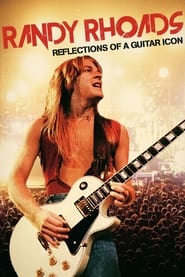
Randy Rhoads: Reflections of a Guitar Icon
English Altyazısını İndir
Sürüm bilgisi
Etiketler
English altyazı önizlemesi
İlk 196 satır.
1975, I got a little phone message
from a guitar player in Burbank, California
who was forming a rock and roll band,
and he was auditioning lead singers.
I met up with him at his mom's house about a week later.
He plugs a guitar into a little Fender practice amp,
and I tell you what, he played some of the best guitar
I've ever heard to this day.
People, don't ever forget the name of this guy.
He was Randy Rhoads!
All right!
In the late 1970s,
Randy Rhoads and his band,
Quiet Riot, were tearin' up the music scene in Los Angeles.
All aboard! (laughs)
Then, in 1979, at 23 years old,
Rhoads etched his place in history as a guitar legend
when he joined Ozzy Osbourne's new solo band.
It was an extraordinary rise to fame on a road
that was paved with hard work, determination, and sorrow.
Randy was an LA kid,
born in Santa Monica, California on December 6th, 1956,
and raised in Burbank.
His parents were musicians and music teachers.
His father left the family when Randy was just 17 months old
and his mother, Delores, raised him
and his older brother and sister.
To support the family, she opened a music school
in North Hollywood called Musonia.
He grew up in my school, my music school,
and he was very influenced that way.
We were steeped and immersed in all the music
and all of the activities that were going on.
Randy started playing guitar when he was six.
I started playing drums when I was 12.
Randy took folk guitar lessons at Musonia,
where he learned basic chords and simple pop tunes.
He wanted more than that, so he came and said,
"Mom, I really wanna take electric guitar."
Randy was taking two to three lessons a week
at Musonia.
His teacher saw that he was no ordinary student.
This is where Scott Shelly taught Randy for nine months
until Scott went to my mom and said,
"Mrs. Rhoads, I can't teach your son any longer."
My mom said, "Why would that be?"
And Scott's reply was, "For the last month and a half,
he's been teaching me,
and I can no longer keep up with him."
In junior high, Randy formed a band with schoolmate
and neighbor friend Kelly Garni.
He taught Kelly how to play bass,
and the two would have regular jam sessions.
And I can remember telling them,
"There's this concert we gotta go to.
I'm gonna take you to see Alice Cooper."
And he thought that that was a folk singer,
so he goes, "Well, why do we have to go see her?"
I said, "When you see her,
you're gonna see why you had to see her."
Total epiphany. Changed his life.
KOMP 92.3, The Rock of Las Vegas.
We're talkin' to Kelly Garni here, who grew up with Randy
and was one of the founding members of Quiet Riot,
which was Randy's basically first real band?
Mhm. Yeah, first real band of any renown.
Everything we had done prior to that
was just little backyard parties and things like that.
We often performed with no singer whatsoever.
We'd show up, me and Randy,
and whatever drummer we could get that night,
and just jam, and people loved it.
One of Randy's most stunning features
was his charisma,
way before he had even developed any big talent
as a lead guitar player, but, I mean,
you just looked at this kid and said,
"Someday, he's really gonna be something.
He's really gonna be somebody."
And you could just tell, he glowed.
Since they were getting more gigs,
Randy and Kelly thought it was time they got a singer.
In March of 1975, Randy reached out to Kevin DuBrow.
DuBrow had been jamming with some friends
but had no live experience.
Known for his flamboyant clothes,
it was clear he always wanted to be center stage.
The only piece missing was a drummer.
After my first year in college
in the summer of 1975,
I was looking for something to do
and just, on a whim, called Randy to see,
you know, what he was up to. Maybe we'd get together,
jam, do something, whatever.
And he and Kelly and Kevin were in the process
of looking for a drummer, so that's when I called him.
It was just pure, dumb luck.
Kevin DuBrow and I were dating at the time,
and he told me that he had tried out for this new band
to be the singer,
and so he had been rehearsing with them,
you know, quite a few weeks and everything,
and then finally he said, you know,
"Would you like to come down and watch us rehearse?"
So I went down and I walked in,
and they were more hippie-like.
They had long hair and kinda grungy clothes
and very plain, like very simple.
I was expecting something more like a British-style band
'cause that's what Kevin really loved.
They started rehearsing and it just sounded really amazing.
It was really fun.
Kevin loved Randy.
He had feelings for him as a younger brother.
He had respect for his talent.
They were very, very close.
Actually, the sun rose and set on Randy,
as far as Kevin was concerned.
When I first heard the guy play,
I knew how good he was that moment.
It was like, whoa, where did this guy come from?
It was like a secret, like a treasure.
He wasn't really classically trained.
He was a regular rock guitar player,
started out playing blues,
listened to things like Johnny Winter, Leslie West,
Alice Cooper, and then, as time went along,
he started listening to more classical music
and started taking a few classes or lessons,
but to say he was classically trained,
which means somebody who started off playing classic guitar,
and Randy, nah, he was a rock guitar player.
When I saw him play,
I just couldn't believe it either.
He was like, here's this little skinny kid,
and he was fucking great.
Ron Sobol was a friend of Kevin DuBrow's,
and they both shared an interest in photography.
We both were photographers, or I was just starting to be,
as far as taking rock pictures.
He says, "Well, bring your pictures over.
I'll show you mine."
And, from then on, we became best friends.
Ron went on to become the band photographer
for Quiet Riot,
capturing many pictures from their early days,
and he too was blown away
by Randy's abilities on the guitar.
He could play fast.
He could play slow.
Or he could play crunchy.
He could play bluesy.
And all of it with so much feeling. It was just amazing.
You know, I just loved it,
and he looked good.
You could just tell this guy was gonna become a rock star.
Randy kinda had an aura about him back then even.
We'd go up and we played Stough Park just on a whim,
like on a Friday, and 3,000 people would show up.
It was always kinda like that.
The group decided they needed a manager,
and, through a friend, Kevin found Dennis Wageman.
Wageman converted his garage into a rehearsal space,
and now the band had a place to jam whenever they wanted.
And, of course, we weren't Quiet Riot then, either.
Throwing out all sorts of ridiculous names at that time.
Okay, I gotta know, what was the name?
The previous name?
Come on, you gotta! - You got any bleach?
Toss in the Dung Heap.
It was... (laughs) It was Little Women.
Really? Are you kidding?
Seriously. — Oh, no.
No wonder you changed it.
Lasted for about a week.
There was a friend of mine.
There was this group called Status Quo, English band.
It was Richie Parfitt, a really good guitar player,
and I told him the name of the band
of what we used to be called, and he said, "Ughhh."
And he said, "If I had a band, I'd call 'em Quite Right."
"Quite Right", and I said, "Hey, this is Quiet Riot!"
He says, "Say it in English!" He goes, "Quiet Riot!"
And so I took it to the guys in rehearsal that night,
and they said, "Eh, it's cool."
Funny how those things happen in life
'cause there was no, "Okay. You know, we're a band now."
That didn't happen.
I remember playing San Souci restaurant.
We got there, and it was this, like, Chinese restaurant,
and, you know, there are patrons eating,
and, you know, Randy turns on his guitar,
and it was like, "You can't play here."
One of the first places I remember us playing,
it was a place in Van Nuys on Oxnard
called The Rock Corporation, and it was like a bikers' bar,
More English subtitles for Randy Rhoads: Reflections of a Guitar Icon
- Randy Rhoads Reflections of a Guitar Icon 2022 720p BluRay x264-ORBS · 40 downloads · 2022-11-07
- Randy Rhoads Reflections Of A Guitar Icon 2022 720p BluRay X264-ORBS · 25 downloads · 2022-08-27
- Randy Rhoads Reflections Of A Guitar Icon 2022 720p BluRay X264-ORBS · 26 downloads · 2022-08-27
- randy rhoads reflections of a guitar icon 2022 1080p bluray x264-orbs sdh eng · 24 downloads · 2022-08-22
Yorumlar
No comments yet. Be the first to leave one.