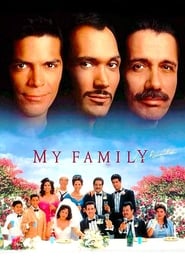
My Family
English Altyazısını İndir
Sürüm bilgisi
Etiketler
English altyazı önizlemesi
İlk 200 satır.
Whenever I see the Bridges
that connect Los Angeles with east Los Angeles,
I remember my family.
I remember my father and my mother,
my brothers-- chucho, little Jimmy,
and memo the lawyer,
my crazy sisters-- Toni and Irene.
But to write the story of my family,
I have to begin
where millions of stories have begun--
in a small village in Mexico a long, long time ago.
Actually, nothing like that ever really happened.
That's just the way my father used to tell the story.
His brother Roberto really died of a ruptured appendix.
In those days just after the revolution,
times were hard,
and my dad's in-laws couldn't afford to feed an extra mouth,
so my father had to leave.
Now, the only living relative my father knew about
lived somewhere north in a village
called nuestra señora reina de Los Angeles.
He figured he could walk there in a day or two.
The other side of the world.
My father thought about it.
"Good god," he thought.
"It might take two weeks to walk there."
Gracias.
Con cuidado. Hazle UN lugar.
It took him over a year
to reach the other side of the world.
He walked most of the way,
and we kids, well, we heard of that journey many times.
He was attacked by 10 bandits in sonora
and had to beat them off with a cactus branch.
He rode the back of a snorting mountain lion.
But finally,
he reached El pueblo de nuestra señora reina de Los Angeles--
the one in California.
The border? Well, in those days,
the border was just a line in the dirt.
They called the old man "El californio"
because he didn't come from anywhere else.
He was born right here in Los Angeles
when it was still Mexico.
My father had found a new home.
Even then, there were Bridges.
My father soon joined the people
crossing from their barrio on the east side of the river
to do the work of the city on the other side.
They mowed the lawns, took care of the children,
cleaned house, worked in restaurant kitchens,
but no one from the West Side of the river
ever crossed the Bridges into the barrio.
Make sure they're all cleaned up
to go to grandma's tonight.
Give us a kiss. Love you.
Love you. Aw, I love you.
Bye!
Toodles!
Ay, niños!
Niños!
O.k., now. Be serious.
And...
Mmm!
Boom, ba da boom, ba da boom, ba da boom.
Children soon followed--
first me, then my sister Irene.
My earliest memory is of the face
of that gentle old man looking at me
and smiling,
and I remember my father always working in his milpa--
corn in the back and beans in the front.
And that's the way it always was at my house
for as long as I can remember.
Jose.
Mi cafecito.
Look...
The children are wonderful.
There is no greater blessing
in all the world than children.
We're going to have another?
Maria, I knew it!
I knew it, Maria.
It's going to be a boy.
I'm going to have another son,
and this one
is going to be a special boy.
I remember when it happened.
It was that Sunday afternoon. Remember?
Huh?
Remember that day old Gomez
crashed his car into the river?
Yes. That was the day.
Maria, I knew it...
Because that day I got out of bed
and walked out to the porch.
I was standing there.
I looked up into the sky,
and I saw an angel pass by.
An angel?
Yes.
How beautiful.
Tonight we celebrate.
Uh-huh.
Then came the day everything changed--
when my mother didn't come home from the market.
It was the time of the great depression.
I guess some politicians got it into their heads
that the mexicanos
were responsible for the whole thing.
I mean, they were taking up a lot of jobs--
jobs that were needed
for what they called "real Americans."
I got to get home to my children.
Move along.
So la migra made some big sweeps
through the barrio,
and they rounded up everyone they could.
No! I live here.
No! I belong here.
Señor, por favor. Señores.
I can't help it, lady.
Move it!
It didn't matter if you were a citizen,
like my mother.
If you looked mexicano,
you were picked up and shipped out.
She had just been out shopping.
She wasn't allowed to come home.
My father was never told.
She was all alone, and she was pregnant.
All these things really happened.
The year was 1933.
Lock her up!
Back!
O.k., roll her out!
The southern pacific railroad
made the U.S. government a deal.
For $14.75 a head,
they took the mexicanos all the way back
into central Mexico,
hoping they would never be able to get back.
Maria?
I remember the day they buried El californio
in the backyard.
He left a will and left everything to my father,
but he made it very clear
he didn't want to have nothing to do
with the pinche church or the pinche government.
He wanted to be buried right behind the house
under the corn field.
Agh!
And El californio said exactly what he wanted
written on his grave marker.
"Don Alejandro vazquez El californio.
"Died 1934.
"When I was born here, this was Mexico,
and where I lie, this is still Mexico."
My mother kept her promise,
and when my brother chucho was old enough,
she set off on her long journey home,
but the rains came early that year.
She had gone too far to turn back.
Ay.
No!
No!
Aah!
Señora!
Aah! Ay! Ay!
Aah!
Aah!
Chucho! Chucho!
Shh. Shh.
Estas a salvo.
Esta todo bien.
Two years had passed since my mother was taken away.
My father lost hope,
but he kept working to take care of me and Irene.
Maria?
Maria?
I promised la virgen
that I would come back to you.
This is your son.
His name is chucho.
Chucho.
Maria.
Jose.
Oh, Maria, it is a miracle.
This is a miracle.
Well, there he is, all grown up--
my brother chucho--
and he did grow up into something special,
but not quite what my father had imagined.
Chucho was one of the baddest pachucos
on the whole east side.
My younger sister Toni-- god bless her--
pretty as an angel,
but sometimes she could get a little bossy.
Hurry up, hermano.
You'll miss your own sister's wedding!
My Family subtitles in other languages
More English subtitles for My Family
- My Family 23 976 FPS · 0 downloads · 2004-06-26
- My Family 23 976 FPS · 0 downloads · 2004-06-26
- My Family 23 976 FPS · 66 downloads · 2004-06-26
Yorumlar
No comments yet. Be the first to leave one.