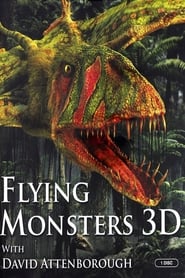
Flying Monsters 3D
English Altyazısını İndir
Sürüm bilgisi
Etiketler
English altyazı önizlemesi
İlk 200 satır.
Birds today are the masters of the skies.
But they were not the first creatures to fly,
and they are certainly not the biggest.
The first large animals to leave the ground
were so extraordinary
they're almost beyond imagination.
They were reptiles.
Pterosaurs.
They evolved into a huge variety of species.
Some, the size of aeroplanes,
were the largest creatures ever to fly.
They could travel half way around the world in a single flight.
And the pterosaurs' extraordinary abilities
enabled them to dominate the skies of the prehistoric Earth
for a 1 50 million years.
But, why did these magnificent beasts take to the air in the first place?
How did they fly?
And why, after such success, did they vanish?
Something very remarkable happened around 220 million years ago.
The planet then was a very different place.
It was much drier, for a start,
but, in the tropics there were rainforests,
and then, as now,
they were the focus of a great deal of varied wildlife.
In the detail however, they were very different.
Most notably, there were no large creatures in the air.
No bats. No birds.
The stage was set for a remarkable advance
in the history of life.
At that time, the only animals that could fly were insects.
They were tempting food for reptiles.
But if a reptile were to catch them,
it, too, would have to take to the air.
And a hint, of how they might first have done so
can be seen in an animal that is alive today.
This little lizard called Draco,
is found throughout the forests of Southeast Asia.
And it must certainly have had, in the far distant past,
lizard ancestors and cousins
that looked very much like it.
Like them, it finds it food, insects, throughout the forest.
And to do that, it has to get around.
And it has a very interesting way of doing that.
Draco is an excellent climber.
Light in weight and with powerful gripping claws,
it can run along the branches of the highest trees
in pursuit of its prey.
But Draco faces a problem.
How can it travel from one tree to the next
without going all the way back down to the ground and then up again?
The way it has evolved of doing so, gives us a clue
as to how early reptiles may first have taken to the air.
It jumps.
But it does more than just leap.
It extends the width of its body
by opening flaps of skin along its flanks,
and they enable it to glide.
Draco may give us the right idea
as to how gliding, flying, amongst the reptiles started.
But one thing is certain.
Flapping flight, powered flight,
remained the preserve of the insects for a very long time.
And then, one group of reptiles developed even that.
And the evidence of how they did so is really very intriguing.
This is Dorset, on England's south coast.
And this is where my journey into the past begins.
A 90 mile stretch of shoreline here
can tell us a lot about the evolution of flight.
This is the Jurassic Coast.
Its rocks are full of fossils of prehistoric creatures,
including evidence of the first backboned animals ever to fly.
But wasn't until the 1 9th century
that scientist started putting together those clues
to form a detailed picture
of one of the most dramatic periods
in the whole of the history of life.
And they had an unlikely ally.
A middle aged woman from the local town,
who used to come out to scour these cliffs for those clues.
She'd come in all weathers,
but particularly, after there had been heavy storms,
which might have removed some section of the cliff,
and so exposed specimens that no one had ever seen before.
Her name was Mary Anning.
Mary is, for me, the heroine of this remarkable story.
She had an almost unbelievable talent for unearthing fossils.
In the early 1 800s, science was still the preserve of men.
Yet, what she managed to unearth,
brought academics flocking to her hometown of Lyme Regis.
So extraordinary were her achievements
that some called her, ''The Princess of Palaeontology''.
When you consider Mary Anning's status,
a woman from a working class background,
with no formal education to speak of,
it may seem strange that she acquired such a prestigious reputation,
until, that is, you see what it was that she discovered.
The Natural History Museum in London.
It holds one of the most comprehensive collections of fossils in the world.
And those Mary Anning discovered
are among the very best, and the most important.
A whole section of the museum is filled with her finds.
Most of the creatures she collected were giant aquatic reptiles,
fish eating monsters that dominated the seas.
But she found other things, too.
One of them in particular is the key to our story.
In 1 828,
Mary Anning made one of her most sensational discoveries.
This is it.
It's a small animal,
but its head is missing,
and its spine is missing,
but what remains is fascinating.
Here's its pelvis,
its upper leg, its lower leg,
and there is its foot with its toes.
And here is its arm,
which ends with a hand with fingers.
Except that one of these fingers is hugely elongated,
it runs all the way along here.
And Mary Anning probably realised what that meant.
It meant that that long finger supported a wing.
And as more specimens were discovered,
it was realised that this was certainly a reptile with a wing,
so, it was called ''Pterosaur''.
''Winged lizard''.
Mary Anning had found the blueprint
for the first large animals ever to fly.
A creature that set the pattern
for a whole new phase of aerial evolution.
It lived 200 million years ago,
at a time when the planet was very different from today.
Much of it was tropical.
The early dinosaurs were rising to dominance.
And flying high above them were the pterosaurs
of the kind whose bones Mary Anning had discovered.
Dimorphodon.
Up here in the trees,
they were safe from those predatory dinosaurs
down on the ground.
And there were plenty of flying insects for them to catch and eat.
But these early flying reptiles were pioneers.
And it maybe that,just occasionally, they were a little clumsy on the wing.
Sometimes, as their bodies lay on the sea floor,
they were slowly covered with mud,
that over millenia, eventually turned to stone.
Fossils of pterosaurs have been discovered
in many parts of the world.
In Africa, Asia and South America.
But the very first were found here, at Solnhofen, in Southern Germany.
This limestone has been quarried for building purposes,
since Roman times.
But those who work here
sometimes find something far more valuable
than just roof tiles.
The discoveries made here
make this one of the most important places in all over the world
for anybody who's interested in pterosaurs.
And the perfection of their preservation
has enabled us to unlock many of the secrets
about how these wonderful animals flew.
The Solnhofen limestone formed on the floor
of a shallow tropical lagoon,
protected from the currents of the open sea by a reef.
So, its waters were still, and they were few currents
to disturb the rotting bodies.
The rock here is really extraordinary.
When it's fresh, it's very solid, hard building stone.
Excellent.
But when the frost gets at it, it begins to split.
And when it's really weathered,
you can open blocks of it like leaves of a book.
Like that, for example.
And sometimes there's something written on these leaves,
but mostly
nothing.
And maybe for...
I was going to say, ''Maybe there's nothing.''
But, on this one, there's a perfect little ammonite,
a shellfish.
This quarry has produced so many fossils
that the town's castle has been turned into a museum to house them.
The majority are sea creatures,
but sometimes, there are animals that fell into the water
from the skies above.
Pterosaurs.
Here is one that did.
It's a kind called Rhamphorhynchus.
Not only are its bones still connected, as they were in life,
you can even see something of its soft parts.
This one of the most perfect pterosaur fossils ever found.
And it's a miracle, bearing in mind it's a 1 50 million years old,
and yet it's complete in all the tiny details.
It had a long bony tail,
long toes on its feet.
Its spine and its ribs still connected.
Its jaws have long teeth
which would've enabled it to snatch fish from the surface of the lagoon.
But the most fascinating parts of its anatomy are its wings.
They are supported as in all pterosaurs by a hugely elongated finger.
This is the wing membrane,
Flying Monsters 3D subtitles in other languages
More English subtitles for Flying Monsters 3D
- Flying Monsters 3D With David Attenborough 2011 720p BluRay x264 AAC-[YTS MX] · 73 downloads · 2021-05-13
- BSkyB Flying Monsters with David Attenborough 2011 720p Bluray x264 AAC MVGroup org · 39 downloads · 2020-08-06
- Flying Monsters 3D With David Attenborough · 72 downloads · 2012-09-18
Yorumlar
No comments yet. Be the first to leave one.