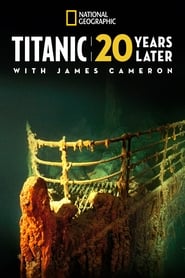
Titanic: 20 Years Later with James Cameron
English Altyazısını İndir
Sürüm bilgisi
Etiketler
English altyazı önizlemesi
İlk 200 satır.
We released Titanic 20 years ago.
Seems like a lifetime.
But I remember everything like it was yesterday,
from the first dive to the wreck,
to our last day of production.
We were creating a living history,
so I needed every detail
as accurate as we could make it.
We owed the truth to the hundreds of souls
lost that night in 1912.
Even now I feel a responsibility
to the living and the dead.
Did we get it right?
After decades of exploration and scientific analysis,
we know a lot more than we did when we made the film.
So I've gathered a team of experts,
Parks Stephenson, Ken Marschall, and Don Lynch,
to reopen the case file on Titanic
and look at what we've discovered
over the last 20 years.
We'll investigate whether more lifeboats onboard
could have saved more lives.
I think I probably would cut faster
if my life depended on it.
Hear the surprising story
of how the long-lost ship was found.
-Did you get spooked? It was spooky.
And learn how the film affected the families
of some of Titanic's famous passengers.
Molly Brown sounds like a real pistol.
I would have loved to have met her.
She was larger than life.
We'll step back in time
to see how our sets match up
against what we found at the wreck site.
And we'll mount tests that may answer questions
about the sinking that have bothered me
for almost two decades.
Yes!
We'll see where we were right, and where we got it wrong.
Background and action.
When we made Titanic,
we tried to do a film that was as if
we had gone back in a time machine to that night.
We tried to be as accurate as it was humanly possible to be.
You could walk out of Rose's cabin,
down the corridor, down the grand staircase,
through the reception room and into the dining room.
It was every photograph I had ever seen.
It was perfect.
And action.
That feeling that you had, no longer was Titanic
just a story in a book or a picture.
You were there.
James not only made this movie, he embraced the subject.
And the success of the movie
made it possible to deploy new technologies
to explore the wreck
in ways that had never been done before.
JAMES (off screen): Who would have thought that stuff would still be there?
It's a dream come true for me.
To me, it just opened the door to so many mysteries
and unanswered questions,
and then that snowballed into a real lasting interest
in the forensic work
that kind of marine archaeology of the wreck site.
And a lasting interest in the history of Titanic
and the impact that it had on society.
The wreck is the last surviving witness
to the disaster.
It still has stories to tell
for anybody willing to pay attention
and listen to what the wreck has to tell us.
Are you ready to go back to Titanic?
On April 14th, 1912, at 11:40 p.m.,
the RMS Titanic struck an iceberg during its maiden voyage
from Southampton, England to New York City.
Two hours and 40 minutes later,
it sank to bottom of the Atlantic Ocean.
Of the more than 2,200 passengers and crew onboard,
just over 700 survived that night.
The wreck remained lost at sea until 1985,
when oceanographer, Robert Ballard, discovered it
while on a secret mission for the US Navy.
His expedition changed the way we explore the deep,
and it changed my life.
Bob and I recently met at the Ronald Reagan Presidential Library
to take a look at their exhibit on Titanic.
This is the story I could never tell.
Bob Ballard is one of the nation's top oceanographers.
But of course, what he's best known for
is discovering the Titanic.
And that's an amazing story
because it turns out that that was just a cover story
for a mission that he was doing for the US Navy at the time.
In the 1960s, the US Navy lost two nuclear submarines,
the Thresher and the Scorpion,
under mysterious circumstances.
In the 1980s, Dr. Robert Ballard
was brought in to explore the wreck sites
and find out if the Soviet Union
had gotten there first.
My mission was to go out
to both the Thresher and the Scorpion,
and completely document 100% of the wreckage.
As it turns out, Ballard found the missing subs
and completed his mission so quickly
that he still had 12 days left to search for Titanic.
It was actually mapping the wreckage
that told me how to find the Titanic.
When the Thresher and the Scorpion imploded,
all these pieces came falling down
to the ocean floor.
So as it was falling down,
the currents carried it for over a mile.
It was a comet of debris.
So instead of looking for Titanic,
I looked for its debris.
When the Carpathia got the distress call,
-it was down here. Yeah.
Headed to the reported position.
Ran into them early. Yeah. Ahead of schedule.
So I said,
"What's the error of celestial navigation back then?" Five miles.
So I said, "Let's go another five."
It has to be to the north.
JAMES (off screen): Yeah, right. So then you just run straight north?
ROBERT (off screen): So I then, I run east-west lines across...
The intersect... Across, across the...
the intersect, but space them 0.9 miles.
And if I don't get it, interspace 'em at half.
But you already knew that at that depth
the debris field would be more than a mile.
Roughly a mile. Yeah.
So I cheated a little, I said, "Let's do 0.9."
That's pretty smart.
And then if I don't get it, I'll just interlace.
Yeah, right.
ROBERT (off screen): So we began running lines back and forth
and on the ninth line, hit the debris.
-Well-- Did you know...
You didn't know it was Titanic until you saw the boiler.
No. We didn't... Correct.
Wreckage.
Bingo! Yeah!
"Somebody ought to go get Bob..."
For some reason that night, I just wasn't sleeping.
And a knock on the door,
this is now at 2:00 in the morning,
and the cook stuck his head in,
and he said, "The guys think you might want..."
He didn't even finish the sentence and I was past him.
And I got into the command center
and just as I entered the command center,
they went over the boiler.
Boiler alert! I got boiler!
Yes, yes.
We knew it wasn't any wreck, it was the Titanic.
And it was like scoring the winning goal at the buzzer.
So our reaction was jubilant,
jumping up and down, celebrating.
And then someone said, "She sinks in 20 minutes."
And that innocent comment
was devastating
'cause what were we doing celebrating anything?
We were embarrassed
that we were dancing on someone's grave.
So I just said, "Stop the ship, I'm going outside."
We went out on the fantail and we had a private memorial.
And that was it.
Everybody that dives Titanic
has their own story of seeing it for the first time.
And probably the most frequently asked question
to me is,
"What was it like seeing the wreck for the first time?"
I get asked, "Hey, what was it like?"
And I always wanna tell them the story
they want to hear, which was,
there she was in, you know,
this beautiful, stately ruin coming out of the darkness.
-That's not what happened. No.
It's like a cliff. Oh, I remember when we...
This was where we came in, we landed here and...
It's a cliff.
The, you know, the Wall of China...
I mean, it's just a wall.
And the first thing I recognized
was the anti-fouling paint.
Yeah, the red, the red paint, right? It was pink.
It was still pink.
And I said, "Too bad they didn't paint the whole ship
with that stuff."
And the bilge keel was sitting on top of the sand. Exactly.
Back, back here. It was right, right there.
And then, the pilot, he said, "We gotta go."
Yeah.
So he dropped his weights and then we began our ascent.
But then these eyes...
Yeah, which is your lights kicking back.
Your lights, all the eyes of the Ti...
Titanic: 20 Years Later with James Cameron subtitles in other languages
More English subtitles for Titanic: 20 Years Later with James Cameron
- Titanic 20 Years Later With James Cameron 2017 WEB-DL DSNP · 31 downloads · 2021-04-28
- Titanic 20 Years Later With James Cameron 2017 WEBRip x264-ION10 EngSub · 60 downloads · 2020-09-05
- Titanic 20 Years Later With James Cameron 2017 WEB-DL x264-VXT · 44 downloads · 2020-08-25
Yorumlar
No comments yet. Be the first to leave one.