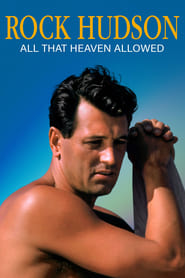
Rock Hudson: All That Heaven Allowed
English Altyazısını İndir
Sürüm bilgisi
Etiketler
English altyazı önizlemesi
İlk 200 satır.
Peter Kevoian: We were sitting at the pool
just sunbathing and talking.
I was a young gay man who was
questioning all kinds of things.
We talked about being gay in Hollywood
and how difficult it was to have a career.
And I asked him how he knew that he was gonna make it,
because I wasn't sure that I ever would.
And he told me about a dream that he had.
He dreamt that there was a perfectly cut diamond
sitting on velvet
in a room that was lit with pin spots.
And every one of the lights
were pointed into the center of the diamond.
He thought he was the diamond.
He said, "That's the dream"
"that made me believe that I could do this.
That's how I knew I was gonna be a star."
- Your name is Roy Fitzgerald? - That's right.
Well, come up on our stage, young man.
This is your life!
Come along here.
Hey!
You see, folks, this young man,
whose name really is Roy Fitzgerald,
is known to you and to movie fans all over the world as...
Narrator: Rock Hudson. Was he the cat's pajamas!
Pleased to make your acquaintance, ma'am.
Kevoian: Well, Rock was an icon.
Alan Shayne: You couldn't take your eyes
off Rock on the screen, you really couldn't.
Robert Hofler: Not only was he
the biggest star at Universal,
he was by far the biggest star in Hollywood.
Ken Maley: There was that period where he was the king.
Carole Cook: The Tom Cruise of his day.
Maley: Women were swooning, men were swooning.
Armistead Maupin: Rock was everybody's type.
Howard McGillin: (laughing) You couldn't invent a name
that was better for a heterosexual leading man than Rock Hudson.
Maley: Not only did women say,
"That's the man I want to marry,"
many men said, "That's the man I'd like to be."
McGillin: He was like a granite facade,
just impenetrable.
Alice Waier: He was a great performer,
not only in acting, but in life.
Why aren't you married, Jordan?
Maley: He had more than one world.
He had the studio world.
He had this gay world.
- You'll come? - I'd be delighted.
Well, good-o, sport!
Maupin: I thought I was the last man in California
to go to bed with Rock Hudson when I finally did.
He was a sort of sexual gladiator.
The lash for you, betrayer of women.
David Thomson: He was closeted,
but there was every reason to be closeted back then.
If the truth had come out, that would've been the end of his career.
It's as simple as that.
Kevoian: The public perception of Rock
was so very masculine and straight.
Privately, he was very free.
Carol Burnett: He loved to laugh. He was also a bit of a devil.
Ken Jillson: The people that he had around him
were very trusted friends.
I think maybe that's the key.
Shayne: People loved him, you know?
He was just a decent, wonderful guy.
And that's unusual in Hollywood.
I hate to say that, but it's true.
He was a quiet man.
I think the thing I most remember him for were his silences.
It was...
As if he were always listening to something inside.
Some voice.
He never talked about it, so...
I never knew what it was.
Oh, he was a good man.
He lived as if he were a stranger here.
I mean, he never let anything touch him.
Became absorbed in things. His job mostly.
He worked hard, he...
always a look around his eyes as if he were
trying to say something.
I don't know what...
protest against what he'd surrendered his life to.
I never knew what he wanted...
- (distant clatter) - and I don't think he ever knew.
Well, I...
guess I can't tell you much more. Enough?
Rock Hudson: Should be going.
Reporter 1: Rock Hudson died peacefully in his sleep from AIDS,
the first well-known person to publicly acknowledge
his struggle with that fatal disease.
Norman Sunshine: He signaled this catastrophe called AIDS,
but Rock was an activist without knowing it.
Reporter 2: Since AIDS is primarily a disease
associated with homosexuals,
talk of Hudson's lifestyle has surfaced.
Maupin: They needed someone to say that he was gay,
and the story would be told, and I didn't want it to be told
in the way that the people in Hollywood wanted it told.
Ronald L. Davis: This is an interview with actor Rock Hudson
taped in his home in Beverly Hills, California,
on August 24th, 1983.
Well, I'm wondering, first of all,
how an Illinois boy like yourself
became interested in acting.
Hudson: I wanted to be an actor all my life.
That has always hypnotized me.
Davis: Did you have acting training as a boy?
Hudson: No. I could never freely say,
"I'm going to be an actor when I grow up."
Davis: Yeah.
Hudson: Because that's sissy stuff.
You oughta be a policeman or a fireman.
So I never said anything. Kept my mouth shut.
Nor did I enter in the drama society or anything like that.
I had to work all the time, so I couldn't do
any form of extracurricular activity.
I had to make a living for myself.
And then I went in the Navy in World War II
and went back home for a summer,
and I thought, "This place is not for me.
Now is the time to do what I want to do."
I did know one person in Los Angeles,
my father.
My parents divorced,
and so he was living out here.
So I came out
and stayed with him.
It was very difficult for me to make friends out here.
Then I got to know
a guy who was an older brother
of a guy I was overseas with.
And it was one of those things,
"If you're ever in Los Angeles, look me up."
So I called him and he said,
"Come on up for Sunday dinner."
So I did, met his brother, who lived in Long Beach,
who used to be a radio producer.
He began inviting me down
to his place down in Long Beach.
We became best friends.
Richard Hodge: Kenneth Hodge was my uncle.
A man of the arts.
Somebody that really loved to help people.
It was never, ever spoken of
that, you know, he might be gay.
I'd never heard that word at that point in time.
Being gay was considered, you know, a neurosis.
It was just a subject that, uh, that was off the table.
Rock was just getting out of the Navy
and hadn't been into the pictures yet.
So Kenneth was really enthralled with him
and was sort of "love at first sight," I think for, for Ken.
They were very much lovers.
Kenneth had a big Hollywood job.
He was a director in radio, and he had a good network.
He had plenty of people to introduce Rock to,
and he helped facilitate some of Rock's early career.
Hudson: He suggested that I get some pictures taken
and send them around to agents.
I said, "What's an agent?"
Now I'm Midwestern hick. Please understand.
Not knowing anything at all.
Anyway, I had one response, that's all.
And that was Henry Willson.
Davis: Is that right?
Hodge: Rock was very ambitious.
He got scooped up with a big-time agent
who really accelerated Rock's career.
And from what I know is,
he kind of dropped Ken on the spot.
I think it ended really abruptly.
I never really saw my uncle in love again.
And I think Rock broke his heart.
And the fella sitting next to you in the audience down there,
there's the man who gave you that name,
your good friend and personal manager, Mr. Henry Willson.
Henry, stand up, please, let the folks see you.
Matter of fact, uh, Henry discovered Rock
and fostered his rapid rise in pictures.
Hudson: Mm-hmm.
Hofler: In the '40s, Henry Willson went to work
for David O. Selznick right after David O. Selznick
finished "Gone With the Wind."
Henry and Rock met at a party
that this boyfriend-agent of Rock's took him to.
Rock realized, "I'm going with the guy
who's the head of talent for Selznick Studios!"
So Rock was one of his first clients,
and there were dozens of other men
who have been completely forgotten,
who had crazy names like "Race Gentry."
You only have to look at the silent movies,
where you would have these men like Ramon Novarro
or Rudolph Valentino.
Rock Hudson: All That Heaven Allowed subtitles in other languages
More English subtitles for Rock Hudson: All That Heaven Allowed
- Rock Hudson All That Heaven Allowed 1080p AMZN WEB-DL DDP5 1 H 264-SCOPE · 63 downloads · 2023-10-16
- Rock Hudson All That Heaven Allowed 2023 720p WEBRip x264 AAC-[YTS MX] SHD · 31 downloads · 2023-07-01
- Rock Hudson All That Heaven Allowed 2023 720p WEBRip x264 AAC-[YTS MX] · 35 downloads · 2023-07-01
Yorumlar
No comments yet. Be the first to leave one.