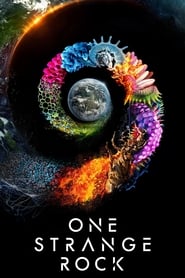
One Strange Rock
English Altyazısını İndir
Sürüm bilgisi
Etiketler
English altyazı önizlemesi
İlk 200 satır.
What do you need to win a game of chess?
Patience, clever tactics, loads of imagination.
You look nervous.
What makes us human
is the squishy triple-pounder inside our heads.
Check.
It lets us checkmate our friends,
build skyscrapers,
and lift a special few of us into space.
Eight astronauts with over 1,000 days in space between them
can tell us how being up there
helped them to truly understand what goes on down here.
From space you get the big picture.
You really see human civilization
spread out below you.
As far as we know,
there's nobody else like us out there in the universe.
The only reason I'm able to comprehend
the incredible complexity of the Earth
is because I have an incredibly complex brain inside my head.
We are the only species on this planet
that can construct realities in our mind
and then go actually build it.
But for three billion years,
life didn't even have a brain.
The story of how our mind evolved
on this one strange rock
is one of chance, coincidence and impossible odds.
I am going to tell you about the most incredible place.
The weird connections,
the dynamic forces that created us.
A species with a brain as complex as yours and mine.
The human brain is unique.
Not just because of its size, but also its ability.
It can meet challenges that are dangerous, demanding.
And wonderfully absurd.
In Spain, thousands come together every year
to build towers out of people.
A ten-story human tower with the youngest kids on top.
Right.
Claudia and Marina, they're seven.
Humans are like no other creature on Earth.
We do these things that might seem pointless,
not because we're stupid; because we're smart.
And we work as one.
It's that ability to link our minds together
that put those girls on top of that tower
and also put men and women up in space.
One of them is Leland Melvin.
Former NFL player, mechanical engineer, and astronaut.
Strong, smart, brave,
and pretty much unstoppable.
But Leland nearly didn't make it to space.
An accident in his training brought his dreams to a halt.
The only way to really simulate a spacewalk on Earth
is in a pool.
I remember getting in the suit, putting my gloves on, my boots.
As you're going down in the spacesuit,
you have to clear your ears.
Ten feet down,
I realized that the Styrofoam block,
you press your nose against it to clear your ears,
was missing in my helmet.
I tell the test director, turn the volume in the headset up.
I was straining to equalize the pressure.
And then, I immediately hear nothing but static.
They were pulling me out of the water.
And now I see the flight surgeon walking towards me.
He reaches up and touches my right ear.
He's moving his lips, but I don't hear anything he's saying.
And then I can feel the blood starting to trickle down
on the side of my face.
I'm like, 'Wow, something's really wrong.'
I was completely deaf.
Somehow the connection between my brain and my ears
had been severed,
along with my chances of going to space.
The accident gave me a profound appreciation
in what we take for granted.
The thing that makes us us: our brain.
The human brain sets us apart
from all other creatures on this planet.
It might look like a lump of Jell-O,
but it's the most complex thing in our universe.
Inside, there's a vast network with 100 trillion connections.
That's more than the number of stars in our own Milky Way.
It hosts our memories.
Our sensations.
Our dreams.
And all this depends on tiny cells firing electrical signals.
There's 86 billion of them.
We call them neurons.
86 billion.
Wow.
I'm just glad someone else was counting.
But here's the thing:
most of life on Earth does just fine without a brain.
I'm talking about some of Earth's oldest inhabitants.
Some brainless creatures are so successful,
you can even see them from space.
On a bright, sunny day,
I'm looking down, and for 1,000 miles,
I see an organized city of coral.
They just glow.
It's just like the most beautiful art in the world.
This burst of color.
I'd never seen colors that vibrant before.
It's kind of amazing that corals are vast, motionless structures,
that thrive without a brain.
In the country of the brainless,
the tiny-brained is king.
Meet this little guy.
He's got more in common with us than you might think.
Inside, he's got neurons, too, just not as many.
About 200.
Kind of a starter kit.
He's a baby sea squirt looking for a home.
His neurons do simple stuff,
like detect light and twitch his tail.
But here's the thing:
once he's found the right rock, his swimming days are over.
For the rest of his life, he stays put.
He dumps the tail and consumes the neurons that made it move.
Then, it grows into a big, old sea squirt.
Takes 'use it or lose it' to a whole new level.
It's kind of a freaky thought that, you know,
when neurons were developed, they weren't for thinking.
They were for simple motion or movement.
But one day, neurons like those, the ones inside our brains,
would help create things
like rocket ships going to space,
cities and music.
Making a tail twitch to move a yard or two
requires just a few neurons.
However, the more advanced stuff,
that needs an awful lot more.
Life needs to sense its surroundings,
otherwise, it's just flailing around in the dark.
There is nothing more complex than the human brain.
But the more complicated something is,
the more ways it can go wrong.
After my training accident,
the doctors couldn't figure out what was wrong with me.
Everything looked physically intact,
but they couldn't fix me.
I was completely deaf.
My goal of getting to space seemed to be thwarted.
But all I could think about
was whether I'd ever hear music that I played again.
Music has been such a big part of my life.
And so, when the music was silent...
That's when I just broke down and started crying.
Leland's ears were fine.
That's not where the problem was.
Because you don't just hear with your ears,
you also hear with your brain.
It's the same for all the senses,
they link our brains to the outside world.
And over hundreds of generations they evolve to suit that world,
no matter how harsh it is.
Hunters have lived here for thousands of years.
But to survive, they borrow the senses of a creature
that's been here even longer.
The eagle is like a weaponized telescope.
It can see a fox up to two miles away.
Out here, that's a crucial tool in the fight for survival.
But to see like an eagle,
you need more than eagle eyes;
you need an eagle brain.
Eyes deliver masses of data about the world around us,
and all that lifesaving data
needed something powerful to make sense of it.
Simply put, if you're an animal with eyes,
you're gonna need a bigger brain than a sea squirt.
Eyes were a real game changer.
But it's not just the eyes.
Creatures had to develop an array of senses
that are each calibrated to deal
with the ever-changing environment of Planet Earth.
Not just barren desserts,
but these very dense jungles,
teeming ocean reefs,
and even icy Arctic waste.
The planet's varied landscapes played a significant role
in how animals sense.
What goes for them, goes for us.
The planet shaped our senses, too.
It's something you might not notice
unless you leave the planet.
Our senses have evolved
to operate on Planet Earth.
When you're up in space,
the inner ear isn't registering an up and down.
So, your sense of orientation
only comes from your eyes.
You know that weird feeling
in the pit of your stomach,
when you go over the top of a rollercoaster?
I was basically in that moment for an entire day.
We're Earthlings.
One Strange Rock subtitles in other languages
More English subtitles for One Strange Rock
- One Strange Rock Season 1 Complete 720p HDTV x264 [i c] · 132 downloads · 2019-12-31
- One Strange Rock S01 720p AMZN WEBRip · 150 downloads · 2018-08-11
- One Strange Rock 2018 Complete 1080p AMZN WEB-DL DDP5 1 H 264-NTb · 179 downloads · 2018-06-02
- one strange rock s01e10 home 720p HDTV x264-DHD · 69 downloads · 2018-05-29
- one strange rock s01e08 alien 720p HDTV x264-DHD · 110 downloads · 2018-05-15
- one strange rock s01e07 terraform 480p hdtv x264 rmteam · 108 downloads · 2018-05-08
- one strange rock s01e06 escape 480p web dl x264 rmteam · 108 downloads · 2018-05-03
- one strange rock s01e05 survival 480p webrip x264 rmteam · 116 downloads · 2018-04-25
Yorumlar
No comments yet. Be the first to leave one.