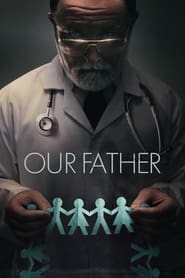
Our Father
Tải xuống Phụ đề English
Thông tin phát hành
Tags
Xem trước phụ đề English
200 dòng đầu tiên.
Vod2srt by Blue-Bird™
I wanna call it a nightmare.
It was
absolutely wrong from the beginning.
I personally think it was an experiment for him,
some sick game.
I think about the "why" every single day.
Hi, Jacoba, this is Dr. Webber calling.
I have your lab results in.
So give me a call when you have a chance, and we can go over those.
Thank you. Bye.
Hi, this message is for Jacoba Ballard. This is Jane over at Dr. Chan's office.
Give us a callback. We want to reschedule you for an appointment.
Thanks so much.
Growing up, I felt different.
I'm this blonde-haired, blue-eyed person
in a family with dark hair
and, like, olive skin and dark eyes.
So, I kept asking my mom
if I was adopted.
I kept, like, reassuring my parents,
and I'm like, "It's fine if I am, you can tell me. It'll be okay."
Finally, my mom told me the truth.
So, I've known since the age of ten
that I was from donor sperm.
I believe it was 1979,
and… I wanted a child so bad,
but my husband could not have children.
So I went to see Dr. Cline
for artificial insemination.
I was young.
I think, like, 20, 21.
He was professional.
Uh, we didn't really say a lot.
I mean, he just told us that he would match us with a donor
that looked like my husband.
He was gonna use medical students,
their sperm.
And so, when I start ovulating,
I went in, they did the procedure…
and, um, I went home, and I was pregnant.
She's my everything.
I love that child more than life itself.
I always had this longing for siblings.
I just wanted somebody that related to me,
that's, you know, my brother or sister,
and I just wanted to have that bond.
When I was around the age of 18,
you know, around, like, 1999,
there wasn't commercial DNA testing.
All I knew was my mom went to Dr. Donald Cline,
and he was the go-to doctor.
My mom was told that
they used a medical resident for donor sperm,
and they never used the medical resident or the donor,
say, more than three times.
So, since there was me,
I figured that I might have one or two half-siblings.
So, I looked him up, and I called him at his office.
He actually answered the phone.
I wanted to know if he had a donor number
or my mom's medical records
to where I could have some kind of identifying information.
He was very
straightforward, matter-of-fact,
um, no empathy.
But I remember asking him,
like, telling him I wanted to find half-siblings,
and he said that I can't ever know that information.
My mother's records have been destroyed.
He wished me good luck, and that was it.
I just went on with life and, you know,
married, raised my children, and hoped that someday maybe
I would find a sibling or two.
Watching our friends' children growing up around us
left us feeling isolated and desperate.
But as we found out, we were not alone.
One out of five couples living in the United States
experience infertility problems.
The physicians and staff at Indianapolis Infertility
can help you understand your particular infertility problem more clearly.
Both Dr. Donald Cline and Dr. Robert Colver
are specialists in the field of infertility
and have achieved excellent results
in diagnosing and treating thousands of infertile couples.
Dr. Cline was the best-known infertility doctor in Indianapolis.
And I started working for him
in '81 to '94.
I worked 13 years.
I was partnered with Dr. Cline from 1987 to 1991, and I have to say,
my career wouldn't be what it has been over the last 35 years
if it hadn't been for Don Cline. So…
You know, I have a very special place in my heart for that man.
Before '85, for an insemination
or for a donor insemination,
fresh sperm was used.
And back then, you didn't have, like today,
you go on a website, 300 guys show up.
We had a notebook
so they could pick from what donor criteria they wanted.
The hospital was-- It's just right across the street.
And I actually went to the hospital and met some of the donors
because they were residents, and I knew 'em.
And they would pass me the specimen,
and I would take it back to the office.
It has to be kept warm, body temperature.
And so I transported the sample in my bra,
so the sperm was still viable by the time I got it over at the office.
It was a great field. It was really interesting.
We were putting tubes back together so people… women could get pregnant.
And he had a terrific success rate at that.
We'd do laser surgery on tubes,
and that was a new thing that Don did that other doctors didn't do.
For these couples, you have to have them
really think through this, talk through this, pray about it.
Really feel like you thought through this whole thing, because
once you do that donor insemination
and they get pregnant, that's their baby. Forever.
It was always very emotional
when one of your girlfriends would call you and say she was pregnant
because there were several times that I'd get off the phone,
and I'd just cry because I wanted a child so bad.
My husband and I had gone to various fertility doctors
trying to find… 'my' issue.
It was hard on me and my husband.
But I thought, "Okay. I've finally found a doctor that might be able to help us
because he was so well-known."
I was about 27.
I, uh… My husband and I talked about having our own children.
My husband got tested, and he was infertile.
I was told, "The only person who's doing live sperm donor insemination
is Dr. Don Cline."
"He's the best of the best, so go to him."
By that point, it'd been two and a half years
of having my period when I wanted to really conceive,
taking my temperature, and… for every month and every day.
So it was the first time I felt-- It was hopeful.
I carried my husband's sperm in a little container.
Well, we didn't have much time because you had to have it there,
I think, within an hour.
And then there was this room
that I would go into for the artificial insemination,
right then with the sperm,
with some kind of long, like, um…
Well, it looked like a needle-type thing, but that was all I remember.
He'd walk me back to the exam room,
I'm lying down, and my knees are up in the air.
He said, "Okay. I'm gonna, uh, put this… this specimen in you."
So I wait on the table for about 20 minutes.
I was thinking actually positive thoughts.
I was thinking,
"Wow. I might be able to have a child."
When the doctor's office called me
and told me I was pregnant,
I… I couldn't believe it.
We were just so happy when I had her.
I even took Julie back into the office and then showed her off to Dr. Cline.
I thought I had altitude sickness.
So I laid off a little bit of skiing,
and ate more crackers, and drank some tea,
and, um, never thinking I was pregnant.
I thought I was just late.
I was ecstatic.
I thought it was a gift at the time.
In 2014, you see 23andMe
on, like, every other commercial on TV.
I was 35,
and I told my husband I was gonna take a DNA test
because I figured, at least, I had one or two siblings.
I felt like it was kind of a bonus if I did find the donor,
but that wasn't, like, my goal.
My goal was to find a sibling.
The fall of 2014,
I received my results.
I remember that day vividly.
It came back that I was related to
seven siblings.
It was actually immediate excitement, um,
with concern.
Finding out that I had siblings was amazing,
but there's, you know, eight of us.
What… what's going on here?
Because my mom was told
that they never used a donor more than three times.
Three times was the ideal.
We didn't want a large population
with all the same father.
There's the concern for consanguinity,
uh, having too many people in a certain geographic area
that could potentially be your brother or your sister, and you didn't know it.
Because you could potentially have a brother and sister marrying.
Hold up.
This doesn't make sense.
Obviously, you used someone's sperm more than three times.
And that's when we started to do our own investigating.
Every weekend, we would call each other,
or we would plug names into Ancestry and work on a family tree.
We joked one day, trying to figure it out,
and we're like, "Wouldn't it be crazy if it was the doctor?"
But we disregarded it, and we're like,
Our Father subtitles in other languages
More English subtitles for Our Father
- Our Father 2022 720p WEBRip x264 AAC-[HQCINEMAS COM] · 53 downloads · 2023-03-01
- Our Father 2022 WEBRip Netflix · 33 downloads · 2022-05-12
- Our Father 2022 WEBRip Netflix en[cc] · 45 downloads · 2022-05-12
- Our Father 2022 720p NF WEBRip x264-VIPEMBED NET · 76 downloads · 2022-05-11
- Our Father 2022 WEBRip x264-ION10 · 67 downloads · 2022-05-11
- Our Father 2022 WEBRip x264-ION10 · 29 downloads · 2022-05-11
Bình luận
No comments yet. Be the first to leave one.