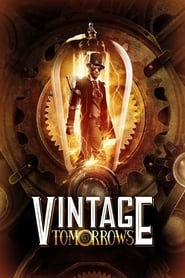
Vintage Tomorrows
English সাবটাইটেল ডাউনলোড করুন
রিলিজ তথ্য
ট্যাগ
Download English Subtitle Files for Mobile (2)
English সাবটাইটেল প্রিভিউ
প্রথম 200টি লাইন।
People constantly ask me, what is steampunk?
It's stories and stuff -- movies, pictures, objects.
That draws its inspiration
from the science fiction of the 19th century.
Based around a fantasticated Victoriana.
Looking back to look forward again and say, but what if?
It's not a historical movement; it's an anachronistic movement.
You get the fantasy stuff, and you get the science fiction stuff,
and it comes together, and it's made of awesome!
I would call it the crossroads of technology and romance.
There's adventure, there's excitement.
You break away from the prim and the proper
and the straight and the narrow
and you end up going just a little bit wild.
Things are on fire. Things are gushing steam.
Things are powered by zombies and ether.
I mean, that's exciting.
People ask me why I like steampunk.
I'm like, "It's fun!"
I love it when a kid runs up and goes,
"Oh my god, this is steampunk!"
The Society for Creative Anachronism
never seemed half as creative as this.
People will debate really what steampunk is.
People have different visions of it.
But trying to distill it down to something
that you can tell your mom is kind of difficult.
And I think it's been very hard to explain to people
that, yeah, steampunk is political.
I made the claim in an issue of Steampunk Magazine
that steampunk would save the world.
I'm a little bit into blind optimism.
We're causin' a riot.
When you walk down the street in a top hat and spats,
you are causin' a riot.
You're makin' a statement.
We're writing a book on steampunk.
So we're getting a group of steampunks together,
along with a futurist
and a cultural historian
to talk about the future and to talk about
what steampunk can tell us about the future.
We've got representatives from all around
the different portions of steampunk culture,
so everything from literature
You get to fashion to games to music, You get you name it.
And there's a whimsy to it and there's a play with the past
that I think can tell us a lot about how human beings
think about themselves in relationship to their past
and what that takes them toward their future.
In the work that I do in future casting,
it's looking five, ten, fifteen years out,
and so I'm always searching for different visions of the future,
and that's one of the things that I found really interesting
about steampunk because steampunk gives you
a revisionist history of the past.
It's recrafting the past, and that fascinated me.
We've referred to me as an embedded cultural historian
in a sense, and so in some senses
I am becoming a part of this culture increasingly.
In other senses, I'm studying it.
I have questions.
I have questions I want answered.
I am here so that I can build a better future,
so that we can build better technologies for people,
and I want to learn from these experts
to get to, what is the future that we want?
And that's not easy.
In the end, it isn't just about being fans of steampunk.
It isn't just about thinking steampunk's cool.
I think that we can really learn something important
and I think that tonight we could actually do something
that's quite important to think about
what is the future that we want to live in?
And it might take a little bit of digging,
but I think we can get there.
I want to thank you all before we start.
Cheers. Thank you so much.
So just give a sort of a little overview
of sort of what you see as steampunk
but then, more importantly, how did you come to it?
It just connects with so many different things that I love.
Like everyone else at this table,
I love things that are beautiful and beautifully made.
I love things that are both functional and ornamental
and I love the creativity and the imagination
that go into a lot of the things
that people in the steampunk community do.
Steampunk is an odd recursive coining
that echoes cyberpunk.
Certainly ever since cyberpunk,
there's been a kind of, I would say,
a sort of parlor game among geeks,
which is, you know, X punk, Y punk, anything punk.
It's nostalgic cyberpunk.
That's like super interesting.
It's science fiction unshackled
from all that tedious reality stuff.
It is retro futurism.
It is the science fiction of the future that never happened.
It's full of grand and glorious stylish people
doing beautiful, hand-tooled stuff with technology.
Imagine the Victorians flying to the moon
in a hot air balloon.
People want to get into things which will have history,
that have stories that are unique and personal,
and steampunk is all about that, and you can do it
not only with the clothes that you're wearing
but with the ideas that are in your head.
And people usually get pretty excited about it.
It's a fun thought experiment.
When the Victorians were writing this sort of material,
they were like, "Oh, this is great!
"Let's build a gun big enough
"to shoot a bullet at the moon!" You know?
And it's like, sure,
and you know what it's gonna get there? Paste.
But you don't have to deal with that in steampunk.
It has more of a sense of fun, and people like that.
When it comes to steampunk, the appeal is so much broader.
It's about 50 - 50 men and women, and you see people of all ages.
I found science fiction very early on as a kid
by watching television shows like Star Trek.
The idea of mashing up science fiction and robots
with this Wild West aesthetic just blew my mind.
And I love the rivets
and I love the gears and I love the steel
and I actually get kinda kinky about that stuff.
I grew up reading books like James Gurney's Dinotopia,
which is a fantastic example
of just a beautifully designed world
that embraces science fiction
and embraces the Victorian setting.
The actual movement,
I probably started to pay attention to it around 2004,
and at first I had a very heavy disdain for it
because, um, as I summed it up:
"It was just robots with top hats."
And I think I had already become tired of the tropes
that I would later associate with steampunk.
But then I met like-minded artists and craftspeople
and I realized that the only way
that subculture is going to improve
would be if we participated in it.
We did Burning Man in 2008
and we discovered this whole steampunk thing.
I come upon this Victorian house on wheels
and this entire camp of people
dressed up like they came out of the 1890s,
and it just seemed like a nice transition
from one subculture to another subculture.
My husband was into neo-Victorian things and goth,
and I was a little bit into it.
I was mostly a huge science fiction fan.
So I started wearing steampunk
to general science fiction conventions,
and people would come up and go, "Oh, is that steampunk?
I've heard of this. This is cool!"
Probably since the early '80s,
I've been wearing bowler hats and vests,
and I've been making models of airships and things like that,
but it wasn't until a few years back
that I went to my first con
and they had a big steampunk theme,
and I thought, I like this, you know,
and it's right up my alley, and, oh, look, it's got a name.
We started a comic quite a long time ago now,
and we called it "gaslamp fantasy"
because we felt that we didn't quite fit the mold
of what was out there being called steampunk.
So it was already in full swing
by the time we found out about the whole subculture part of it,
and it was a really cool surprise.
Somebody said to me, "Oh, well, you should really
look into steampunk, 'cause I think you'd really
like the aesthetic."
So I started hunting around on the Internet,
and it was a really wonderful environment to share
and we started talking about what would happen
if this became a subculture, hypothetically?
I actually started Steampunk Magazine
in, essentially, a cultural vacuum.
I was only aware of steampunk in this very periphery way.
And what I found right away was that there was actually already
a small and growing community around steampunk.
To me, the fun part was the punk part.
I like the idea of taking history and just twisting it.
It has a pleasingly counterculture aspect to it,
but it's not the kind of angry, antagonistic
kind of counterculture which you often see
in the original punk movements.
We can do this ourselves.
We don't need this handed down to us.
You know, the government or culture, you know, writ large
has nothing for us.
We can go out and find it ourselves.
You find a lot of artists in the movement:
writers, musicians, makers...
What might bring all of these people together, I think,
is a sense of theatricality and of wanting to live
মন্তব্যসমূহ
No comments yet. Be the first to leave one.