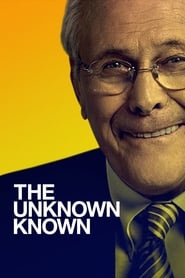
The Unknown Known
English সাবটাইটেল ডাউনলোড করুন
English সাবটাইটেল প্রিভিউ
প্রথম 200টি লাইন।
Let me put up this next memo.
You want me to read this?
Yes, please.
"February 4, 2004.
Subject: What you know.
There are known knowns.
There are known unknowns.
There are unknown unknowns.
But there are also unknown knowns.
That is to say, things that you think you know
that it turns out you did not."
I wonder if in the future
public figures will write as many memos as I did.
I doubt it.
I must have gotten in the habit of dictating
things that were important.
Not a diary.
Not a journal.
They're almost all working documents.
Now, they've become historical documents in retrospect,
but at the time, they all had a purpose.
In the later years of my using the dictaphone,
why, they were called snowflakes,
because they were on white paper.
What would you say the total number of memos
might be?
They said I dictated 20,000
just in the last six years at the Pentagon.
There have to be millions.
"July 27, 2001."
A memo to Condoleezza Rice concerning Iraq.
"We have discussed Iraq on a number of occasions.
The discussions have been inconclusive.
Sanctions are being limited
in a way that cannot weaken Saddam Hussein.
We can publicly acknowledge that the sanctions don't work
over extended periods and stop the pretense
of having a policy that is keeping Saddam
'in the box' when we know he has crawled
a good distance out of the box.
Within a few years,
the U.S. will undoubtedly have to confront
a Saddam armed with nuclear weapons.
If Saddam's regime were oustered,
we would have a much-improved position
in the region and elsewhere."
Why the obsession with Iraq and Saddam?
Well, you love that word, "obsession."
I can see the glow in your face when you say it.
Well, I'm an obsessive person.
Are you? I'm not.
I'm-- I'm cool.
I'm measured.
If you look at the range of my memos,
there might be 1/10 of 1% about Iraq.
The reason I was concerned about Iraq
is 'cause four-star generals would come to me and say,
"Mr. secretary, we have a problem.
Our orders are to fly over the northern part of Iraq
and the Southern part of Iraq on a daily basis,
with the Brits, and we are getting shot at.
At some moment-- could be tomorrow,
could be next month, could be next year--
one of our planes is gonna be shot down
and our pilots and crews are gonna be killed
or they're gonna be captured."
The question will be,
"what in the world were we flying those flights for?
What was the cost-benefit ratio?
What was our country gaining?"
So you sit down and you say,
"I think I'm gonna see
if I can get the president's attention.
Remind him that our planes are being shot at,
remind him that we don't have a fresh policy for Iraq,
and remind him that we've got a whole range of options."
Not an obsession.
A very measured, nuanced approach,
I think.
In my confirmation hearing
when I was nominated to be secretary of defense,
the best question I was asked was,
"what do you worry about when you go to bed at night?"
And my answer was, in effect,
"intelligence.
The danger that we can be surprised
because of a failure of imagining
what might happen in the world."
There are known knowns, the things we know we know.
There are known unknowns,
the things we know we don't know.
There are also that third category
of unknown unknowns,
the things we don't know we don't know.
And you can only know more about those things
by imagining what they might be.
Pearl harbor was a failure of imagination.
We didn't know we didn't know
that they could do what they did the way they did it.
We had people working on breaking codes.
We had people thinking through,
"what are the kinds of things they might do?"
And lo and behold, the carriers were able to,
on a Sunday morning, get very close to Hawaii,
launch their planes, and impose enormous destruction.
Was it failure of imagination
or failure to look at the intelligence
that was available?
They had thought through
a great many more obvious possibilities.
People were chasing the wrong rabbit.
That one possibility was not something
that they had imagined was likely.
"July 23, 2001.
Subject: 'Pearl harbor post-mortem.'
in some future hearing,
I am going to say that I do not want
to be sitting before this panel
in a modern-day version of a pearl harbor post-mortem:
Who didn't do what, when, where, and why.
None of us would want to have to be back here
going through that agony."
A month or so before September 11, 2001,
it would be wrong to think that someone who wrote it--
namely me, was prescient.
I wasn't.
I simply had read enough history
that I worried.
American 11, climb,
maintain flight level 350.
American 11, climb, maintain flight level 350.
American 11, Boston.
The American on the frequency, how do you hear me?
American 11, if you hear Boston center
re-contact Boston center on 127.82.
That's American 11, 127.82.
My military assistant,
admiral Ed Giambastiani, came in and said,
"a plane has hit the world trade center."
It was assumed to be an accident.
And I went into my office from the conference room,
and admiral Giambastiani said, "another plane has hit
the other world trade center tower."
And of course, at that point,
it wasn't an accident; It was an attack.
Within minutes, I felt the Pentagon shake.
That's how our day began on September 11th.
They had hit the center of economic power in New York,
and they then had hit the center of military power
at the Pentagon.
You need to find out what had happened.
What was it?
I got up and went down the hall, and--
on my floor, until the smoke was so bad
I had to get outside.
Then I went downstairs and outside and around the corner,
and here were pieces of that American airlines airplane
just spread all over the apron, all over the grass.
Flames and smoke,
people being brought out of the building
who were injured and burned and wounded.
The first responders really hadn't arrived yet.
There were very few people there.
How do you think that they got away with 9/11?
It seems amazing in retrospect.
Everything seems amazing in retrospect.
Pearl harbor seems amazing in retrospect.
It's a failure of imagination.
It's not as though you aren't aware of possibilities,
but you tend to favor some possibilities
more than others.
And it's enormously important to have priorities.
What are you gonna worry about?
What is it you want to do?
What are you gonna be prepared for?
And you have to pick and choose.
Well, to the extent you pick and choose
and you're wrong...
...the penalty can be enormous.
"September 30, 2001."
Memorandum. Title: "Strategic thoughts."
"The U.S. strategic theme should be aiding local peoples
to rid themselves of terrorists
and to free themselves of regimes
that support terrorism.
The regimes of such states should see that it will be fatal
to host terrorists who attack the United States.
The United States government should envision
a goal along these lines.
New regimes in Afghanistan and another key state or two
that supports terrorism.
Syria out of Lebanon.
Dismantlement or destruction
of weapons of mass destruction capabilities.
If the war does not significantly change
the world's political map,
the U.S. will not achieve its aim."
On my orders, the United States military
has begun strikes
against Al-Qaeda terrorist training camps
The Unknown Known subtitles in other languages
More English subtitles for The Unknown Known
- The Unknown Known 2013 1080p BluRay X264-Japhson · 155 downloads · 2016-08-22
মন্তব্যসমূহ
No comments yet. Be the first to leave one.