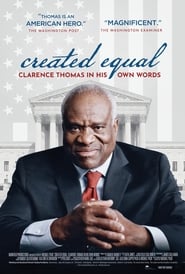
Created Equal: Clarence Thomas in His Own Words
English সাবটাইটেল ডাউনলোড করুন
রিলিজ তথ্য
ট্যাগ
English সাবটাইটেল প্রিভিউ
প্রথম 195টি লাইন।
James, are we keeping the glasses on or off?
Does it matter?
The only issue is that because they're bifocals
there's a line going through his eyes.
Do you need them on, Justice Thomas?
No.
I wear them, that's my normal--
I normally have glasses on.
Yes.
Not on the cover of your book.
Well, except for the cover of my book I normally wear--
Justice Thomas, how did you decide you wanted
to become a lawyer?
You look around society and you see, its laws.
Laws affect everybody.
If you're poor, and you look at people
like my grandfather,
I think of when he came home one day,
and he was very upset,
and he was taking a drink.
He never took a drink in the middle of the day.
Well what had happened was, he was driving the oil truck,
a police officer stops him
for having too many clothes on,
and that's ridiculous.
He has no way of challenging that.
So the law, he ran into the law
and he always was afraid of that.
You couldn't walk across certain parks;
you couldn't go to certain schools;
people's property being taken; people taking advantage of him
because they could say "The law did this" or "Did that."
So I decided I was going to go to law school.
Senator BIDEN: Judge Thomas, do you solemnly swear to tell the truth,
the whole truth, and nothing but the truth, so help you God?
Judge THOMAS: I do.
Senator BIDEN: Please be seated.
Let me look a little bit from your life and history,
you are somewhat an enigma.
You have gone through many changes in your life.
Which brings us to the question:
what is the real Clarence Thomas like?
Judge THOMAS: The person you see is Clarence Thomas.
I don't know that I would call myself an enigma.
I am just simply different from what people painted me to be.
My earliest memories are those of Pin Point, Georgia,
a life far removed in space and time from this room,
this day and this moment.
We were isolated.
It was a community.
You could see the river from there.
You hear of the song Moon River,
Johnny Mercer's from Savannah.
I am descended from the west African slaves
who lived on the Barrier Islands and in the low country
of Georgia, South Carolina and coastal northern Florida.
In Georgia my people were called Geechees,
in South Carolina, Gullahs.
It was just a distinctive culture, it was West African.
It had a mixture of English, and other words,
with kind of a diction that was somewhat
difficult to understand.
I know when I first went down to Pin Point I said
"Clarence, I can't understand a word that they just said"
because they talk in a dialect.
So I just try to listen and smile.
I was born at home, right on Shipyard Creek in 1948.
My mother always I was too stubborn to cry, and I guess
that was a sort of indication of the kind of person I would be.
A middle child.
My mother had all of us, we think, before she was 20.
And then she and my father separated when I was a toddler.
So I would have no early memories of him.
I have memories of other family members, but he wasn't there.
He wasn't among the family members.
Many of the men raked oysters
during the winter, and caught crabs,
and fish in the spring and summer.
Their boats, which were called bateaus,
could be heard far away in the marshes.
They would slowly emerge from the labyrinths
of surrounding creeks and pull up to the dock
where the day's haul was unloaded.
The women picked crab; people like my mother, and my relatives
did that at the crab factory.
And they also shucked oysters-- all of which is hard work.
Well, when they were gone, we were on our own.
We were off on our adventures.
We would catch minnows in the creek.
We would walk along the water's edge,
throwing oyster shells.
Most people didn't have store-bought toys.
So, you had lots of old tires that had gone bad.
If you go back to the movie, To Kill a Mockingbird--
You Ready?
Uh-huh, let her go.
Scout, the young girl,
when she is pushed into Boo Radley's yard, she's in a tire.
I have no idea how kids today can have any idea
what they were doing with her inside a tire.
We always did that.
I remember years later reading Huck Finn, and Tom Sawyer,
and wondering what the fuss was about.
We had done a lot of those things.
One day I came home someone said there had been a fire.
And we get there, and this little shack that we had
all been living in was just ashes and twisted tin.
Everything that you ever knew in life is just there,
I mean it's smoldering.
When I was a boy Savannah was hell.
My mother lived in one room in an old tenement
with an outdoor bathroom.
That is the worst place I've ever lived.
And so, you had the contrast between rural poverty,
which is what we had in Pin Point, which was very livable.
And then you had urban squalor, and that was horrible.
Whenever you flushed the toilet, or someone else flushed,
it didn't actually go in the sewer system.
It went in somebody else's yard.
My all encompassing word is gross,
I mean it was putrid.
It was the smell of raw sewage.
There were these boards, people would make these sort of
makeshift paths to get across the just,
the gross wetness in the back yard.
Savannah is still a segregated city.
One of the major parks downtown is a rectangle, Forsyth Park.
You were never allowed to walk to the interior of that park.
That's how I figured out the word "circumnavigate."
You would walk around.
You could not go across the park.
I was supposed to go to school in the afternoons
and my mother wasn't there to make me go,
because she had to go to work, so I wandered
the streets by myself.
I was six.
You were hungry, and didn't know when you'd eat, and cold,
and didn't know when you'd be warm again.
My mother had difficulty with two little boys
and working as a maid.
So she asked my grandparents for help.
And my grandmother suggested that she let--
her raise these two boys.
And one day, one Saturday morning we w--, we woke up,
and my mother said "Put all your things in the grocery bag."
And remember the paper grocery bags in those days,
and my brother took one, and neither one was full.
But we, all of our items, just imagine everything you have
in less than a paper bag.
So, we took our grocery bag each,
and walked the couple of blocks from Henry Lane,
to East Thirty-Second Street.
That was the longest, and most significant journey
I ever made, because it changed my entire life.
My grandfather was this myth.
He was very stern.
And he sat us there at the kitchen table,
and he said "Boys, the damn vacation is over."
And he said from then on it was going to be
"Rules and regulations" and "Manners and behavior."
Oh my goodness, and he meant it, and he just explained what
the rules were: my grandmother was always right,
that he was in charge.
He made it very clear that it was by grace that we were there
his grace.
And the door in 1955 when we went to live with him
was swinging open, inward, and if we didn't behave ourselves
there'd be a day when it would swing outward
and we'd be asked to leave.
They lived in this new house, and it was beautiful.
For us, it could have been a palace.
We had never been in a house with a bathtub,
beautiful white porcelain toilet.
My brother and I, one of our activities was to flush
that toilet every time we had a chance.
I mean we would walk by and flush the toilet.
And my grandfather said, he would chastise us and said you,
as he would say "You're runnin' up my damn water bill."
Beautiful, as we used to say back then, modern kitchen
with a refrigerator, etc. and lots of food.
And my grandmother would just lavish you with those things.
My grandmother was as sweet as she could be
she would always be saintly.
By the time we went to live with my grandfather
he was delivering fuel oil.
The rule was: we got out of school at 2:30;
you had to be home, dressed, and ready to be
on the oil truck by 3:00.
When you rode with him, he was the professor.
You could not initiate a conversation,
so you were constantly getting this one-way input.
He thought that we were destined to have to work for everything
because of what happened in the Garden of Eden,
and because of our fallen nature; we would have to earn
everything by the sweat of our brow
More English subtitles for Created Equal: Clarence Thomas in His Own Words
- Created Equal Clarence Thomas ins Own Words 2020 1080p WEBRip DD5 1 x264-NOGRP · 15 downloads · 2020-10-19
- Created Equal Clarence Thomas ins Own Words 2020 1080p WEBRip DD5 1 x264-NOGRP · 17 downloads · 2020-10-19
মন্তব্যসমূহ
No comments yet. Be the first to leave one.