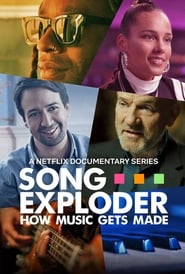
Song Exploder
Λήψη English Υπότιτλων
Πληροφορίες έκδοσης
Ετικέτες
Προεπισκόπηση υποτίτλων English
Οι πρώτες 151 γραμμές.
Every moment that you survive in life
makes you stronger.
It's going to bring something good if I want to see it,
if I want to take it.
Natalia! Natalia! Natalia!
Natalia Lafourcade is a singer and songwriter from Veracruz, Mexico.
Since her debut in 2003,
she's become one of the most influential artists in Latin music.
She sang the theme song from the Oscar-winning Pixar film, Coco .
She's won a Grammy and 12 Latin Grammys,
including Record of the Year and Song of the Year for "Hasta la Raíz,"
which means "To the root."
The roots, in this case, extend in two directions:
into Natalia's own past
and the soil and history of where she's from.
I'm Hrishikesh Hirway.
This is Song Exploder .
- -
I moved to Veracruz when I was two years old.
It was when my parents separated.
That's when my mom decided to move to Coatepec.
Look how yummy.
I want to eat everything.
This just got out of the oven.
This is hot.
This is very bad for you. This is bad.
I just like it here.
It's simple, and it's familiar.
Life is so cheap here and rich.
Want to see pictures
-you left a year ago? -When I came with Dad!
Handsome boy. Look how pretty.
Oh, yes. Here you are with my dad.
The Captain.
The Captain.
My father, who is a musician…
There's actually photos of me playing my father's clavichord
when I was one or two years old.
- -Playing Bach or whatever.
My father really wanted me to be a piano player,
and I was like, "No, I don't want to play classic music.
I want pop, and I want rock."
My father was really mad at me.
He was like, "This is not music."
He was super strict.
Then everything…
When Natalia was 17 years old, she released her first album.
It featured the hit song "En el 2000."
The album went Platinum in Mexico and reached number one on the charts.
Everything got really huge.
My name was everywhere and…
everything happened too fast.
The music industry was so huge for me.
I was too young for dealing that much information.
Something was missing.
I didn't know what it was.
I was having a block with inspiration.
Like, I wasn't able to write my own music.
I was being a solo artist
and having this successful moment,
but at the same time, I wasn't feeling that happy, you know?
And it didn't feel real to me.
So I needed to step back and have this space.
Something in my spirit got sick,
and I needed to heal it.
I knew that I needed to go very far away from home.
In 2006, despite her phenomenal success,
Natalia moved to Canada with a plan to rest, work on her visual art,
and leave the music industry behind.
She was 22, but as things turned out, she didn't escape music altogether.
I ended up in a house full of musicians.
Great musicians.
It was just like a window to another world that I didn't know.
Music that I didn't know that exist.
Funk,
blues,
Afrobeat.
For me was, "Wow, okay,
there's a whole world out of my world."
I started writing again
and trying to have that with my own music.
I was writing songs on the piano every day, playing the piano.
I started, like, feeling comfortable, only me and the guitar.
I was just trying to find my own way of writing my music,
and I knew that I wanted it to be more like from the heart.
And after almost a year, I said,
"Maybe I should go back and try again,
but this time will be my way."
Natalia contacted an old friend, Leonel García,
about trying to write together.
A singer-songwriter who has sold millions of albums…
- Leonel García. Take one. -
Mark.
- - By then, we were friends.
So I was like, "Hey, would you write a song with me?"
And he was like, "Of course."
He asked me, "Do you know already what you want to sing about?"
And I said, "I just feel like writing a song
that is about the place I come from, Veracruz.
I want to have a lyric that will remind
all the time where I come from,
what I am, and all those things that build me as a person."
"It's like something that people can relate to in a big way, emotionally.
A very proud song."
And I said, "Okay, let me see what I can come up with."
He had a melody and chords,
and then we were just like, "We should do this like a huapango."
I thought about many ideas,
but I started with this approach to huapango,
that is a folkloric rhythmic of Mexico.
Always used to sing huapangos in the parties,
and I learned that part of my family relation,
like the way we were having fun or celebrating something,
huapango is always there.
It is music that is happy,
but at the same time, it's got a seriousness.
You feel free when you listen to it.
And you dance and drink with it.
The huapango thing is something that I think Natalia has too, in her DNA.
So I think that helps us to connect
and to felt we were doing something together from our roots.
Is this what you were playing?
- - Yeah, it was like mixing both things,
right, like the acoustic guitar and also like the Wurlitzer.
And we build the song from those two instruments.
That help us go into another direction,
more like pop music.
One of my rules was not taking it so seriously.
Play around and sharing the experience.
Didn't want to be so strict
and so serious about it,
because I was like that before. I wanted to be more like…
…not thinking this is going to go on the radio,
or this is going to go commercial.
It was more free.
And then Leonel asked me to go into the studio and sing the song.
If you want to make people be excited and proud,
you need to give them some phrases, some words,
that makes them feel related to their roots
-and feelings. -
I was discovering the words by singing them.
It helped me to really make a stronger connection
to what I was singing
and where I was singing from.
The image of burning dreams to clean with this sacred smoke
every memory is what it says.
We have copal, which is this essence that you burn,
and it has this… smoke.
They say that this copal, you clean your aura,
and you clean your energy.
-Something like that. -Yeah.
Song Exploder subtitles in other languages
More English subtitles for Song Exploder
- Song Exploder S02 720p NF WEB-DL DDP5 1 H 264-NTb · 20 downloads · 2020-12-16
- Song Exploder S02E03 eng · 19 downloads · 2020-12-15
- Song Exploder S02E02 eng · 15 downloads · 2020-12-15
- Song Exploder S02E01 eng · 16 downloads · 2020-12-15
- Song Exploder S01 720p NF WEB-DL DDP5 1 x264-BTN · 39 downloads · 2020-10-10
Σχόλια
No comments yet. Be the first to leave one.