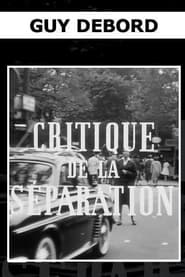
Critique of Separation (Critique de la Séparation)
English സബ്ടൈറ്റിൽ ഡൗൺലോഡ് ചെയ്യുക
റിലീസ് വിവരങ്ങൾ
ടാഗുകൾ
English സബ്ടൈറ്റിൽ പ്രിവ്യൂ
ആദ്യത്തെ 120 വരികൾ.
When one thinks how it's natural and advantageous...
for mankind to identify his own language and reality,
one guesses what sophistication degree we must have reached...
to dissociate both,
and study them as separate objects.
This is a quote from Andre Martinet's book...
Elements of General Linguistics.
The documentary you are about to see is called 'Critique of Separation'.
It was written and directed by Guy Debord.
The images are from André Mrugalski,
About a subject which cinema never dared to approach.
This film was screened in February 1961,
And was produced by "Dansk-Fransk Experimentalfilm Kompagni".
We don't know what to say.
Sequences of words are repeated; gestures are recognized.
Outside us.
Of course some methods are mastered,
some results are verified.
Often it's amusing.
But so many things we wanted have not been attained,
or only partially and not like we imagined.
What communication have we desired, or experienced,
or only simulated?
What real project has been lost?
The cinematic spectacle has its rules,
its reliable methods for producing satisfactory products.
But the reality that must be taken as a point of departure is dissatisfaction.
The function of the cinema, whether dramatic or documentary,
is to present a false and isolated coherence
as a substitute for a communication and activity that are absent.
To demystify documentary cinema,
it is necessary to dissolve its "subject matter."
A well-established rule is that any statement in a film...
that is not illustrated by images must be repeated,
or else the spectators will miss it.
That may be true.
But this same type of miscommunication...
constantly occurs in everyday encounters.
Something must be specified but there's not enough time,
and you're not sure you've been understood.
Before you have said or done what was necessary,
the other person has already gone.
Across the street. Overseas.
Too late for any rectification.
After all the empty time,
all the lost moments,
there remain these endlessly traversed postcard landscapes;
this distance organized between each and everyone.
Childhood? Why, it's right here -
we have never emerged from it.
Our era accumulates powers,
and imagines itself as rational.
But no one recognizes these powers as their own.
Nowhere is there any entry to adulthood.
The only thing that happens is that this long restlessness...
sometimes eventually evolves into a routinized sleep.
Because no one ceases to be kept under guardianship.
The point is not to recognize that...
some people live more or less poorly than others,
but that we all live in ways that are out of our control.
At the same time, it is a world that has taught us how things change.
Nothing stays the same.
The world changes more rapidly every day;
and I have no doubt that those...
who day after day produce it against themselves...
can appropriate it for themselves.
The only adventure, we said, is to contest the totality,
whose center is this way of living,
where we can test our strength but never use it.
No adventure is directly created for us.
The adventures that are presented to us...
form part of the mass of legends transmitted...
by the cinema or in other ways;
part of the whole spectacular sham of history.
Until the environment is collectively dominated,
there will be no real individuals -
only specters haunting the objects...
anarchically presented to them by others.
In chance situations,
we meet separated people moving randomly.
Their divergent emotions neutralize each other...
and reinforce their solid environment of boredom.
As long as we are unable to make our own history,
to freely create situations,
our striving toward unity will give rise to other separations.
The quest for a unified activity...
leads to the formation of new specializations.
And only a few encounters were...
like signals emanating from a more intense life,
a life that has not really been found.
What cannot be forgotten...
reappears in dreams.
At the end of this type of dream, half asleep,
the events are still for a brief moment taken as real.
Then the reactions they give rise to become clearer,
more distinct, more reasonable;
like on so many mornings...
the memory of what you drank the night before.
Then comes the awareness that it's all false,
that "it was only a dream,"
that the new realities were illusory and...
you can't get back into them. Nothing you can hold on to.
These dreams are flashes from the unresolved past,
flashes that illuminate moments...
previously lived in confusion and doubt.
They provide a blunt...
revelation of our unfulfilled needs.
Here we see daylight,
and perspectives that now no longer have any meaning.
The sectors of a city are to some extent decipherable.
But the personal meaning...
they have had for us is incommunicable,
as is the secrecy of private life in general,
regarding which we possess nothing but pitiful documents.
Official news is elsewhere.
Society broadcasts to itself its own image of its own history,
a history reduced to a superficial and static pageant of its rulers -
persons who embody the apparent inevitability of whatever happens.
The world of the rulers is the world of the spectacle.
The cinema suits them well.
Critique of Separation subtitles in other languages
More English subtitles for Critique of Separation
- Critique de la séparation 1961 DVDRip XviD, thanks to and made by hellboytr! · 20 downloads · 2006-09-25
അഭിപ്രായങ്ങൾ
No comments yet. Be the first to leave one.