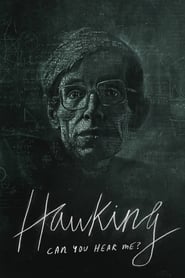
Hawking: Can You Hear Me?
English സബ്ടൈറ്റിൽ ഡൗൺലോഡ് ചെയ്യുക
റിലീസ് വിവരങ്ങൾ
ടാഗുകൾ
English സബ്ടൈറ്റിൽ പ്രിവ്യൂ
ആദ്യത്തെ 200 വരികൾ.
Peter: I'll never forget that
first meeting with Stephen
in the parking lot of the Holiday Inn in Chicago.
A small compact car kind of pulled into the parking lot.
Someone got out, went back to the trunk
and took out this collapsible wheelchair.
Suddenly, this wheelchair kind of spun to life,
spun around literally did a 360
and took off across the parking lot.
I guess I opened my door at that point and this young man said
"Uh, Peter Guzzardi, is-- is that you?"
"Is that Peter Guzzardi?" And I said, "Yes, it's me."
And he said, "Well, that's Professor Hawking."
"And we've gotta go, we've gotta go after him."
So, I-- I start to blather a little bit.
It's like, "How are you Professor Hawking?"
"It's wonderful to meet you."
And then there was this-- this kind of silence.
Stephen Started to emit sounds
and the graduate student translated.
What-- what this young man said to me was,
"Where's the contract?"
All that came to mind was, you know, like, "Uh-oh!"
This is not gonna be easy.
The book about scientific theory
has been a top best seller.
Woman on TV: It's called "A Brief History Of Time"
and it was written by a remarkable scientist
named Stephen Hawking.
Man on TV: The man often compared to Galileo,
Einstein and Newton.
Peter: Stephen really was this strong willed man
who was singularly focused
on what he wanted to accomplish
and was gonna move Heaven and Earth to do it.
Soon it will have been in the best seller list
longer than any other book in history.
Lucy: Who knows what else he would have done.
What else would he have achieved if he hadn't had
motor neurone disease.
All the time I knew my father...
he was 24 hours off dying.
Um, the fact that it didn't happen is a miracle.
Stephen: Can you hear me?
I was 20 in October 1962.
I had moved to Cambridge to undertake my Ph.D.
It was a very cold winter and my mother persuaded me
to go skating on the lake in St. Albans.
I fell over and had great difficulty
getting up again.
My mother realised something was wrong
and took me to the doctor.
Mary: Stephen was first diagnosed
with the motor neurone disease
shortly after his 21st birthday.
Stephen ended up in St. Bartholomew's hospital
where I was...
a pre clinical student.
The prognosis he was given was a maximum of three years
with a rapid deterioration before then.
Stephen: At first I became depressed.
There didn't seem any point working on my Ph.D.
because I didn't know if I would
live long enough to finish it.
Ammar: Professor Hawking was diagnosed
in the early 1960's.
There was no treatment that could prolong survival.
That is essentially a death sentence.
The nerve cells controlling
the muscle movement die off.
Eventually, the patients lose the ability to walk,
to use their arms, to speak, to swallow or to breathe.
Most people feel very, very low.
And some people find it very difficult to come out
of that in a positive state of mind at all.
Stephen: While there is life, there is hope.
I had come to Cambridge to do Cosmology
and Cosmology I was determined to do.
Mary: Stephen was always one for puzzles.
Wanting to... work out the logic of things.
Stephen: I had a passionate interest in model trains.
I was always very interested in how things operated.
And used to take them apart
to see how they worked.
My aim was always to build working models
that I could control.
If you understand how the universe operates
you control it in a way.
Mary: All scientific laws are hypothesis.
The mathematical rules that will tell you
how other things will behave.
Stephen was always looking for the rules
that would let him win.
Stephen: I began to make progress in my work.
There was also a young woman called Jane
whom I had met at a party.
It makes me laugh even to think of him now.
Jane: I was an undergraduate
in London at the time.
I was drawn by his sense of humour and his wide smile.
And he had his beautiful grey-blue eyes.
I thought he was so clever.
He had his own particular charm...
which was very attractive.
Conversations were
always entertaining,
always funny, and Stephen
always had the last word.
He had a romantic side,
as he invited me to May Ball in Trinity Hall
soon after we met.
And that's a very romantic thing to do.
That was fun.
Mary: My family had considerable reservations.
Your son gets terminally ill
and suddenly introduces a girl that's
someone he wants to get married to.
It doesn't sound like a very good
basis for a marriage,
and does the girl know
what she's letting herself in for?
Jane: We were in love with each other
and I thought to myself,
"Well, really he may have
only two years to live."
But this was in the '60s,
"I might have only four minutes to live."
John F. Kennedy: This latest Soviet threat
must and will be met with determination.
Nobody knew when the next confrontation was going to be
which could lead to a nuclear war
and we would have four minutes warning of that.
Jane: July the 15th, 1965.
It was a very happy day and a very beautiful day.
We were married in the chapel in Trinity Hall...
where he was a post graduate student.
From the outside, Jane's decision was most unwise.
But it was Jane's decision.
Lucy: One thing that always strikes me
is the courage of both my parents.
It's quite extraordinary
when you think of what happened to those two,
probably rather naive, quite innocent 21 year olds.
Nobody could have foreseen what lay ahead of them.
We set off for New York state...
for a physics conference.
That was really our honeymoon.
It was almost as if everything had to be sacrificed
to what I call the worship of the Goddess of physics.
Roger: When I first encountered Stephen Hawking...
it was a kind of lazy journalistic cliche to say
that he was a new Einstein or the new Newton.
But certainly even right at the outset of his career...
Stephen Hawking wasn't just thinking big,
he wasn't just thinking enormous,
he was thinking cosmic,
about the whole universe.
Stephen: The big question in cosmology in the early '60s
was "Did the universe have a beginning?"
Roger: Stephen really started thinking
about the birth of the universe in mathematical form.
Stephen: I showed that the universe had to have
had a beginning...
in the singularity or Big Bang.
Roger: The Big Bang theory is a really extraordinary idea
you know, you look around the universe
look around your surroundings and the thought that you,
your house, the Earth, the solar system,
everything you can see was packed into this
unimaginably small space is an extraordinary thought.
Jane: Survival... and physics
were the prime motivators in his life.
Plus his children.
Mary: When Robert came along that was a surprise.
They hadn't been married that long.
And the normal pattern at that time
was to have your family when
you had a secure income to support them.
But Stephen obviously, didn't have time.
Robert: My father would sometimes be
deep in thought about whatever topic was on his mind,
whether that was scientific or not.
And so, sometimes it would be
hard to get his attention.
But that's I think sometimes
can be the case for most fathers.
He wanted to be involved as a father
but his disability meant that
he wasn't involved in some things that
normally as a father would be.
Jane: He very rarely spoke about his illness
but when he did, he said that the advantage of his illness
was that he was able to devote himself 100 percent
to his work.
He didn't have to change nappies,
he didn't have to make cups of tea,
he didn't have to cook meals.
But he could just get on with concentrating on physics.
He started using a wheelchair shortly after Lucy was born.
Lucy sat on Stephen's knee.
Hawking: Can You Hear Me? subtitles in other languages
More English subtitles for Hawking: Can You Hear Me?
- Hawking Can You Hear Me 2021 WEBRip x264-YTS MX-YIFY · 24 downloads · 2022-01-26
അഭിപ്രായങ്ങൾ
No comments yet. Be the first to leave one.