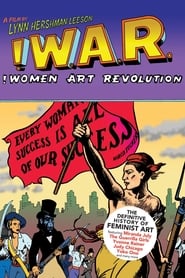
!Women Art Revolution
English സബ്ടൈറ്റിൽ ഡൗൺലോഡ് ചെയ്യുക
റിലീസ് വിവരങ്ങൾ
ടാഗുകൾ
English സബ്ടൈറ്റിൽ പ്രിവ്യൂ
ആദ്യത്തെ 191 വരികൾ.
In the late 1960s, a few women artists formed a coalition...
and named it WAR-- Women Artists in Revolution.
And you have to ask yourself...
why it was necessary for them to do this in the first place.
The books that you read in those days...
were written in a way that denigrated women artists,
if they even mentioned them.
As an undergraduate at Harvard University,
I don't think there was a single woman artist...
whose work was ever discussed in any one of my classes.
When you're a woman, it's hard to tell that you're being censored...
when you're not in a museum to begin with.
Can you name three women artists?
Who's a woman artist?
Um, Frida Kahlo.
That's one.Yeah?
Uh, Frida.
Oh.
Can anyone name three women artists?
- I need two more women artists. - Two more women artists.
Yes. A female.
This film is peppered with images...
that for years you were prevented from seeing...
because there was no access to them.
This film is the remains of an insistent history...
that refuses to wait any longer to be told.
1968.
One year after the summer of love,
America was still in Vietnam.
While at home, the Black Panthers, civil rights and free speech movements...
were only part of the subterranean agitations.
Another revolution was in progress.
There was a moral fervor to gather the fractured,
displaced and scattered remnants of the conditions of obscurity.
I was a freshly radicalized graduate student at Berkeley...
during the free speech movement.
I came from Cleveland and was expected to return,
but, after Berkeley, there was no turning back.
I felt an urgency to capture that moment,
to hold on to that experience.
I wasn't about to trust my own memory,
which was fragile even then.
So with a borrowed camera, I shot people that came through my living room...
right here on this very sofa 35 years ago.
One of the earliest feminist demonstrations...
was staged at the 1968 Miss America contest,
which was a symbol for women who measured up...
or didn't measure up to artificial standards.
The new Miss America stands 5 feet 7,
weighs 125 pounds...
and measures 36-24 1/2-36.
Police arrested a young woman inside the Atlantic City Convention Hall.
Police said the woman was spraying a foul-smelling vapor...
about 20 yards from the end of the runway.
And it was at that precarious moment in history...
that art and politics fused...
and then transfused...
into the blocked cultural arteries of the time.
It was a weeklong protest of art events against the Vietnam War.
I used a formation from my war piece.
And we snaked through the streets of SoHo with black armbands.
The politics of 1970 must clearly say to all American people...
that the walls between the races and the walls between the classes...
must come crashing down.
Judy Cohen-Garrowitz was inspired by the Black Panthers...
when she changed her last name to Chicago.
So we adapted the forms of the Black Panthers...
before we developed our own forms.
No, it was absolutely true.
I didn't feel like I had a name, you know, and I wanted to make some statement,
some kind of symbolic statement about the fact that I was taking control of my own destiny.
I was fighting it out, pretty much alone and isolated.
I shot wherever and whenever I could.
This clip of Judy Chicago was shot in a bathroom at Hayward State,
where we were able to get good sound.
Uh, let's see if I can think back that far, Lynn.
Now, we're going back into the end of the '60s, okay?
There were almost no women artists who were visible at all.
We all thought we were alone.
Some friends said to me,
"If anybody can tell you, you know,
what galleries you can go to or what you can do with this stuff,
go to Leo Castelli."
So like a fool, I made an appointment.
And I went to the uptown gallery, but of course he didn't see me.
Ivan Karp saw me.
And I was wearing high-heeled boots at the time,
and so I was, you know, really kinda tall.
And Ivan is small.
And there were these sculpture stands all around the place,
and he didn't have me put my big tablet--
24-by-36-- on this.
He had me put it on the floor.
So every time I turned a page,
it was like I was genuflecting to this guy, you know?
I felt humiliated.
And then he said-- he said,
"What'd you bring these to me for?"
I learned to, you know,
look into a lot of facets of the real world...
and what it meant to be a woman artist...
in the society and in the art world.
And as it was-- it was pretty tough.
Women aspiring to success in the male-dominated art world, as we know,
must work much harder at it...
and will be defined as second-rate for the most part.
It was sort of a built-in attitude within the institutions...
that it was acceptable, normal and preferable...
to have all-white-male shows.
So, coming up against that, both as a black person and as a woman,
was very daunting because it had to do with basic attitudes.
The people I was meeting didn't realize that I was recording...
and that they were creating much of what would become...
part of the feminist art movement.
But we all felt something transformative was occurring...
and that we were a part of it.
One voice, and then another,
became a chorus,
syncopated into a movement,
became a revolution.
These works are relics of resistance...
and very different from the work...
that was being exhibited in museums and galleries...
or was taught about in art schools and universities.
Minimalism was the prevailing tendency at that time.
The whole ethos of minimalist art...
was to arrive at an ever-purer notion of what an object could be.
I stepped forth from the university trying to figure out how,
trained as a minimalist painter,
I was going to make my work relevant to people I loved and cared about.
And there was that incredible disjunction at that point...
between content and the notion of making art.
In other words, art was content-less.
It was free and devoid of politics.
And that was a higher form.
When you have a culture...
in a state of grave agitation,
where people are marching by the hundreds of thousands in the streets--
Come alive, brothers! We are waiting for you!
And the leading artistic activity of the day is mute...
because of the way that that art is construed as an intellectual pursuit.
The growing tensions between minimal and feminist art...
are expressed in this performance...
where one artist represents minimal art...
and the other feminist art...
as they wrestle for domination...
to the background drone of minimal art rhetoric.
Art had reached an impasse...
that American culture was already breaking through.
There had to be an invention of a new kind of art,
and that's exactly when feminism starts in the art world.
In cooperation with the armed forces of South Vietnam,
attacks are being launched this week...
to clean out major enemy sanctuaries on the Cambodian-Vietnam border.
The National Guard is called out to restore order at Kent State in Ohio.
Leave this area immediately.
Guardsmen, harassed by rock-throwing and name-calling,
fire into a group of students.
What really spurred me to do performances...
was around 1970 when the killings at Kent State happened...
and Nixon invaded Cambodia.
I got a sense of the immediacy of these issues in my life...
that made me feel as though the work I had done up to that point...
was just not adequate to express my current concerns.
And so I felt the need to move out into the world...
and also the need to be more concrete and confrontational...
in my interactions with people through my work.
In protest to the invasion of Cambodia,
the artist Robert Morris closed his exhibition at the Whitney.
Robert Rauschenberg and Carl Andre withdrew their work from the Venice Biennale,
and together they opened a Biennale-in-Exile in New York City.
But the artists in this exhibition were only white men.
They said, "This show can't include women!"
Well, we just got mad, and we said, "We're mad! We're not taking it anymore!"
Faith contacted the organizers...
and threatened to demonstrate if they didn't integrate the exhibition.
And that was the first action.
And that was done by a group called WSABAL--
Women, Students and Artists for Black Art Liberation.
That group was actually just me and my daughter Michelle Wallace.
Those were the days when two people could raise a lot of hell.
And make everybody think we were 35,000 people. You know what I mean?
Between May and September 1970,
simultaneously and spontaneously,
other creative actions for integration surfaced throughout the country.
We had already picketed the Corcoran Gallery's Biennial...
for having an all-male exhibition...
right at the time when people were beginning to have a discussion about this.
And we organized that at my house,
and the conference used one of my bedrooms...
as our headquarters.
അഭിപ്രായങ്ങൾ
No comments yet. Be the first to leave one.