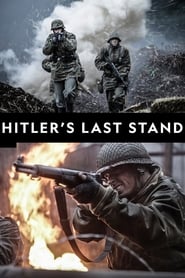
Hitler's Last Stand
English സബ്ടൈറ്റിൽ ഡൗൺലോഡ് ചെയ്യുക
റിലീസ് വിവരങ്ങൾ
ടാഗുകൾ
Download English Subtitle Files for Mobile (6)
English സബ്ടൈറ്റിൽ പ്രിവ്യൂ
ആദ്യത്തെ 200 വരികൾ.
When a U.S. Battalion is surrounded by Germans,
Soldiers of a segregated Japanese-American unit fight to reach them.
Pinned at the base of what they would call Suicide Hill,
No one moves when given the order to charge.
Until an unlikely hero steps up to lead the way.
On June 6th, 1944,
Allied forces finally land troops in Normandy
to open the western front.
But Nazi fanatics and diehards continue to fight ferociously for survival.
D-day was a battle.
They still need to win the war.
Friday, October 27th, 1944. The Vosges mountains, France.
American sergeant Shiro Kashino
leads his soldiers along a narrow path deep in the forest.
At 0300 hours they struggle to see their route.
It's almost unimaginable how dark it is.
The overhang of the trees, the blackness.
The total absence of any kind of city lights that would illuminate the sky
makes it seem like you're in the middle of a nightmare.
Afraid the men of the 442nd regimental combat team
will lose their way in the forest,
they pin squares of white paper to their backs for the soldier behind to follow.
Their mission is to rescue part of a battalion of American soldiers
completely cut off by German forces.
The other battalion is five miles away as the crow flies,
but the valleys dip and peak, to greatly increase the distance.
When they volunteered for the army,
many soldiers of the 442nd lived as detainees in incarceration camps.
After the bombing of Pearl Harbor,
an executive order signed by President Franklin Roosevelt
forced Japanese-Americans on the mainland from their homes.
Anyone with 1/16th Japanese heritage is incarcerated,
Including thousands of children, the elderly and disabled.
The government built ten so-called permanent relocation camps
spread across the United States and these were basically army shelters.
They were big barracks with common latrines,
set in the middle of nowhere, and surrounded by barbed wire,
and this would be the home for more than 100,000 Japanese Americans
for the next three years of their lives.
Japanese-Americans serving in the military on December 7th, 1941
are discharged or reassigned in February 1942.
But many young men in the camps still volunteer
when Roosevelt activates the segregated 442nd regimental combat team a year later.
Well you have to remember, these were boys.
They were youth ranging from 17, 18 years old to 21, 22 year old.
Some of them were patriots.
They wanted to fight to prove themselves to their country.
Some of them just wanted to get out of the camps. It was a terrible environment.
After training, the 442nd fights in Italy,
and then lands in southern France.
They were literally dodging bullets abroad
and they knew they had to win to save their lives.
On the other hand they also knew they were representing something about themselves
and their people who were still in the camps or were still in Hawaii.
And they understood that this was a test of who they were as Americans.
After their 3:00 am start,
the 442nd arrives at their jump off point in the late morning.
The unit they must rescue is still three miles away.
The lost battalion is from the 141st infantry regiment,
a sister regiment to the 442nd, within the 36th infantry division.
The 36th Division was pretty highly combat experienced by this time.
It had led the way in the invasion of South France in August 1944.
It had plunged into the Vosges by September.
And here's where the figurative fun began to kind of end.
As the 141st attacked to take hill 5-9-5,
First battalion pulls too far ahead.
Germans close in from behind and separate them from their regiment,
Cutting them off from reinforcement, resupply and relief.
The encirclement kicks off the Second World War version
of the Lost Battalion saga.
It was a term left over from World War I,
when you had a similar kind of situation,
where you've had a unit,
not really lost because loss would indicate that, you know,
they're gone, or you never know what happens to them.
No, you know precisely where they are. You just can't get to them.
Lieutenant Martin Higgins establishes
a defensive perimeter to secure their position.
For three days, the cut off battalion fends off a series of German attacks.
All attempts to fight their way out, or for the regiment to fight their way in,
have failed.
As their remaining rations and ammunition run low,
the situation for the Texan regiment grows desperate.
It's not clear how long they can hang on.
Sergeant Shiro Kashino and the members of "I" company
fight for every advance in the forest during the rescue attempt.
As they lead the American assault, the Germans launch a fierce counter-attack.
"I" company's left flank becomes exposed.
Kashino identifies a platoon pinned by a machine gun nest on the slope above.
Kashino was a Japanese American who grew up in Washington State,
and he was by all accounts a kind of all-American boy.
He played on the football team.
He found himself uprooted and sent to the Minidoka relocation camp in Idaho.
And I think he was impatient to get out of Minidoka,
and he saw the army as an opportunity to prove himself.
Suddenly, Kashino bursts out to relieve pressure on the trapped platoon.
He rushes uphill giving the Germans a moving target.
Kashino distinguished himself as consistently rising to the challenge.
If that meant risking his own life for the soldiers he was serving,
he would do it and he did it, time and time again.
Kashino succeeds.
He draws the German fire to himself, so the other men are able to advance.
He motions for them to loop around and take out the machine gun nest.
Still under intense fire himself,
he uses his Thompson submachine gun to cover their attack.
I think that kind of action both endeared him to his men
and proved that soldiers were capable of doing things,
you know, beyond their imaginations.
With the Germans distracted by his fire,
the others can eliminate the machine gun nest.
As the Americans fight ahead,
a German tank creeps into position above them.
The noise and chaos of the battle have masked its arrival.
Tech sergeant Al Takahashi spots the beast at the last second.
As its muzzle flares... - Feuer!
He throws himself to the side.
The shell fired by the tank lands in the dirt beside Al Takahashi,
but does not explode. Thankfully it's a dud.
But had he jumped in the other direction, the impact would've surely killed him.
The Americans fight an entrenched enemy,
spurred to make any Allied advance as costly as possible.
It's relatively rare in the war in 1944
that the Germans encircle an entire Allied battalion.
And this chance now is too good for the propaganda to lose.
So, German troops are ordered to stop any rescue attempts
from the Americans of this battalion.
Special mountain units are assigned to reinforce German positions.
Gebirgsjäger , or Mountain Troops,
were already founded in the First World War to defend the Austrian Alps.
They are trained to fight under severe weather conditions.
To fight at high altitudes.
The peculiarity of the Gebirgsjäger
is that they are mostly recruited from the alpine areas,
from Austria and from Bavaria.
Major Franz Seebacher commands the Heeres-Gebirgsjäger battalion 2-O-1.
Franz Seebacher is a relatively young battalion commander.
He's only 26 years old when he takes over command.
He is an Austrian, initially enters the Austrian army,
later is transferred into the German Army,
and pursues a distinguished career in the Second World War.
Seebacher moves into position with 1,000 men
armed with machine guns, light artillery, and mortars.
The Germans have got the maps.
They know the region, they know the strength and weaknesses of the terrain,
and they position their troops on the defense line on the top of the hills
and can fire down on the Americans in the valley.
The German counter attack continues
with more tank and artillery fire.
Feuer!
Trees explode around the soldiers
of the 442nd regimental combat team.
Without exception, every soldier I spoke to spoke about the tree bursts.
They were terrified of them.
If you can imagine being in a forest with pine trees
stretching 60, 70 feet above you, and then suddenly,
out of nowhere, artillery fire opens up and explodes in the trees,
so you're vulnerable not just to the hail of lead,
but to the branches that had been burst off by this explosion.
Under intense pressure from German snipers and shells,
the Americans must withdraw.
Fall back!
They halt the German counter attack,
but also cede some of the hard fought gains of the day's fighting.
It's a painful set back.
Saturday, October 28th, 1944.
With their rescuers still three miles away,
Lieutenant Martin Higgins and the remains of his battalion
of the 141st infantry regiment face mounting challenges.
After four days of isolation with very limited rations, they're slowly starving.
But drinking water is their biggest concern.
You just simply have to have access to it.
If your soldiers are dehydrating over time,
it doesn't necessarily mean they're going to keel over dead any minute
but it does mean as they're more and more dehydrated,
they become less combat effective.
Just beyond their perimeter,
a muddy puddle provides their only source of drinking water.
And worse, they have to share it with the enemy.
A dead body would contaminate the supply.
So, both sides avoid shooting any one nearby.
But even without a corpse, it may not be safe to drink.
There's a recognition,
that you're going to have to get stream water, river water,
all those kinds of things where there are microorganisms that can make you sick.
So, Halazone tablets were vital to purify the water that you're drinking.
Halazone is a chemical compound,
that uses chlorine to kill bacteria and parasites.
Debate over the effectiveness of chlorine
delayed Halazone's widespread use until 1944,
when research proved it safe and effective.
Two dissolved halazone tablets make a canteen of water drinkable
in about 10 minutes.
Four tablets can be used for muddy water.
It's a low tech, portable water purification system.
The lost battalion's initial supply of tablets only lasted for one day.
They desperately need more Halazone, food,
medical supplies for the wounded, and batteries for the radio.
The first attempt to resupply by air failed
when cloud cover made it impossible to identify their location.
But the pilots remain determined.
Hitler's Last Stand subtitles in other languages
More English subtitles for Hitler's Last Stand
- Hitlers Last Stand S03 NORDiC 720p WEB-DL H 264 DDP5 1-CiNEMiX · 32 downloads · 2025-02-21
- Hitlers Last Stand S02 NORDiC 720p WEB-DL H 264 DDP5 1-CiNEMiX · 25 downloads · 2025-02-21
- Hitlers Last Stand S01 NORDiC 720p WEB-DL H 264 DDP5 1-CiNEMiX · 25 downloads · 2025-02-21
- Hitlers Last Stand Series S01 720p HDTV x264-1 · 33 downloads · 2022-03-03
- Hitlers Last Stand S02 WEBRip x265-ION265 · 63 downloads · 2022-03-02
- Hitlers Last Stand S01 WEBRip x265-ION265 · 44 downloads · 2022-02-28
അഭിപ്രായങ്ങൾ
No comments yet. Be the first to leave one.