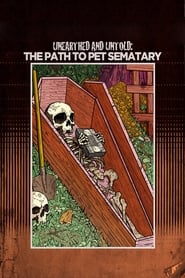
Unearthed & Untold: The Path to Pet Sematary
English സബ്ടൈറ്റിൽ ഡൗൺലോഡ് ചെയ്യുക
റിലീസ് വിവരങ്ങൾ
ടാഗുകൾ
English സബ്ടൈറ്റിൽ പ്രിവ്യൂ
ആദ്യത്തെ 200 വരികൾ.
Pet Sematary fans, there's a lot of them.
A lot of them.
When we were shooting it, it was a big studio production
but it was low budget, and then over the years,
it's just become a big deal for many people.
I can't tell you why.
People just, it really hits people somehow.
I first saw Pet Sematary in the theater when it came out.
I was just a big horror fan.
I used to go see everything,
so anything Stephen King that came out,
you always made sure you went opening night.
So yeah, I went and saw Pet Sematary
and fell in love with it immediately,
"Sometimes dead's better."
Been quotin' that forever.
It was one of those films that you find
with a group of friends, and you all immediately love it.
We were exposed to a lot of horror,
but for some reason, that one really stood out
and scared the hell out of us as kids.
It was my first Stephen King book that I ever read.
Scared me to death.
He doesn't just write a scary monster in the closet story.
It's always a psychological aspect to it.
People have really connected to it, and it's surreal.
It's a blessing, it's amazing.
The way it was shot visually, was done very well.
Mary Lambert had a great visual, artistic ability.
It made my career as a film director.
It's still my most successful film.
The term in film was to make it work.
If the lighting worked, if the editing worked,
if the performance worked, it all worked really well.
You wanna watch out for that road.
My family was like, they want me to look good.
They didn't get it on this one.
It was such a specific moment in time
that I hardly remember, and yet it seems to...
have effected a generation of people so deeply
on this subconscious level,
that it's just amazing to me that it could be so powerful.
Well, at least something good come of it,
this place.
Couldn't plant nothing but corpses here anyway, I guess.
I wrote a book called, Pet Sematary.
I got pretty scared toward the end of that book,
kind of, "Oh boy."
Some of the things, it was very black,
and when I finished the book, I actually put it in a drawer
because I didn't think anybody would wanna read anything
like that, but they did.
When I interviewed Steve on one of the occasions
back in, I think this was the late 80's,
I asked him about his preparation for Pet Sematary,
and he told me, he gave me the name of at least three books
that he had researched carefully
in learning about the lore of the wendigo.
It was essentially a Native American mythological figure
that was especially pronounced during the winter months.
The reason that I think the Indians gave birth to this
is because they wanted to create a taboo
against cannibalism during those rough winter months
where food is scarce.
The wendigo is essentially this figure who,
once it's led into a community,
it wrecks havoc on the community.
At the time that King was writing Pet Sematary,
he was also writer in residence
at the University of Maine Orono,
and the course that he was teaching was a course
in 19th century British horror fiction.
The three texts were Frankenstein,
Jekyll and Hyde, and Dracula.
I think that all three of those books
have always had a pronounced influence on Steve.
That's one of the reasons why he wanted
to teach this course.
He's always thought those books are the seminal texts
in horror literature, but they also had a pronounced effect
on the writing of Pet Sematary.
All three of those texts, for example, revolve around
the same theme of the destruction of the family.
All three of those texts revolve around a monstrous presence
that threatens to overcome normative behavior,
and all three of those texts are about secrets,
specifically male secrets,
and keeping those male secrets from women.
That's what causes, very often, the destruction
that centers all three of those texts.
You know, Jud Crandall's line that
women are supposed to be good at keeping secrets,
but I think men might be better.
Another British horror story to influence Stephen King
while he was writing Pet Sematary
was a 1902 short story by W.W. Jacobs
called The Monkey's Paw.
Essentially The Monkey's Paw is about a talisman
in the form of a dead monkey's paw
that granted the possessor of it three wishes,
the issue being that all three of these wishes
came with a huge price.
Essentially the moral of the story is, don't mess with fate,
and of course those themes are present
in the story of Pet Sematary, and I think at one point
King was even quoted as saying that
Pet Sematary is essentially a retelling,
in many ways, of The Monkey's Paw story.
Orrington is a real small town, very rural.
Why they picked that area to live in, I'm not sure,
other than it was available, I think.
But, Steve had rented the house in Orrington
while he was teaching at the university,
and behind the next door neighbor's house
was an actual pet cemetery
the kids in the neighborhood used.
The way his mind works, he can see something like that
and get the beginnings of a story, and he obviously did.
They rented the house right next door to us,
and it had always been a really creepy house
because nobody had lived there.
It was owned by, we called it the Pierce house.
It was owned by the Pierce family,
and it was always vacant for many, many, many years,
and it was just a spooky old house,
like a lot of those old colonials are in Orrington.
I certainly knew who Stephen King was when he moved to town.
I had read some of his books at that point.
I met him down at the corner store,
and he rented an office at the corner store
to actually write in for a number of years,
so you would see him all the time,
and he would go out for walks and kinda cross our lawn.
You'd be sittin' there watchin' TV and look up,
and hey, there's Stephen King.
We started the Pet Sematary in the early to mid 70's
out of necessity, basically, because growing up
on Route 15 in Orrington, it's a major truck route.
There's an oil depot at the end.
There's a pulp mill there, so there's trucks
back and forth all the time.
You lost a lotta pets.
There's only so many you can bury in your side yard so,
we just started puttin' up in the field
and making our little markers for them.
It was a place you could go visit your dead cat or dog,
or the occasional goldfish that was intentionally
taken out of the tank so it could be buried.
The spelling of Pet Sematary, a neighbor up the road,
Johnny, who was really into spray painting
anything and everything, we decided our cemetery
had to have a sign, because there was a growing population.
We gave Johnny the task of making the sign,
and he showed up with it, spelled the way it's spelled,
and we had a really good laugh.
We should've known better than to stick him
with spelling anything.
One of the reasons why the story of Pet Sematary
is so effective, is because at least part of it
deals with real life people and events
in Stephen King's life.
Ellie Creed's cat, Church, for example,
and his untimely demise
was based on King's daughter's cat, Smucky.
Back in 1978, Smucky became one of the many victims
of Route 15 when he was unfortunately struck
by a passing vehicle.
Of course, King knew it would break his daughter's heart
when she found out about it,
so he had considered not telling her,
and it was actually his wife, Tabitha,
that said they had to tell her because,
as she said, she has to learn about death sometime.
The next day they buried Smucky in the Pet Sematary,
and it's interesting to note that when you watch the film,
if you look closely, you'll see that the crew
actually paid tribute to Smucky
by putting his name on a grave marker.
As far as Gage getting run over,
that was based on one of his boys running towards the road,
and Steve grabbed him just at the side of the road
as a truck went by.
I guess he and Tabby were terrified by it,
and eventually it worked its way into the story.
Stephen told me that in that period of five seconds,
or 10 seconds, between when he saw his son in danger
and he saved his son from that danger,
that the entire story of Pet Sematary flashed into his head.
This is the son that I took care of as a newborn,
and made this fictional character,
I knew this fictional character.
This was real flesh and blood, which made it even more
I think emotional, as far as dealing with child death.
I said to him, "This is a horrible story.
"It's very emotionally charged,
"and I don't think you should have this published."
He laughed.
When Steve originally wrote the book and turned it in,
the buying committee didn't like it,
because it dealt with the death of a child,
അഭിപ്രായങ്ങൾ
No comments yet. Be the first to leave one.