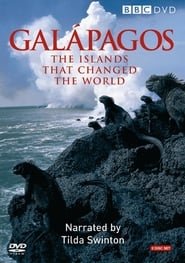
Galapagos
Скачать English субтитры
Информация о релизе
Теги
Предпросмотр субтитров (English)
Первые 119 строк.
90 degrees west.
1 degree south.
A world lost in the vastness of the Pacific.
Home to the strangest life imaginable.
Governed by nature's brutal forces.
Islands which have transformed our understanding of life on earth.
Galapagos lies remote, 600 miles off the coast of South America,
astride the Equator,
a scattering of 13 main islands with more than 100 islets, rocks and reefs.
Each island has its own character.
Some are cloaked in forest concealing life.
Others, smouldering giants, rugged and austere,
home to pirates,
lair of dragons.
All are the creation of one of the strangest features found anywhere on our planet.
Galapagos are no ordinary islands,
a mysterious prehistoric world,
a landscape that profoundly influences life.
These islands are plumbed directly into the heart of the earth.
An artery of superheated rock rises to the surface from hundreds of miles beneath the crust.
It's a volcanic hotspot.
Galapagos constantly simmers even beneath the waves.
These tiny bubbles of gas give a vital clue to the genesis of the islands.
Sea vents are like pressure valves releasing growing tension from chambers of molten rock beneath the crust.
But if the pressure gets too much this magma reaches bursting point.
The largest of all the Galapagos volcanoes - Sierra Negra,
recently blew smoke and ash 7 miles into the sky.
The only rivers here are rivers of red hot rock at a scorching 1100 degrees Celsius.
Galapagos is one of the most volcanic places on earth.
The hotspot has been active for millions of years,
building island after island.
But it's not just how these islands are born,
but where they're born that makes Galapagos so special.
They emerged at the crossroads of four ocean currents,
sweeping in from all corners of the Pacific.
This interplay of warm and cold currents generates an extraordinary diversity of marine life.
Over 500 species of fish make the most of these plankton-rich waters.
Among them, residents like these barnacle blennies,
and strange garden eels.
Even ocean travelers like scalloped hammerheads gather in huge numbers.
The converging currents that envelop Galapagos have also brought creatures to these shores from opposite ends of the Pacific.
Galapagos sea lions are related to Californian sea lions, they came here from the North.
And from as far south as the Sub-antarctic swam the ancestors of these birds - Galapagos penguins.
The cold waters here allow them to survive on the equator.
Fish shoals like these seek refuge from open ocean predators by keeping near the shoreline.
But in Galapagos, this strategy can be risky.
The coastal margins are the feeding grounds for the most aerobatic hunters,
blue-footed boobies.
When the fishing is good, they gather in their thousands.
Piercing calls synchronize an assault.
Plunging in unison overwhelms their prey.
Blue-footed boobies can dive in waters just 3 feet deep.
But as they chase the shoals further in shore, they risk treacherous under currents and hidden rocks.
But the biggest hazard is the battering surf.
A wing smashed by the breakers means slow and certain death.
Ghost crabs normally sift the sand for food, but they always got an eye out for something meatier.
For creatures of the sea and air Galapagos is a welcome sanctuary.
But these islands are not a choice destination for land animals.
Those that came here were probably victims of flash floods ...
swept out from the mainland on rafts of floating trees,
crossing 600 miles of ocean with no food and no freshwater.
For any survivor, landing in a place like this would be a daunting prospect.
Fernandina is the harshest, most volcanically active of all the Galapagos islands, a lava scar giant.
This is a single monumental volcano with a caldera half a mile deep and nearly 4 miles wide.
Where the volcano meets the sea dragons stir.
It's hard to tell reptile from rock.
These creatures are found nowhere else on earth.
At dawn, the cold-blooded iguanas thaw from the night's chill absorbing the heat of the equatorial sun.
When they've warmed the coastline of Fernandina comes alive.
On this island, food is scarce,
and the only way to find it involves a mission that seems suicidal.
Only the larger adults dare to take the plunge.
Marine iguanas are strong swimmers.
With a single breath, they can comfortably dive to 30 feet.
And all this effort for red and green algae,
which thrive in the cold water.
Marine iguanas are the world's only sea lizards.
But when their distant ancestors were washed ashore in Galapagos,
they were land animals.
To survive, they were forced to tackle the ocean.
This male must graze as quickly as he can.
In these chilling waters, his body temperature falls fast.
A 10-minute dive is about the most he can manage before his muscles seize up.
Fighting the surge back to the shore is a Herculean task.
And to make matters worse, he must now run the gauntlet of sea lions.
They are the last thing the iguana needs.
No harm is meant,
it's nothing more than a rather one-sided game of cat and mouse.
Marine iguanas take in too much salt with their food.
But with the help of special glands they sneeze it out.
They also welcome these resourceful visitors.
Sally light foot crabs like to groom them for algae, parasites and dead skin.
Lava lizards, far smaller reptilian relatives,
have found their own ingenious ways to get by on this fierce shoreline.
They enjoy a special relationship with the sea lions.
The lizards rid them of flies which can be a ticklish nuisance.
This sea lion accepts these predatory lizards
both benefit
Survival depends on seizing every opportunity in this volcanic wasteland.
Fernandina is the youngest of all the main Galapagos islands.
It may have raised its head above the waves as recently as 30,000 years ago.
It sits right above the volcanic hotspot in the far west of the archipelago.
But how is it that the other islands created at this same hotspot ...
are now scattered over hundreds of miles of ocean to the east?
All the islands are moving.
They're traveling south-east at an inch or two a year on a massive tectonic plate which continually slides over the hotspot.
Their journey begins as soon as they are born.
And in their wake, new islands emerge.
It's like a geological conveyer belt.
So the archipelago we see today is just a snapshot in time.
The oldest islands are in the east the youngest in the west.
And as Fernandina ages, it will be carried on this conveyer belt to where the biggest of all the Galapagos islands currently resides
Isabela.
It's shaped like a giant sea horse, almost 100 miles long with a backbone of volcanoes.
Isabela is a teenage Galapagos island nearing a million years old,
time enough for life to settle.
It's giant calderas still tower more than a mile above sea level and are draped in vegetation.
Although Isabela is softening with age it's still close enough to the hotspot to remain active.
On its summits, like here on Alcedo volcano live the most iconic of all Galapagos animals.
Galapagos subtitles in other languages
More English subtitles for Galapagos
- BBC Galápagos (2007) - Complete Series · 55 downloads · 2018-07-16
- David Attenborough’s Galapagos Complete BluRay 720p bluray x264 Pahe · 60 downloads · 2017-11-22
- Galapagos 2007 720p BluRay x264-CtrlHD · 30 downloads · 2016-12-28
- BBC Galapagos 2 Islands That Changed The World [Bluray 720p and 1080p SRT] · 30 downloads · 2010-04-25
- BBC Galapagos 3 Forces Of Change [Bluray 720p and 1080p SRT] · 33 downloads · 2010-04-25
- BBC Galapagos HDRE x264 a1080 dd20 mouse55siluHD all3E · 38 downloads · 2009-02-11
- BBC Galapagos · 30 downloads · 2008-07-26
Комментарии
No comments yet. Be the first to leave one.