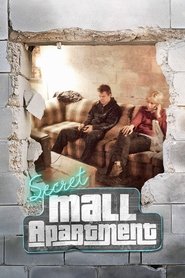
Secret Mall Apartment
Download English Subtitle
Release info
Tags
English subtitle preview
The first 200 lines.
Our other top local story
on Eyewitness News at Noon --
This is an incredible tale.
Artists set up an apartment inside Providence Place Mall,
going undetected for years.
WPRO-FM, Providence.
It's 11:00 with the G-Man,
rolling through 10 hits in a row,
the most music every hour.
We were listening to the radio,
and this ad came on
for the Providence Place Mall.
It was this woman.
She was a mom, and she was talking about
how great her life was about to become,
because it was going to be so convenient for her
to get everything that she needed for her kids,
for herself.
If only she could live there.
I just had this idea --
"Oh. we should live in the mall."
Live at the mall.
Like, it seemed like a very absurd fantasy,
and a great way to plow through
all of the negativity
that had been built up for years
in the loss of our homes
and the homes of like hundreds of people.
And so Adriana and Andrew and Jay and myself decided
that we would go live there for at least one week.
It was more of a game of survival --
Who was gonna get kicked out from security
and who was gonna last the longest.
And I think we were making bets about it.
I definitely thought that I was gonna
live there the longest.
I think, in my mind, I was like,
oh, we need to document.
And I'm like, oh, we need a sketchbook.
And Mike's instinct on the document was like,
"All right, we all need to have a point-and-shoot camera
and be able to do video."
We had a little camera
called a Pentax Optio S4i.
It is incredibly low-res and the audio is terrible.
It's not designed for video.
Interestingly, it fit inside an Altoids can.
In my hand, that camera disappears,
which meant that I could walk through the mall
with my arm like this.
It sounds silly, but I would forget it was there.
It was a fair bit of the food court.
It was trying on clothes.
You know, a funny kind of teenage mall-hang existence.
We ate all the leftover food
at the food court.
We saw, like, almost every movie
at the movie theater, which was awesome.
But as the sun set,
we started to internalize the dilemma
we'd put ourselves in, which is we have no plan.
Where are we gonna sleep?
Jay and Andrew found
a four-foot-by-four-foot column in the parking garage
that had an opening that they could sneak up inside of.
I was in a really small space,
unable to stretch out.
I believe I slept in my jacket
with my knees kind of curled up to my chest.
I've been camping in some way, shape, or form
since I was a small kid,
and I've had a lot of miserable nights out.
And this is in the pantheon of worst.
The place that Adriana and I find
is based on my memory of the mall's construction.
When the mall was being built,
I saw a space that I could not figure out
what it would be used for.
It was a nowhere space,
and I saw them store construction materials on it,
and I just sort of made a mental note about it.
I proposed that perhaps the nowhere space, as it were,
would give us shelter for the night.
And we went looking for that anomaly in the architecture,
and we snuck ourselves in there
and we took out our flashlights
and we kept poking around.
And it struck me that the nowhere space,
as it were, must be up here somewhere.
And we were able to push ourselves up I-beams.
And there it was. And it was safe and secure.
We're completely off the radar.
We weren't even entirely sure
where we were in the mall, but there was
the debris of construction was still there,
you know, four years later, after the mall had opened.
It was dirty. It was truly abandoned.
And we were like, "Oh, this is great!"
Mike been like, come see the space I found.
And so, like, we all went down and into the bowels
and saw the like cavern that he had found.
Looking around at all the clues,
it's like no one's been in here
since they built the mall.
It started the conversation immediately about like,
wait, this is a lot of space.
Maybe we have a responsibility to do something with it.
It was sort of agreed pretty quickly
that the couch was the most important thing.
Any time I went to a hearing at City Hall
for a new real estate development,
this term of "underutilized space" kept coming up.
It was almost like it was a moral obligation
on the part of the developers
to tap into this underutilized space.
It was almost like a crime.
"We must extend our progress,
and it must fill in every gap and crevice in the city
until there's a seamless development."
And so this was like a funny way of like itching back
at that, of like, "Well, we found some space."
We need to develop this underutilized space.
And I remember having this funny,
jokey conversation about being micro developers.
You know, that seemed really funny to us
that we would become developers,
but just for 750 square feet.
We put a bunch of ideas on the table,
some of them absolutely ridiculous, you know,
even about opening up our own store.
We're like, "How would anybody visit it?"
And we're like, "We can just build a condominium,
like right here."
PlayStation.
And, like, the couch,
is the thing that sort of made it a home immediately.
Providence had at one time
been one of the wealthiest cities in the United States,
and after World War II,
inexorable decline began to happen.
Providence seemed little more
than a parking lot by day
and an abandoned city by night.
Serious decline soon created an uninviting,
neglected environment.
It wasn't until in the mid 1980s, late 1980s,
that the idea of a mall became the centerpiece
of the whole Providence Renaissance.
You wanted retail to come back.
You wanted performing and visual arts.
You wanted all the things that Providence had been known for,
all of those things that would make Providence a destination
and not just a drive-through to another major city.
The Providence Place Mall was considered to be
a major new engine
to help the revitalization effort take place.
The city had began to lose its retailing sales
to the surrounding suburban areas.
But the mall did not happen overnight.
It took years and multiple administrations
in order for this to occur.
It was a major building.
While the mall was being built,
I really started to internalize
its impact on this city
because all of a sudden I literally couldn't see
the city anymore.
Look at this giant.
Look at this thing. It's totally overpowering.
It looks like something out of a science fiction movie.
You got the statehouse, you can't even see it anymore.
They practically buried it.
I mean, it was no small task to move the rivers
and to move the railroad tracks,
but I think it began to show that things were happening.
I remember the preview event
and everybody coming from all parts of New England.
It wasn't even just Rhode Island.
This is a large mall. Am I correct?
Oh, definitely. You know, 3.5 million square feet.
You don't get this type of mall
in any city and everything.
It's very unique.
It makes this a destination city.
So having this big mall
that represented a big investment.
It was kind of like a new face for Providence.
I think that was more probably something
that was aligned with what politicians wanted,
but not necessarily for the communities,
especially the adjacent communities.
We all hated them all when it went up, right?
Nobody wanted that to happen. It was infuriating.
Instead of putting the money into downtown in general
and supporting the businesses that were already here,
they built that monstrosity.
We hated it.
And then as they started to sort of
shore up the side facing our neighborhood,
I realized like, wait, there's no entrances for us.
Secret Mall Apartment subtitles in other languages
More English subtitles for Secret Mall Apartment
- Secret Mall Apartment 2024 1080p AMZN WEB-DL DDP5 1 H 264 (SDH) · 84 downloads · 2025-08-17
- Secret Mall Apartment 2024 1080p WEBRip x264 AAC-[YTS MX] · 239 downloads · 2025-03-29
- Secret Mall Apartment 2024 1080p WEBRip x264 AAC-[YTS MX] · 384 downloads · 2025-03-27
Comments
No comments yet. Be the first to leave one.