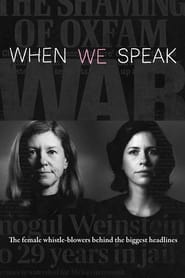
When We Speak
Download English Subtitle
Release info
Tags
English subtitle preview
The first 200 lines.
My fellow citizens.
At this hour, American and coalition forces
are in the early stages of military operations
to disarm Iraq, to free its people,
and to defend the world from grave danger.
On my orders,
coalition forces have begun striking
selected targets of military importance
to undermine Saddam Hussein's ability to wage war.
These are opening stages
of what will be a broad and concerted campaign.
[Bomb exploding, pulsing percussive music]
Allegations of sexual assault
spanning more than three decades.
I want to extend to the people of Haiti
the unwavering support of the American people.
The heroes without a shadow of a doubt to me
are the whistleblowers.
He's accused of leaking classified information
and faces felony charges here in the United States.
Why did you become a whistleblower?
There's a difference between knowing something
and doing something about it.
We need transparency into how Facebook operates.
I think a whistleblower should be protected
if the whistleblower's legitimate.
My house was bugged. I knew I was being hacked.
I knew I was being surveilled.
It's like being hurt by your own family.
- - Whistleblowers
claims that vote leave cheated the rules.
Out of a scheme to affect the primaries
and ultimately the election.
It's not reality.
They're basically lying to people.
Shouldn't you be in gaza, Mr. Blair?
Shouldn't you be in gaza?
Suddenly you have to choose
where your loyalties lie.
Why won't you listen to what I have to say?
When you open your papers, behind every headline
of an enron, a theranos, a scandal,
there is always a human being.
There's always a whistleblower
who brought that information to light.
I think it's often we take for granted
that this information made its way to us.
But it only sees the light of day
because some brave individual decided to speak up
against powerful institutions
to bring that information to light
so that we might all benefit.
We're in a moment now, in a historical moment,
where there's a very powerful idea
that feminism has done its job, that we have equality,
um, and that women have an equal public voice.
Um, and actually, women are in some...
Many ways encouraged to have a voice.
In many ways, culture encourages us as women
to speak up and to speak out.
And yet, um, when women do speak up
and do speak out,
and when they actually challenge power
with their voices,
they are routinely punished, um, for doing so.
Okay.
It's just to synchronize
- these two cameras. - Right.
I'll do that every now and again.
Well, gchq stands for government communications headquarters.
Uh, it's based in cheltenham,
uh, and it's, uh, an organization
that basically intercepts, uh, communications.
Um, whether that's phone, fax, mobile, email,
uh, any sort of data that's transmitted.
I would just, um, listen to raw data,
raw intercepted, um, communication,
and then produce a report
and submit it to, um, you know,
one of the UK ministries... Um, the home office,
the foreign office or other places like that.
But, you know, to be honest, it was fairly mundane.
A very kind of normal,
sort of "normal," uh, office environment,
um, gossip and, you know, joshing with your colleagues
and that sort of thing.
When we started at gchq on the first day,
they tell you what your legal obligations are,
that you're bound by the official secrets act.
I told my parents that I was working at gchq.
I told my husband, I told my friends,
but I said, "I can't discuss my work with you.
Uses my language skills, but that's all I can say."
And my husband was like, "oh,
she's got a good civil service job," you know?
"Nice."
And that's what I thought,
you know, a... a job for life, basically.
In September of 2002,
I was invited, along with my line manager,
to go to the us for a work conference.
And we went to San Diego
and while we were at the work conference,
um, as part of our sort of free day,
um, they said, "would you like to go
on the naval base?"
And, you know, we can go...
And actually go on board an aircraft carrier.
It was the first time
I'd been on any kind of military hardware.
All these kids looked
like they were 18 or 17, you know?
They were so fresh-faced and young.
And we asked one of these young lads,
and we were like, "what are you doing?"
'Cause they were busy.
And they said, "oh, we're shipping off
to the Gulf in three days," you know?
And, uh, "we just hold this... This ship out of retirement.
We've been painting it gunmetal gray.
And we're... you know, we're going to go off
to whoop some Iraqi ass."
And I was... Me and my line manager
just kind of looked at each other
and we were like, "what?
This is serious.
You know, they're not...
Just messing around here."
I suddenly thought, "wait a minute,
what has Iraq got to do with 9/11?"
I was convinced, you know,
that the... the Iraq invasion
would be ill... illegal,
that there was no real justification for it.
On the 31st of January, I went into work as usual.
It was a Friday, I sat down at my desk,
and, uh, I was looking at the various emails
that had come in, and there was one from the us.
It was from, uh, the national security agency.
It was basically an email
that, um, asked UK, or gchq,
to assist the us
in collecting the communications
of, um, the six swing nations
that were sitting on the UN security council,
uh, at that time.
So, that was, uh, countries like Angola, Bulgaria,
Chile, Cameroon, Guinea and Pakistan.
So, those six nations.
And the memo was written
in... in such a way that it was kind of very...
It was sort of, you know,
"look, guys, this is what we're doing."
You know, "help us out here."
And we need, quote, "the whole gamut of information
that would give us policymakers
an edge in obtaining results favorable to us goals."
And that one sentence justjumped out and hit me.
And I thought, "they want war
and they want to get it by any means necessary,
including sub... Subverting the diplomats
at the UN security council.
Blackmailing them, bribing them,
whatever it took...
To persuade them to vote for this UN resolution
that would authorize an invasion of Iraq.
And it was just like this "oh, my god" moment.
I was shocked, I was angry and I was appalled.
Because I thought we're basically...
Colluding...
For the purpose of launching an illegal war.
Tony Blair at the time desperately wanted
UN authorization for legitimacy,
basically to cover his own kind of, uh, reputation.
It would be devastating for, uh, people
who had already
basically suffered 20 years
of, um, war
and sanctions already.
You know, there were generations of young Iraqis
who have grown up knowing nothing
but this sort of chaos and horror.
It was like I was blinkered, basically.
I felt like I literally could think of nothing else
except what was going to happen
to, um...
The nation of Iraq
a... and to some extent, the British armed forces
who were going to be deployed.
National security, ibeheve,
should be in the interests
of the British public.
Anybody else on the London bombing?
Those actions led
in the direct opposite direction
of British national security.
Launching an illegal war,
which mi5 themselves
argued in reports would lead
to increased risks of terrorism and... terrorism
Comments
No comments yet. Be the first to leave one.