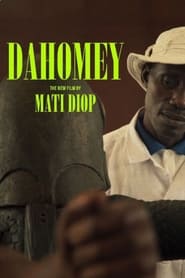
Dahomey
Download English Subtitle
Release info
Tags
English subtitle preview
The first 200 lines.
As far back as I can go
there has never been a night
so deep and opaque.
Here, it is the only possible reality.
The beginning
and the end.
I journeyed so long in my mind
but it was so dark in this foreign place
that I lost myself in my dreams,
becoming one with these walls.
Cut off from the land of my birth
as if I were dead.
There are thousands of us in this night.
We all bear the same scars.
Uprooted. Ripped out.
The spoils of massive plundering.
Today, it's me they have chosen
like their finest and most legitimate victim!
They have named me 26.
Not 24.
Not 25.
Not 30.
Just 26.
26.
Why didn't they call me by my real name?
Don't they know it?
"You can leave now!
"26, go back home!"
Return to the surface of time...
leave behind my brothers, prone, ignored deep in the unnamable.
Go back home?
What awaits me elsewhere?
Leave the kingdom of the night
to enter another.
My head is still assailed by the rattle of chains.
I have in my mouth an aftertaste of the ocean.
In several languages, these memories whisper in my ear
the full weight of a past of which I am the trance, the trace.
I'm torn
between the fear of not being recognized by anyone
and not recognizing anything.
HISTORIC!
RESTITUTION OF ROYAL TREASURES OF BENIN
PALAIS DE LA MARINA PRESIDENCY OF THE REPUBLIC OF BENIN
Ladies and gentlemen...
Mr. President of the Republic of Benin...
Your highnesses...
Dear guests...
Is this the end of the journey?
Everything is so strange.
Far removed from the country I saw in my dreams.
My head is spinning.
I give myself up to this tropical caress
to the smell of childhood, a road to myself.
I did not expect to see daylight again.
Statue of King Ghezo.
Designation:
anthropo-zoomorphic royal statue.
Medium:
painted wood,
metal,
fibers.
Weight:
220 kilos.
Condition:
average condition overall.
The pictorial layer presents gaps.
The sculpture is stable despite cracks.
The metal is stable, although oxidized and deformed.
Description:
this statue is a representation of a Bo ,
a power-figure of King Ghezo.
The iron blades covering the body of the statue
allude to metals, the symbol of the Vodun Gû ,
the Vodun of iron and, by extension, of war.
Condition:
good structural condition despite cracks and missing parts.
Description:
this throne was taken from Cana, less than 20 kilometers from Abomey.
The arrangement of the sculpted characters shows
that this work has Yoruba origins,
and was made for the king.
The upper part of the throne depicts the king under his sunshade,
surrounded by his maidservants.
On the level below,
a line of shackled slaves
alludes to two major characteristics of the kingdom.
Its expansionist policies
and the enslavement of the population in conquered regions.
Statue of King Glele.
Condition:
average condition overall.
Peeling and defects in certain areas,
particularly on the head.
Keep under observation.
An asen , or sinuka, its real name in Fongbe,
was intended to perpetuate the memory of the dead.
Every deceased person is entitled to a sinuka .
It symbolizes an accomplished life on earth
and integration into the world of the ancestors.
Not by the fin.
Not the head.
Don't let go. Hold it.
Paul, hold it.
Stay on this side to hold it.
Statue of King Béhanzin.
Description:
this statue depicts Béhanzin,
King of Dahomey from 1890 to 1894.
Béhanzin's coat of arms featured a shark
in memory of the words he uttered,
announcing to his people his intention to wage war on the French...
"The shark has been angered
and the ocean has been clouded."
We have centuries ahead of us.
If our conservation efforts so far
failed to reassure you in the long term,
we will do what it takes.
What you have seen demonstrates our commitment and determination
to do things properly, abiding by all standards.
We shall work
for the best conservation of what stayed here,
what has returned and what will return.
There's an asen here that is intriguing.
For researchers and traditionalists alike,
it continues to be a subject of debate.
How was it possible for Dodds to carry off the asen of King Béhanzin?
King Béhanzin was still alive
when Dodds entered the royal palaces.
A King must not see his asen .
A living being may not see their asen .
Our researchers may be on the right track
when they say that the court soothsayer,
the soothsayer Guédégué,
had questioned the oracles
and informed the King that he would lose the war.
The response was always the same.
"Your Majesty, fight like a worthy son of Dahomey,
but you will lose this war."
Did you know thousands of Beninese artifacts
were held overseas?
If so, at what point in your life, did you find out?
To answer your question, I'd say,
during my childhood, I grew up with Disney,
I grew up watching Avatar ,
I grew up watching Tom & Jerry ,
but I didn't grow up watching an animated movie
that focused on Béhanzin,
that focused on our cultural heritage.
During my childhood therefore, I was never made aware
that artifacts belonging to us
had been deported and...
would return who knows when.
So I grew up completely ignorant that my heritage,
my culture, my education,
my life and soul had been kept overseas for centuries.
You understand?
I'd been told in high school but partially,
because our teachers used to say in social science classes,
"A lot of things were stolen from us."
By "a lot of things", I got it into my head these were "things."
I didn't know they were treasures,
only that they were things.
To answer the first question, I didn't know.
In primary school, it was the history of victors and vanquished.
That's what we got.
But when I heard about the return of this stuff...
I call them "stuff" because so far it...
I feel nothing with regard to...
these statuettes.
I call them that since I feel nothing.
90% of Beninese heritage...
Hmm...
Careful with your statistics.
I reiterate, 90%!
I weigh my words. 90%.
- All our heritage, meaning? - Our heritage.
- Only 10% is here? - Exactly.
When you say that 90% of our cultural heritage...
...is overseas, I don't think you're right.
Cultural heritage is composed of material
and immaterial heritage.
Now, part of our material heritage
is in other countries.
But our immaterial heritage,
our dances, traditions and know-how are still in our country!
To go see these 26 works
is a patriotic act. Why?
For me, it's about more than pride.
I remember last Sunday,
when I went to the Palais to see the 26 works,
I cried for fifteen minutes.
I was like, wow!
Wow...
I...
I cried so much that...
I was taught...
In school, the king's throne...
We all have our own sensibility.
I cried because I said to myself,
Dahomey subtitles in other languages
More English subtitles for Dahomey
- Dahomey 2024 1080p AMZN WEB-DL DDP5 1 H 264 (SDH) · 103 downloads · 2024-12-12
Comments
No comments yet. Be the first to leave one.