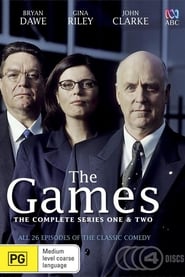
The Games
Download English Subtitle
Release info
Tags
Download English Subtitle Files for Mobile (13)
English subtitle preview
The first 200 lines.
Tonight's episode of the popular documentary series 'The Games'
has been held over and will be broadcast at a later date.
This evening, we present a special program in the public interest.
The winner is... Sydney!
But it's not all good news.
More than $36 million in budget cuts...
President Juan Antonio Samaranch
has warned of tough actions...
Back at the Palace Hotel,
IOC board members were giving little away...
over claims that widespread corruption...
The marketing of the Games brought an enormous public response.
More than a million Australians...
over its secret marketing of ticket...
Tonight, John Clarke, Olympic supremo,
is a man under pressure.
Has anybody got any questions that have nothing to do with lacrosse?
How much over budget are the Games at the moment?
Have we got any more lacrosse questions?
Oh, I can answer that, John.
With two months to go, the greatest event ever staged in Australia
is $194 million over budget.
The Games are facing a storm of protest
over the country's refusal to repeal mandatory sentencing,
the condition of the Aboriginal population
and the threat of boycott from Cuba, West African nations,
the Balkan Federation and China.
For Clarke personally, too, the stakes are high.
He has long acknowledged that he hopes to go on to higher things
in the international Olympic movement,
and it's upon Sydney 2000 that these hopes depend.
No, I don't think I'm incompetent, no.
I don't think I'm out of my depth. This is a huge job.
Anyone who's been following these Games
since we got the right to stage them would be aware of that.
You can't tell what's going to happen
when you take on a job like this.
Nobody knew how big this job was going to be.
Among those who've watched Clarke operating at close hand
is Gina Riley.
Headhunted out of private industry herself,
and now working in what many regard
as the most demanding marketing job in Australia.
I think he's one of the genuinely great Australians,
I really do.
I don't think anyone has any idea of the contribution John's made.
It's... it's quite fantastic.
Long-time associate Bryan Dawe,
once Head of Development with Pacific Orient,
is responsible for the finances of the organisation.
If it was listed on the stock exchange,
the Games would currently be Australia's fourth biggest company.
He's got a very soft side, John.
You don't see it all that often, but it's there.
I remember we were once in Milan
and we were sitting out on this 15th-century old balcony
and we were drinking this local liqueur called Mist of Heaven.
And all of a sudden, John started to weep.
I don't think he was unhappy.
We drank about three bottles of the stuff
and the weather was very beautiful.
We were just sitting out there overlooking the harbour.
In a surprise move today,
the top logistics job at the Sydney Olympics
has gone to a rank outsider -
sports and business management honcho, John Clarke.
Largely overlooked by...
Five years ago,
John Clarke was holidaying in Zimbabwe with his family
when he received word that the Sydney 2000 Games
was looking for someone to head up
the difficult but extremely important logistics operation.
The task would be to supervise the mounting of the biggest event
in Australia's history.
I'm just gonna roll my arm over in there. 500 laps - just the usual.
Rightio.
If I'm not back in three weeks, send a search party.
Okey-dokey.
Oh, you fixed that.
And you fixed that too! That's good.
Well, I've always responded pretty well to a challenge.
I can remember when I was a kid once playing cricket with my cousins
on the lawn at the back of my grandmother's place.
Somebody said, "I bet you can't put a ball on the roof of that toolshed
"at the bottom of the garden."
I can still remember thinking, "You reckon I can't do that, don't you?"
And could you do it?
No, it was too far away.
It was only three months later
when John and his team were beginning to build the complex web
of strategic alliances and industry contacts
which would bring the Olympic dream to life
that he realised it would need all the reserves he had often called upon
during his own time as an athlete.
I think it was the 1972 NSW Cross-country Championships.
John was a very good runner,
but there were a lot of very good runners in the field that day.
It was a really wet day
and they had to cross a bog, I think,
down the bottom of the valley.
John got knocked over and I thought he'd never get up.
Yeah, I remember that, yeah.
And what happened?
Well, nothing happened. I couldn't get up.
Yeah, he had some disappointments,
but John could have been a world-class runner.
No question about that.
He wasn't, but he could have been.
When John was actually appointed,
it's fair to say the news didn't meet with universal approval.
No, it didn't.
I think there were probably quite a few people
who thought they had this job.
I think I was probably a bit of a surprise.
There were people who thought this job was gonna go to someone else.
The way this town works
is that there are a great many strategic alliances.
There are people with these connections here,
people with those connections.
A great deal of networking goes on, of course. I don't do that.
Well, he rang me and he said this job was going,
that I knew how these things worked.
He said he wouldn't network. He made that very clear.
He then started muttering about
whether I knew what gifts were appropriate for the delegates
who were making the decision.
Another Clarke supporter at the time
was former politician Nick Thetake.
He was the stand-out candidate.
There were others with strong plans,
but no-one with the mix that we were looking for -
the strong credentials in public administration and private business.
His personal background in sport. Just wasn't there.
Uh... John's appointment was unanimous.
One of the people who worked with John a lot at that time,
who shared the triumph of bringing the 2000 Games to Sydney
and was also on the Olympic Network of Allied Nations with John,
was Allan Ronaldson.
John Clarke?
Look, we've known each other a while.
We've both had involvement with ONAN for a good long time.
I've worked with John on a number of projects.
Had you always got on?
Yes, always got on. Very good team, Allan and I.
Yes, we'd... always got on.
The marketing of the Games brought an enormous public response.
More than a million Australians applied for tickets, many of whom...
While preparations seemed to go well in the early stages,
problems with the allocation of Olympic tickets
turned a dream run with the media into a running sore
and threatened to stop the juggernaut in its tracks.
find ways to provide more seats for ordinary Australians.
No, I don't think it was a fiasco.
We had put in place the most sophisticated ticketing system
available anywhere in the world at that time.
We couldn't take a trick with the media, though.
I think the media's got a great deal to answer for in that period.
Yeah, there'll be more than enough tickets to go around.
Everyone who applied for tickets will get something, yep.
No, there are no special ticketing arrangements for the rich.
I knew nothing about any arrangement
to get special ticketing arrangements for the rich, no.
I knew about those arrangements, yes,
but not about the extent of them.
In retrospect, the ticketing packages were a mistake, yeah. Next!
It appears we lied about the ticket package
from the very beginning, yep.
No, well, we can't provide tickets that we haven't got, can we?
We haven't got them!
No, I mean, you asked me
if I think we've got anything to apologise about.
I say no, we don't, not at all.
Who are you?
Look, there was a difficulty with the tickets.
Obviously, yes, of course there was.
There was some mistakes made with the ticketing process.
But I think it was handled very well
and I think ultimately the public were satisfied
that we'd secured for them the very best possible deal.
Would you be prepared to just repeat that into the camera, please?
Certainly, yes.
I'm satisfied that ultimately the public was happy
that they knew that we had secured for them the very best possible deal
on the tickets.
And in yet another embarrassment over Olympic ticketing,
organisers have been quick to withdraw 260,000 hockey tickets
which were issued with the rowing venue printed on them.
Another in the firing line over the ticketing problems at the time
was ministerial secretary Nicholas Bell.
Well, the decisions about ticketing came out
of the area of John's responsibility, really.
It wasn't something the minister had any control over.
And so, you had nothing to do with them?
No, we had nothing to do with them.
Carriage of the ticketing procedures
was solely in the hands of John and his people.
What was your impression of those ticketing arrangements?
What, personally?
Well, it was a fiasco.
It was a PR disaster.
More English subtitles for The Games
- The Games S01 WEBRip iview · 38 downloads · 2021-08-06
Comments
No comments yet. Be the first to leave one.