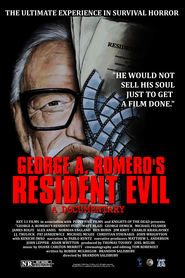
George A. Romero's Resident Evil
Download English Subtitle
Release info
Tags
English subtitle preview
The first 178 lines.
- A bizarre incident had occurred
near the end of the 20th century.
A German production company
called Constantin Film had purchased the rights
to a bestselling video game created by Capcom
with legendary director George A. Romero
hired to write and direct.
One year later, he was fired from the production.
The case was apparently closed
with the release of a feature film in 2002
directed by Paul W.S. Anderson,
but questions regarding Romero's unrealized film
and his removal were far from answered.
In 1968, Image Ten unleashed
a visceral experience upon the world
that shocked audiences everywhere.
- "Night of the Living Dead."
The dead, who live on living flesh.
The dead, whose haunted souls hunt the living.
The living, whose bodies are the only food
for these ungodly creatures.
- George Andrew Romero was born in February of 1940
in Bronx in New York.
His father was a graphic designer
and he used to make posters for films
and for Broadway shows, banners and the like like that,
so when George was growing up,
he was really in a household that kind of celebrated film.
- He was one that took that love of film
and actually acted on it.
He didn't say, "I just wanna grow up and be a filmmaker."
He started making his films at an early age,
and the famous story of throwing the flaming dummy
off the building and getting arrested at a young age.
George came to Pittsburgh
to attend what was then called Carnegie Tech.
It's now Carnegie Mellon University,
and he came here to be an art student.
Came, started taking his art classes,
and eventually kind of got rolled in
with some folks in the drama department,
started doing theater,
and eventually they kind of got swept up in
sort of emerging television.
Eventually they knew that sort of this crew
with Latent Image, which was sort of the company
that they had put together.
So you have George and Russ Streiner and Jack Russo
and a couple of the Ricci folks
kind of all together working to figure out
how they can kind of navigate this space.
And eventually the idea came to make a horror film,
that it'd be easier to get funding for, it'd be cheap,
they didn't need a lot of skills,
they kind of pull this off.
And they had a script that was adapted by Jack Russo.
He had written this "Night of Anubis."
It was the original title,
but it was this general story that we know as
"Night of the Living Dead."
- There was an aspect of it that was very surreal
and sort of dreamlike.
I remember when the character Ben is clubbing the zombies,
and the way he's hitting them
and the way the sound effects are kind of off sync a bit,
and it's just kind of strange.
It feels like you're watching it,
you're just slipping into some kind of nightmare.
- They really learned how to make a film together
sort of organically.
I think fans know that George did not go film school,
neither did any of the other folks in Latent Image.
They took their video production skills
that they had learned from television and applied it,
but they learned it sort of in a different way
and on their own.
- Some of the ways the characters speak are a little funny.
"They're coming to get you, Barbara."
It's kind of funny, but then it like,
it gives you a sucker punch and scares the shit outta you.
- And it's like, Roger Ebert's original review
of "Night of the Living Dead,"
he said, "These kids were dropped off in a matinee
thinking they're gonna see some spooky Vincent Price movie,"
and of course they're eating livers and stuff
and these kids were in shock!
There's a pretty safe scene
where they're shouldn't be anything of menace.
But then all of a sudden this zombie comes out for no reason
and starts killing one of the characters who you've just met
and you're like, "Wow. What's going on now?"
I wound up going to Scream Theater
and watching "Night of the Living Dead,"
and you know, the dead are alive to eat the living!
The weird thing is they made references
to all these other places
that my family would camp in when we'd go to Pittsburgh!
So it was utterly terrifying!
- I love that. I can't tell if "Night of the Living Dead"
is an old or a modern film.
It just kind of splits two eras down the middle.
I'm 14 years old
and they're having a convention in Monroeville,
and I see George Romero,
director of "Night of the Living Dead" is gonna be there.
And I was like, "All right, I wanna go meet this psychopath
that would make a movie
that would give somebody nightmares like this."
Met George, got an autograph from George,
realized George was one of the nicest people on the planet.
And then me, this 14-year-old, cornered George Romero,
literally cornered him in the hotel
and was asking him question after question after question.
And finally he just writes on a piece of paper,
"247 Fort Pitt Boulevard," the address,
and goes "Here, write me."
Then it was just, we became pen pals
and I still have those letters.
I just remember the immediacy
of the sequences with the zombies
and how it felt like you were under
a constant sense of terror and foreboding.
There were no R-rated movies
before "Night of the Living Dead,"
and "Night of the Living Dead," of course, has no rating.
That really made a big impact
because at the time it was released, of course,
on the news, you're seeing worse stuff in that every day,
people being burned with flame throwers
and you all the Vietnam with the napalm
and the skin falling off and shit.
And so suddenly the horror movies were not that horrific
because what you saw on the news
was a lot more frightening.
- I think George really took things
to the next level on that.
One of the most memorable scenes
is when the truck is burning
and there's flames flying everywhere
and somebody's taking a piece of flesh and gnawing.
We hadn't seen anything like that on camera.
- After "Night of the Living Dead,"
the definition of zombie would change.
No longer inspired by misconstrued Haitian folklore,
the zombie would now be your neighbors, your friends,
your family, the reanimated corpses
of the recently dead, seeking flesh.
- Yeah, they're dead. They're all messed up.
- And while slow moving,
could only be stopped by destroying the brain,
- Beat 'em or burn 'em.
- Of course, it famously set the rules for zombie film.
How zombies work, how the brain is the zombie,
you shoot the brain, you kill it.
And that's been the common trope ever since.
- They didn't try to go back to New York City,
they didn't try to go to LA, they didn't go to Chicago,
they did it here in Pittsburgh.
The fact that we still have a film industry here
is because of the work they did.
- This is probably the most inspiring
independent film of all time.
- For Romero, attempts to branch out
into other genres were met with less enthusiastic results.
So in 1973, he returned to horror with "The Crazies"
about a chemical weapon unleashed upon the population
of Evan City, Pennsylvania,
turning them into violent psychopaths.
And "Martin."
My name is Martin.
I'm 84 years
- The 1977 Classic about a serial killer
that believed he was a vampire.
But it was his next film that cemented George Romero
in the minds of audiences worldwide.
- "Dawn of the Dead."
- Meet me on the roof at nine o'clock.
We're getting out. - But I don't believe it.
More English subtitles for George A. Romero's Resident Evil
- George A Romeros Resident Evil 2025 1080p AMZN WEB-DL DDP5 1 H 264 · 87 downloads · 2025-01-06
Comments
No comments yet. Be the first to leave one.