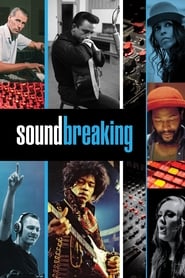
Soundbreaking
Download English Subtitle
English subtitle preview
The first 143 lines.
-In the beginning was the music, music, music...
-"Video jockey" was added to Webster's dictionary.
A new concept is born.
I want my MTV!
[ The Bangles' "Hazy Shade of Winter" playing ]
-We offer more than cars or grain or MTV.
Let's do it.
-The rise of the music video was a gamechanger for pop music.
Videos, I think, were cool.
Songs became grander and bigger than they were because of MTV.
The avalanche of MTV as the --
I mean, it grew so fast like a sort of a virus.
It just swept everything aside.
Video music! 24 hours a day!
-I mean, cable itself was exploding,
...and we were exploding along with it.
-It became so huge and so powerful.
It was sort of like, you get a video on MTV,
boom, that's it for you, that's the magic ticket.
-Suddenly, music had another dimension,
and musicians had a new way to express themselves.
-It was really wonderful to use these visual images to sort of
develop the meaning of the songs.
To convey some other depth in them --
that was really experimental at the time.
[ Duran Duran's "Hungry Like the Wolf" playing ]
I think it was sort of
a whole new level of modernism, you know?
It was a new style, and who are these people?
These people came from nowhere.
Duran Duran -- who are they?
-It was a cultural phenomenon that transformed
the way we see music.
-When I was growing up, music was what you heard first
and you maybe saw later.
Today music is what they see first and maybe hear later.
Okay, then. Okay.
It'll be an F for you.
Here we go.
Just one more time.
-Right after I say, "Are you sure?"
Da da da -- yeah.
Oh.
-Hal, here's how I want to do it. Takes like this.
-All right, it's fun time. Fun time.
Here we go.
-Oh, really? -17, take one.
-This will be the keeper. -
I had been exposed to music videos
through my travels in Europe.
I had seen them. I saw the power of them.
I loved this idea.
So I was one of a team of six
who sort of developed the concept of MTV.
-And behold, a new concept is born.
-I had been living, uh, in Afghanistan and India
for 8 years, came back to the States
after my business kind of went kaput.
So then I went to see the guy
who was going to run the music channel.
It wasn't called MTV yet.
He said, "we're looking to hire people
who have no experience in television."
-We don't want people from PBS or NBC or CBS.
-I said, well, I have no experience in television.
I just came from a country that didn't even have television.
-Television? -No! Check this out.
Lo and behold, they hired me.
-Ladies and gentlemen, rock 'n' roll.
-Technology was new, the whole concept was new,
that you go to this channel, and it was this world of music.
Starting right now,
you'll never look at music the same way again.
So everybody was young.
Nobody really knew what the hell they were doing.
And musically, there was no videos.
You'd see DEVO every hour
'cause they they needed enough videos
to fill in 24-hour, you know, programming.
-I think of the 160 videos that we had when we went on the air;
something like 35 of them were Rod Stewart's.
-He really used to bang out these cheap ones
in front of the fireplace with the acoustic guitar, yeah.
-It was just these crazy bands from England.
-So by default, we wound up being really progressive
and really sort of ahead of our time.
-There hadn't been that much on MTV,
so whatever you put on MTV you were going to stylistically
start creating...
what MTV could do.
Yeah, we wanted to push the boundaries
of what was on MTV.
If you know how to shock,
you know how to rock, you know, that's...
We had sort of hybrids of punk coming up in the '80s.
Sort of a way forward that, say, may have kept
the sort of energy of punk.
That's what I wanted to do anyway with my music.
-It was very radical, that energy like, you know,
you can just rip something up to shreds.
It's that horrid we just -- we're just burning this up,
and we're doing something that you've never seen it before.
-I never thought of myself as a punk, per se,
but I was really, really influenced definitely by it.
It was like, I cut my hair, I dyed it.
It was a kind of statement to say that
you're at odds with society.
-"Sweet Dreams" -- it was totally surreal.
We were using Buñuel and Salvador Dalí
and, you know, French filmmakers,
Italian filmmakers, as references.
It was like a little weird sort of surreal, uh, vignette.
-It was very much using the visual tools to say something,
but it wasn't a superficial statement.
It was a really profound thing that was more than skin deep --
wearing a man's suit to look like a twin
with the opposite gender.
My cohort in Eurythmics, both of us, we were like equals.
And looking back on it now as an older woman,
I look at that, and I think
I was trying to find a way to be equal.
-So it wasn't really anything like a pop video.
But what happened, MTV had just started,
and they were desperate to have stuff to play.
And every time they showed it,
everybody was going nuts about it.
So this critical mass started to happen.
-By the time Annie and I arrived in America to play a tour,
when we were in San Francisco, Annie and I got a call
and we were told we were number one in America.
So from being, you know, really experimental
and seeing ourselves more as performance art,
it was like number one in America,
cover of Rolling Stone, Annie on the cover ofNewsweek.
And it was just bang, you know,
all in about the space of four weeks.
-I just remember the sensation of my world suddenly feeling
like in these films when you see a very, very small
cartoon person knocking at a huge door,
the Hall of the Mountain King or something.
And then, all of a sudden...
You know, the door opens.
And it's like...
More English subtitles for Soundbreaking
- Soundbreaking E08 I Am My Music · 30 downloads · 2016-11-24
- Soundbreaking E06 The World is Yours · 27 downloads · 2016-11-24
- Soundbreaking E04 Going Electric · 28 downloads · 2016-11-24
- Soundbreaking E05 Four on the Floor · 26 downloads · 2016-11-24
- Soundbreaking E03 The Human Instrument · 34 downloads · 2016-11-24
- Soundbreaking E02 Painting with Sound · 21 downloads · 2016-11-24
- Soundbreaking E01 The Art of Recording · 25 downloads · 2016-11-24
Comments
No comments yet. Be the first to leave one.