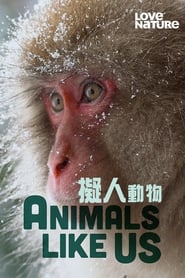
Animals Like Us
Download English Subtitle
Release info
Tags
English subtitle preview
The first 200 lines.
Narrator: Welcome to a new way
of seeing the natural world...
where wild animals act just like we do!
Across the animal kingdom,
charismatic critters exhibit human-like traits.
From octopuses that dream
and a bird that applies make-up,
to teenage elephant tantrums.
and complex emotions.
One of the fascinating things
about studying animals
is discovering how many aspects of their behaviour
have parallels with our own.
Narrator: The amazing thing is...
the more we learn about them,
the more we realize
animals are a lot like us!
About as far from human civilization as you can get,
you'll find some charismatic little animals
on a search for a soulmate.
These are gentoo penguins.
They call these frozen,
rugged shores of Antarctica home.
The Antarctic is actually
the great penguin capital of the world,
and it's actually extraordinary
to see the lengths that some of these birds will go to
to find a mate.
Narrator: It's one of the largest
breeding colonies of gentoos
in the world.
More than 300,000 noisy couples.
Courting,
mating,
and settling down.
Living in such close quarters can mean tempers get frayed.
But in this frigid outpost,
during breeding season,
there are a lot of young "singles"
focused on finding that special someone
who can warm their heart.
Gentoo penguin s are largely monogamous.
Some stay with the same partner
for at least three breeding seasons.
Others mate for life:
up to 16 years in the wild.
So, for all th e eligible bachelors out there,
impressing just the right female
carries high stakes.
Competition is massively fierce among penguins.
So, they really do pull out all the stops
in order to impress a mate.
Narrator: The females are in charge around here
and will get to pick their preferred partner
out of a large field of very dapper candidates.
These lotharios have to be loud,
impressive, and romantic
if they hope to win some affection.
For gentoos, that means finding a special gift
that they can offer as a token of their love.
Lucy: Males are looking for the perfect present
in order to impress the female.
And in order to find that,
they've got to search their surroundings,
look everywhere for basically the gentoo-equivalent
of a bouquet of flowers, or a box of chocolates.
Narrator: On land, they may look a little awkward.
But fortunately for these guys,
the perfect love token, that can win a female's heart,
can often be found where they're most at home.
The sea.
In the water, these penguins are agile,
elegant, and quick like lightning.
Zipping along with bursts of speed
up to 35 km an hour,
the gentoo is the fastest swimmer
in the bird world.
They can also dive deep,
as far as 200 metres down,
and can stay underwater for as long as seven minutes.
It takes time to find just the right present.
This requires some very careful consideration,
because there's a lot at stake.
Winning a mate,
fathering chicks,
all depends on his choice.
Narrator: This male can't seem to find
what he's looking for on the seabed.
So he's come out,
and now searches the shoreline.
At last!
He likes the look of this.
It's... a pebble.
This is exactly what he's been looking for.
He's found the perfect little pebble,
that is kind of like
an engagement ring,
to impress his desired mate.
And I'm sure if he could get down on one knee,
he would.
Narrator: The male waddles over
to the female he's had his eye on
and presents his prize pebble
as a token of love.
He can only wait and hope that she likes it.
If she accepts, he's got a chance
at fathering her eggs.
Now, of course, pebbles come in all shapes and sizes,
and gentoo females are very particular.
They actually prefer ones that are smooth.
Narrator: Luckily, his pebble wins her affections.
The pebble becomes part of a "love nest"
where the two birds get better acquainted.
What they're after is building a nest
that keeps their eggs high and dry.
Narrator: These nests are called "scrapes"
because of their simple construction.
And gentoos line their small fortress of rocks
with feathers and moss.
For this happy pair, it's mission accomplished.
But not all gentoos want to put in the effort.
This guy's looking a bit shifty.
No one likes a thief!
Lucy: That gentoo male,
he's worked hard for that pebble.
It's not really fair for some other penguin
to sidle up and steal it.
Competition is super fierce,
so this guy doesn't look too happy
that the other guy has found this shiny pebble.
He's like: "Hey, man, come on, share the love.
That was my pebble."
The other guy's like: "No, go find
your own shiny one."
But the rest of those rocks
in the pile
do not look half as shiny as this one.
Narrator: With all pebbles accounted for,
the newlyweds can focus on starting a family.
In most cases,
the female will lay two eggs at a time,
then share egg-sitting duties with her mate.
Gentoos are great at co-parenting.
They will often share the responsibility
of incubating the eggs.
Narrator: When the chicks hatch about a month later,
both parents will step up--
fishing,
and feeding the youngsters.
They can do this for up to 14 months seamlessly.
Narrator: Being a penguin parent
is hard work.
And just like a human father,
the gentoo dad might realize
that his new, busy life as both carer and provider
all started with a small romantic gesture.
Surviving in the wild,
sometimes in extreme conditions,
can be exhausting.
So after a hard day's work,
it's not just people who want to relax and unwind.
Animals need some downtime too.
In places where it can be exceptionally cold,
bears hibernate for five to seven months
without moving from their den.
Lions sleep for up to 20 hours a day.
And sloths?
Well, they tend to go at their own pace
and usually just like to chill out.
Lemurs enjoy letting their hair down too.
But they go a step further.
Incredibly, lemurs have made a medical discovery
that helps them relax in their forest home.
Lemurs are amazing.
They are the most diverse group of primates on the planet.
There's actually over 110 different species,
and they spend a lot of their time
high up in the trees,
so no wonder they need some downtime.
Narrator: Lemurs are found exclusively on Madagascar...
...The large island nation
off the Southeastern coast of Africa.
Because of its long isolation,
Madagascar is home to an incredible array of animals
found nowhere else on Earth.
Known for their long tails and big eyes,
lemurs like to tree-hop in the forest.
They use their powerful legs to leap between branches,
relying on their keen sense of smell to find food.
They eat fruit, leaves,
small birds, and insects,
and occasionally,
they add a little something extra
to their diet.
It comes from nature's own medicine cabinet,
and a dose of it works wonders
in more ways than one.
Red millipedes are invertebrates
and they're really common in forests
right across Madagascar.
Animals Like Us subtitles in other languages
More English subtitles for Animals Like Us
- animals like us 2024 s01e06 1080p web h264-cbfm · 28 downloads · 2025-02-01
- animals like us 2024 s01e04 1080p web h264-cbfm eng · 30 downloads · 2025-02-01
- animals like us 2024 s01e05 1080p web h264-cbfm · 31 downloads · 2025-02-01
- animals like us 2024 s01e03 1080p web h264-cbfm · 31 downloads · 2025-02-01
- animals like us 2024 s01e02 1080p web h264-cbfm · 25 downloads · 2025-02-01
Comments
No comments yet. Be the first to leave one.