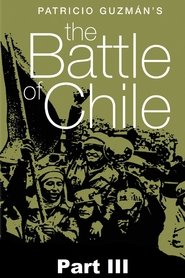
The Battle of Chile: Part III
La batalla de Chile (Parte 3). El Poder Popular
Download English Subtitle
Release info
Tags
English subtitle preview
The first 200 lines.
THE BATTLE OF CHILE
THE STRUGGLE OF AN UNARMED PEOPLE
POPULAR POWER
A PATRICIO GUZMAN FILM
IN MEMORY OF JORGE MUELLER SILVA
Allende!
The left, united, will never be defeated!
Santiago de Chile, 1972.
In only 18 months,
Salvador Allende's socialist government
has carried out a large part of its social change program.
Over a year and a half, it has nationalized
the big copper, iron, coal, nitrate and cement mines.
In this time,
the State manages to control
most of Chile's principal monopolist companies.
Allende, we're with you,
so hit the "mummies" hard!
It has also expropriated six million hectares of arable land
and nationalized almost all national and foreign banks.
On their part,
the North American government and the opposition
have seriously hampered the government's work.
Despite this,
Allende still receives firm support
from wide sectors of the population.
Towards the end of 1972,
the toughest sector of the opposition
reaffirms its strategy.
The National Party insists on the need
to provoke the fall of the government
before the next parliamentary elections.
To do this, they encourage a truckers' strike,
which spearheads
a general collapse of the economy.
The scarcity of spare parts, fomented by the U.S.,
creates ideal conditions for the National Party
to win control of the truck owners' organization.
If we, the means of mobilization,
want an acceptable solution,
then we'll have no more tricks, no more zigzagging!
We are going after a solution
to the problems of tariffs and spare parts,
of adequate reorganization.
We want more justice and less bureaucracy.
And so we're asking you
for your support so that our Board of Management
can work from this position.
We believe that the time has come when, as one single man,
one single trucker,
and along with the women who are participating
side by side in this,
we have no alternative
but to raise the banners of an indefinite, decisive strike
whatever the consequences.
If we have to perish
in misery, in bankruptcy and ruin,
let's do it on our feet, vibrant, upright and proud,
for that's the image of the poor Chilean expressed through this organization!
Thank you.
And that, gentlemen,
was how the Confederation's Board
gave the necessary instructions
to all our fellow organizations
so that from yesterday, Tuesday,
at midnight,
all services in Chile would be paralyzed.
Therefore, we have fulfilled, gentlemen,
the mandate which the national assembly
gave to the Board of this Confederation.
On October 11, 1972,
the first transport strike begins.
The next day,
the truckers get the support of the National Agricultural Society,
and of large and small storekeepers,
who also call a stoppage.
On the night of October 14,
the Christian Democrat party also resolve to support the strike.
Urban and highway transport
"is a strategic sector of the production chain.
The absence of vehicles disrupts the supply of raw materials
and interrupts distribution on a national scale.
The New York Times would later reveal
that the main economic support for the strike
came from the U.S. government.
The big employers,
grouped in the Society for Manufacturing Development,
also halt production,
and begin an indefinite closure of their factories.
These sectors defend private companies
and reject any kind of socialization of the economy.
Chilean industry has grouped together
in the Society for Manufacturing Development,
of which I am president.
This institution
is the oldest of its kind in Latin America.
It was founded in 1883.
To date it has had 19 presidents, and I'm the 20th.
Historically, the Society for Manufacturing Development
is a mouthpiece for big national and foreign capital.
During the strike,
it represents the main industrialists.
We asked the industrialists to submit to this movement,
and they submitted to it, as persons.
Industry was paralyzed in many places, and that was because
many groups of workers followed the movement,
professional workers, such as engineers,
bank employees, health workers,
professionals such as lawyers and engineers.
And there were storekeepers, small and medium-sized industrialists.
Really, all of industry and commerce.
It was a movement which took in extremely wide sectors.
In Santiago,
70% of private buses stop working.
The country's urban communications are in crisis.
The workers take factory trucks on the streets,
and improvise minimum transport.
Given the emergency,
they fight the strike from the start.
In response to the government's call,
the great majority of workers get to their jobs.
As soon as we heard
that the carriers had voted for the strike,
we thought it was a maneuver against the government.
We had a meeting immediately to take precautions,
for this is a state company and we have to look after it.
We worked every day, as normal.
We arrived late, but we got here.
How did you come?
In trucks, or whatever.
The factory put on trucks, and got private buses,
and we came in them.
We're here to work,
and give our support to the factory.
And how did you manage to get here?
We came in the bus, on foot, or whatever.
The important thing was to get here.
Some comrades who worked here lent us their trucks,
and we used those to get to work and go back home.
- Did the factory stop? - No, never.
Our attitude is that
we'll always keep working to cooperate with the government.
So we've done everything that's within our power
to be able to stand by the government.
We've never missed work during the strikes.
We've always been here, regular as clockwork.
It's a seditious strike.
How did the workers respond?
By working as normal every day.
And there were even young mothers
who came to work with their babies in their arms,
and even pregnant women turned up.
Meanwhile, in the center of Santiago,
the opposition's agitators attack those buses
which haven't joined the strike.
In the residential areas,
most industrial executives,
engineers and technicians
stay at home, firmly supporting the strike.
At present,
I am president
of the Confederation of Chilean Professionals,
which has a membership of some 50,000 professionals,
workers with professional qualifications
who work in various industries or other companies in the country.
These kinds of associations, supposedly apolitical,
work in close collaboration with the opposition parties.
We have great organization amongst our members.
People who are disciplined, aware, responsible.
The October strike showed that.
Gradually, these organizations start to behave
in an almost fascist way.
I don't believe in the myth
that a worker, just by being a worker, can do everything.
Well, the engineers left.
They went with the company executives.
They abandoned the company,
and it was left in the hands of our manager comrades.
So we organized ourselves immediately,
and, along with them, we've taken on this responsibility.
We're doing well now that our bosses have abandoned us,
and we're carrying on ourselves.
They went off and left the factory to us,
so we just carried on working as normal.
So far, we haven't had any problems.
We're getting on with things.
I think what they did was wrong.
They didn't even say anything to us.
Despite everything, we're more satisfied now,
much better off,
and I wish I could shake comrade Allende's hand.
We're doing perfectly well the way we're working now.
I think we're doing very well with the new industrial reforms.
We're doing well,
and working with more determination.
In the factories,
the more experienced workers take charge of the main operations.
The few engineers who support the government
look after various neighboring factories.
Thus, just one engineer can attend to the problems
The Battle of Chile: Part III subtitles in other languages
More English subtitles for The Battle of Chile: Part III
- The Battle of Chile - The Power of the People part 3 [1979] · 10 downloads · 2026-07-03
- the battle of chile part iii 1979 dvdrip x264-bipolar · 42 downloads · 2020-10-27
Comments
No comments yet. Be the first to leave one.