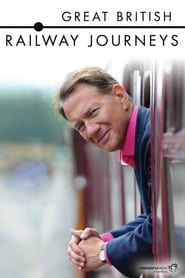
Great British Railway Journeys
Download English Subtitle
Download English Subtitle Files for Mobile (20)
English subtitle preview
The first 200 lines.
In 1840, one man transformed travel in Britain.
His name was George Bradshaw
and his railway guides inspired the Victorians to take to the tracks.
Stop by stop, he told them where to go, what to see and where to stay.
And now, 110 years later,
I'm aboard for a series of rail adventures across the United Kingdom
to see what of Bradshaw's Britain remains.
From 1830, booming Liverpool and Manchester were linked
by the world's first twin-track locomotive-hauled inter-city railway
and a region already enriched by the mass production of cotton goods
became globally dominant.
I'm beginning a journey around this Victorian industrial heartland,
starting in a notorious slum and ending in one of its grandest stately homes.
Following my "Bradshaw's" guide,
my journey starts in the world's first industrialised city
before heading west to Merseyside and Birkenhead.
Hugging the coastline north,
I'll turn inland to the rugged foothills of the Pennines
and on to the gritty West Riding of Yorkshire.
My journey ends in Chesterfield,
where the father of the railway, George Stephenson, is buried.
On today's leg I'm travelling through Manchester
from Oxford Road Station to Old Trafford
before heading along the Mersey
to its once famous ship building port of Birkenhead.
On the first leg of this adventure I travel back in time,"...
George Bradshaw never saw trams. He didn't know what he was missing.
...go in search of some left-wing credentials...
Eventually their work after this time
would culminate in the Communist Manifesto.
Which must be one of the most important political documents of all time.
...and I surprise even myself by becoming a red.
At last, the adulation that I've always craved.
My guidebook says, "Watt's steam engine,
Arkwright's power loom and factory system
and inexhaustible supplies of coal
have given superiority to Manchester which it has retained to this day."
You can perhaps hear the tone of pride for Bradshaw was Manchester-born,
but the Quaker George Bradshaw was probably both impressed
by the productivity of industrialisation and appalled by its social consequences.
In Victorian times,
Manchester was the beating heart of industrial Britain.
During the 19th century, most of the world's cotton
was processed or woven here
before being exported throughout the British Empire.
I'm travelling into Manchester Piccadilly,
where I'll change to the local network
to head southwest to the city's Oxford Road Station.
It was the epicentre of Cettonopolis, as Manchester had come to be known.
Today I want to look at those who toiled in the mills,
those who came from the wrong side of the tracks.
I'm meeting Manchester tour guide, Phillipa Cave,
who has offered to show me their side of the city.
In the Victorian era, this area was known as Little Ireland
and was notorious as one of the worst slums in Manchester.
We've descended into a shadowy hollow. Why was this called Little Ireland?
Well, in Manchester in the early part of the 19th century,
there's a massive population increase
of people trying to find work in Manchester's mills.
One of those groups of people is Irish immigrants
and this area is predominantly inhabited by them.
And what were conditions like here for living?
They were dreadful. There were probably two groups of cottages here.
Maybe 200 of them. But 4,000 people living in them,
so in one room you might get ten people
living in a space that's only ten feet by nine feet.
They were also really damp, these properties.
We are down in a little dip from the road here and surrounded by a river.
In fact, the cellar dwellings are below the level of the river
so they would frequently flood.
Anyone who could afford not to live here would move further out.
And the area was surrounded by chimneys
that would be belching forth this dense smoke,
and the noise of the crunching of the machinery in the mills,
the shrieking of boiler engines
and also the incessant beat of the loom, the rhythm of Manchester.
And I often think of the fact that George Bradshaw died of cholera.
What was the public health like in the slum?
Very poor. By 1841, the average life expectancy is 26 years.
Friedrich Engels, the son of a German manufacturer,
highlighted the immigrants' plight
and created the text for a political movement.
He wrote a treatise, "The Condition of the Working Class in England“ in 1844,
documenting their shocking circumstances.
"A horde of ragged women and children swarm about here
as filthy as the swine that thrive upon the garbage heaps and in the puddles."
"The race that lives in these ruinous cottages behind broken windows
or in dark, wet cellars in measureless filth and stench,
this race must really have reached the lowest stage of humanity."
Powerful writing. What was he doing in England?
Well, he'd have come from Germany.
His family had a manufacturing business there
and it was always assumed that Engels would join that business.
He had rather other ideas. He'd gone to military school in Berlin,
and become politically engaged.
He began to write a critique of the manufacturers
and what they were doing to their workers.
So his father thought the best way
to bash these radical ideas out of him and put him back on track
would be to send him to a business that he co-owned here in Manchester.
Unfortunately, his father couldn't have sent him to a better place
to develop those radical tendencies. Because, as Engels said,
here in Manchester the modern art of manufacturing
has reached its perfection.
Determined to find a way to eradicate the exploitation of capitalism,
Engels teamed up with his friend, the philosopher Karl Marx.
Both were regarded as political troublemakers.
Indeed, Marx had recently been deported from Paris.
Manchester was the ideal place for the pair to develop their ideas
and can claim to be the womb of communism.
Chetham's Library was founded in 1653,
and is the oldest surviving public library in the English-speaking world.
I love libraries and this one is absolute perfection.
What you're seeing here is really how it would have looked from around 1655,
through Engels's time and that of Bradshaw,
and it continues like this today. Books were very expensive
and so originally they'd have been chained to the shelves
but then later these gates were added.
Marx and Engels were coming here because this was a great resource?
Absolutely. All the manuscripts and volumes on philosophy,
economic theory, they'd have access to.
So, what we have here are some of the actual books
that we know Marx and Engels referred to
when they were studying in the library in 1845.
Let's see what they were getting up to.
"An Inquiry Into the Duties of Men
in the Higher and Middle Classes of Society in Great Britain."
"Discourses on the Publick Revenues, and on The Trade of England."
- Solid topics, aren't they? - Light reading.
"The State of the Poor:
An History of the Labouring Classes in England. Parochial records."
What was the intellectual relationship between the two?
Marx is perhaps the better known, but Engels is working behind the scenes.
He's the more empirical, the more methodical, and he gets the work done.
He gets the books written.
Marx is perhaps more impetuous, more impulsive.
He's personally indignant about the plight of the working classes.
There's one more place I want to show you before we leave Chetham's.
Lead on.
So it's in this alcove, at this very table,
that Friedrich Engels and Karl Marx
would sit and do their research from all these books
and they were drawing on the experience of Engels
from places like Little Ireland,
and eventually their work after this time
would culminate in the Communist Manifesto.
Which must be one of the most important political documents of all time.
A prescription for revolution,
without which there wouldn't have been a Soviet Revolution.
No Lenin, no Stalin, no Mao Tse-tung in China.
And it all began here in Manchester.
So communism was hatched in this little alcove.
Marx and Engels proved that the word is mightier than the sword.
An idea honed amongst dusty library books
had the power to change the world,
to shape the destiny of nations and humanity.
My own political career left somewhat less momentous marks
on the development of our species.
In 1989 when I was Minister for Public Transport,
I had the honour to approve the contract to build this:
the Manchester Metrolink.
The idea was to use trams
to connect the suburban railways running into Victoria and Piccadilly Stations,
running along the streets of central Manchester.
Now it's carrying 21 million passengers a year
and there are plans to make it the largest light rail system
in the United Kingdom.
With a captive audience I have an opportunity to find out
how those decisions have affected Mancunians.
- Hello. - Hello.
Do you use the tram,
- the Metrolink, very much? - Yes.
Are you using it on a daily basis to visit family?
Baby-sitting. Visiting family in Manchester.
And how do you find it?
Brilliant. Best thing Manchester has done.
Bradshaw's tells me that Old Trafford is in the vicinity of Trafford Park,
seat of Sir Humphrey de Trafford
descended from one of the most ancient of old families.
Nowadays, Old Trafford is associated with Manchester United
and having had a brother who was a keen supporter of the club,
my childhood memories are of its triumphs and tragedies.
And today I'm excited to be visiting its iconic stadium.
This temple of sport inspires awe
amongst believers and unbelievers alike.
I'm meeting Graham Simmonds,
a lifelong Manchester United supporter and one of the club's tour guides.
Imagine you're the captain of the opposition team
and I'm the captain of Manchester United.
All the United fans, the hard-core, passionate supporters, will be here,
traditionally, on this left-hand side, known as the Stretford End.
It's amazing, isn't it?
It's so vast, the seats reaching up almost into the sky.
Incredible number of people. How many can be seated here?
It seats 76,000. It's the biggest in the football league.
I've sometimes spoken to 2,000 people.
This is just vast. So how did it all begin?
It all started back in 1878 when we were known as
Newton Heath Lancashire and Yorkshire Railway Cricket and Football Club.
All started by a group of guys that used to make carriages for the railways
More English subtitles for Great British Railway Journeys
- Series 7 · 72 downloads · 2016-04-19
- Series 6 · 37 downloads · 2016-04-19
- Series 4 · 29 downloads · 2016-04-19
- Series 3 · 50 downloads · 2016-04-19
- Series 2 · 54 downloads · 2016-04-19
- Series 1 · 43 downloads · 2016-04-19
- Great British Railway Journeys S05 DVDRip X264-FUtV · 13 downloads · 2015-05-20
- Great British Railway Journeys S05 DVDRip X264-FUtV · 19 downloads · 2015-05-20
Comments
No comments yet. Be the first to leave one.