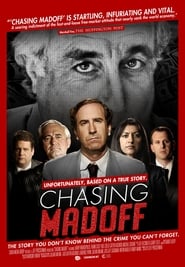
Chasing Madoff
Download English Subtitle
Release info
Tags
English subtitle preview
The first 200 lines.
Wall Street is one big turf war.
The basic concept of Wall Street,
which sometimes the regulators lose sight of,
is, it's a for-profit enterprise.
By benefiting one person,
you're disadvantaging another person.
I had no inkling that
anything was gonna change my life that day.
Okay, guys, let's get ready to go to karate.
Come on. Get your stuff.
Let's go.
Wall Street veteran Bernie Madoff
has been arrested and charged with running
a $50-billion Ponzi scheme.
This is one of the biggest fraud cases ever.
His name is Bernard Madoff.
He is under arrest, charged with running...
The SEC accusing Bernard Madoff
and his investment firm...
You don't get to steal that much money overnight.
I don't know if you can answer this-
But he had 17 billion under management.
How do we get up to that?
And his investment firm...
The SEC doesn't pay attention to it.
Assumed the right things were invested...
We lost everything.
We lost everything.
We are major crime victims.
Bernie Madoff stole every dime we gave to him.
$1.3 million. That's all gone.
The retirement is never.
I guess his addiction was money.
The only sorrow he feels
is that he got caught, and he's behind bars.
The government let us down.
They were supposed to watch him, and they didn't.
What is the purpose of the SEC
other than to investigate fraud?
Where were they?
Shortly after Bernard Madoff confessed,
I got a call from the former chairman of the SEC
asking me to investigate how come the SEC
did not uncover Madoff's Ponzi scheme.
What the heck went on?
We did not bring an enforcement action.
We're using the Madoff scandal as a platform
to set the basis for regulatory reform.
Nothing about this case was ever believable.
It was always the twilight zone.
And that's how you knew it was the Madoff case,
'cause every time you saw something,
it never made sense.
Joined Rampart August 1991.
Started out as a portfolio manager
and worked for the chief investment officer.
Harry's a loveable, affable geek.
He's extremely bright,
magnitudes brighter than me.
And he can make the numbers dance.
I mean, he looks at numbers, and they sing a song to him.
Frank Casey was the horse
that did the work on the money.
He was the moneyman.
My first impression of Harry was, I would say,
maybe the crazy professor.
Neil was my backstop.
He would look at all the math, all the formulas,
prove all the math, all the formulas.
Check all the spreadsheets.
I was trying at the time
to build a new product for Rampart,
and when Harry mentioned to me
that he knew a fellow down in New York
that had hired a manager, a single manager,
instead of a group of 30 or 35 of them,
who was putting out a return stream
similar to what I was trying to do,
this I had to go see.
That's when I went down to New York
to meet the investor that had hired this manager:
Thierry de la Villehuchet.
He said, "Well, I can't tell you anything about him."
And that perked my ears up.
I had been around Wall Street since 1974,
and very seldom do you ever hear of a manager
that no one can talk about.
So I begged him
for the opportunity to compete with this fellow.
He showed me the return stream,
and I brought them back to Harry in Boston.
Late '99, Frank comes back from New York,
and he hands me a marketing document.
Read the strategy description.
Looked at the performance line.
It was straight up, 45-degree angle.
It looked like nothing from finance that I've ever seen,
'cause the markets go up, then they go down.
Harry looked at it for no more than four or five minutes.
He turned to me.
He says, "Frank, you know options.
You know this is a fraud."
[indistinct police radio transmission]
And he said, "Are you sure?
"Is your math good enough to figure this out?
Can you reverse engineer it?"
And so I felt, you know, a little bit offended,
and my pride was wounded.
"What do you mean, something wrong with my math?
"These numbers don't exist.
"Don't you understand?
"You don't get straight lines in finance.
It never happens."
I said, "Oh, but, Harry, I need to believe.
Come on. We got to compete."
So he began building mathematical models
to show what the probability would look like,
what the returns would look like
if this guy was actually doing what he said he was doing.
And after four hours, I knew this was explosive.
This is gonna rock the world.
Everybody's gonna sit up and take notice.
I remember Harry looking at the numbers and saying,
"Frank, if this guy was a professional baseball player,
he would be hitting a .964."
It was pretty clear that it was a fraud.
It took me five minutes to figure it out.
Thierry de la Villehuchet was a sailor,
and I'm a sailor.
We built a bit of a rapport that first day.
I said to Thierry, "How much is this guy running?"
He says, "Oh, I don't know.
I'd say $2 billion or $3 billion."
So that made him automatically
the largest manager on Wall Street at the time,
and no one knew that he was doing it.
He then mentioned that his money manager
was Bernie Madoff.
I said, "Okay, this is a massive fraud.
"It's the biggest fraud ever.
I better have somebody recheck my math."
And so I gave my math to Neil Chelo,
who was my assistant portfolio manager at the time.
My initial thought was, "Too good to be true,
but maybe I'm missing something."
I needed to dig in.
So he checked, and he ran through all the math.
Now, this wasn't gray area.
This was black-and-white.
This was fraud.
When I first saw this portfolio-
seven times bigger
than the number of options in existence.
So if you only have this many options in existence
and you're seven times larger,
that's a problem.
Harry said, "Frank, you're an options guy.
"You know that this can't be true.
It's got to be a fraud."
And then he says, "I probably-
I figure it's even a Ponzi."
And I said, "Whoa.
That's a big word."
You're basically robbing Peter to pay Paul.
It was called a Peter-and-Paul scheme
before Ponzi came about in Boston
in the late '20s, early '30s.
What I do is, I bring the money in,
and I'm always paying everybody else-
the earlier investors-
with the money that I'm bringing in.
You need an ever-increasing flow of new victims
to pay off the old victims.
You can build that Ponzi scheme up
until it becomes so big that its own weight crashes it,
because you cannot raise money fast enough
to pay back all the people you owe a return to.
I went to some very sophisticated,
successful friends of mine
who are established on Wall Street,
and they both suggested different ways
in which to invest my money,
one of which was to invest in the Ascot Fund,
which turns out, unbeknownst to me at the time,
to be a 100% feeder fund for Bernie Madoff.
And once the money was put in,
you got these wonderful monthly reports.
Every month, you were richer than the month before.
What could be bad?
And life went on.
And we didn't take money out, and it just grew.
And now, you got to remember that this guy, Madoff,
he became the chairman of NASDAQ.
I mean, this was a very powerful, prominent man
who ran a major trading company.
You didn't make accusations lightly
against an individual like that.
The fact that the market
goes down 300 points or up 300 points,
take my word, but for the most part,
More English subtitles for Chasing Madoff
- Chasing Madoff 2010 720p BluRay x264-BiQ · 28 downloads · 2014-02-16
Comments
No comments yet. Be the first to leave one.